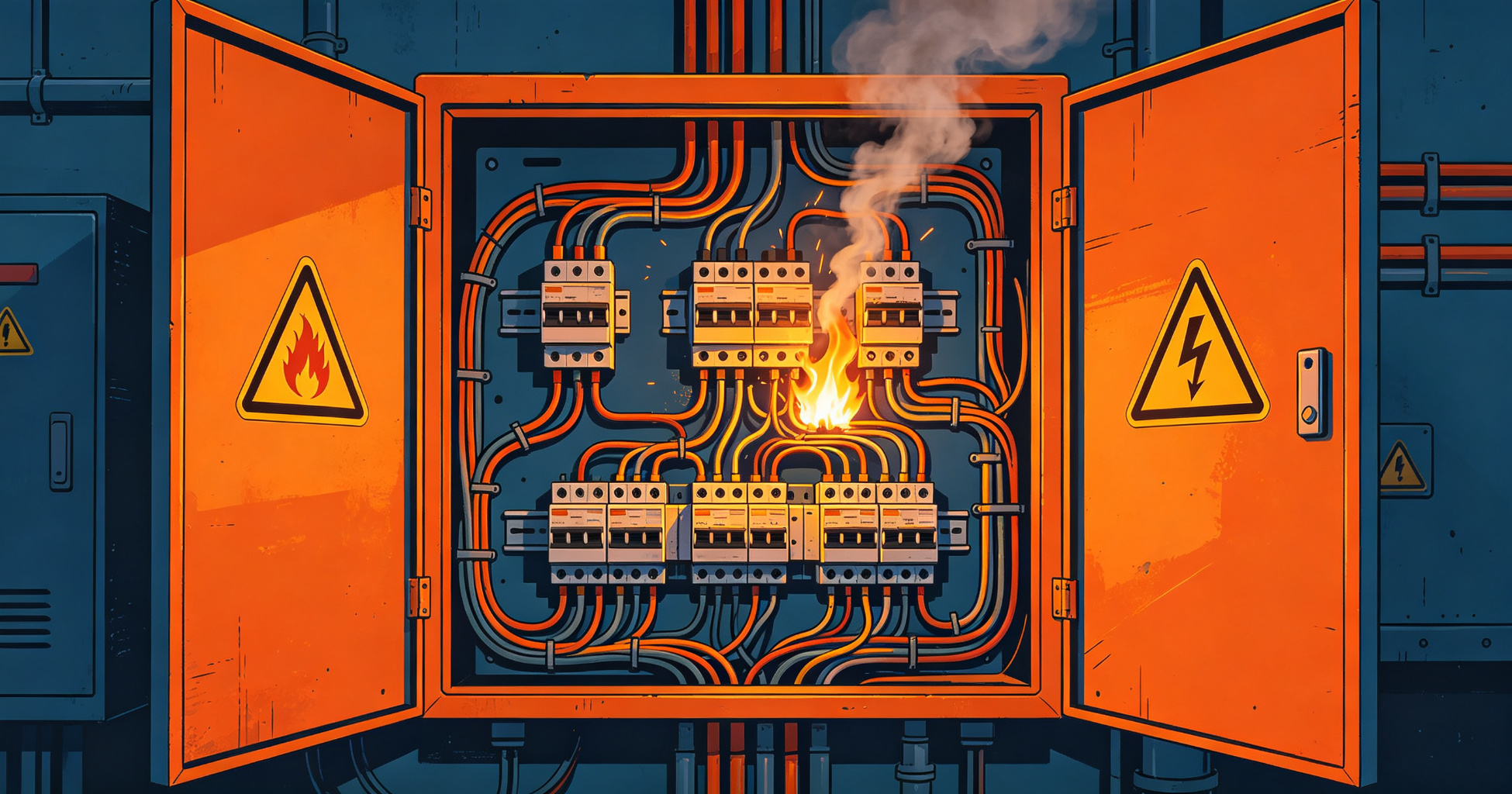
Discolored busbars and the smell of hot phenolic insulation, the marks NFPA 70B treats as early signs of a cabinet fire.
Most electrical cabinet fires announce themselves weeks in advance. Thermal damage, discolored busbars, and the smell of hot phenolic insulation are reliable early indicators. The seven signs below are drawn from NFPA 70B maintenance practice and field investigation reports, and each one is verifiable with basic test equipment.
1. Discolored or Heat-Stained Components
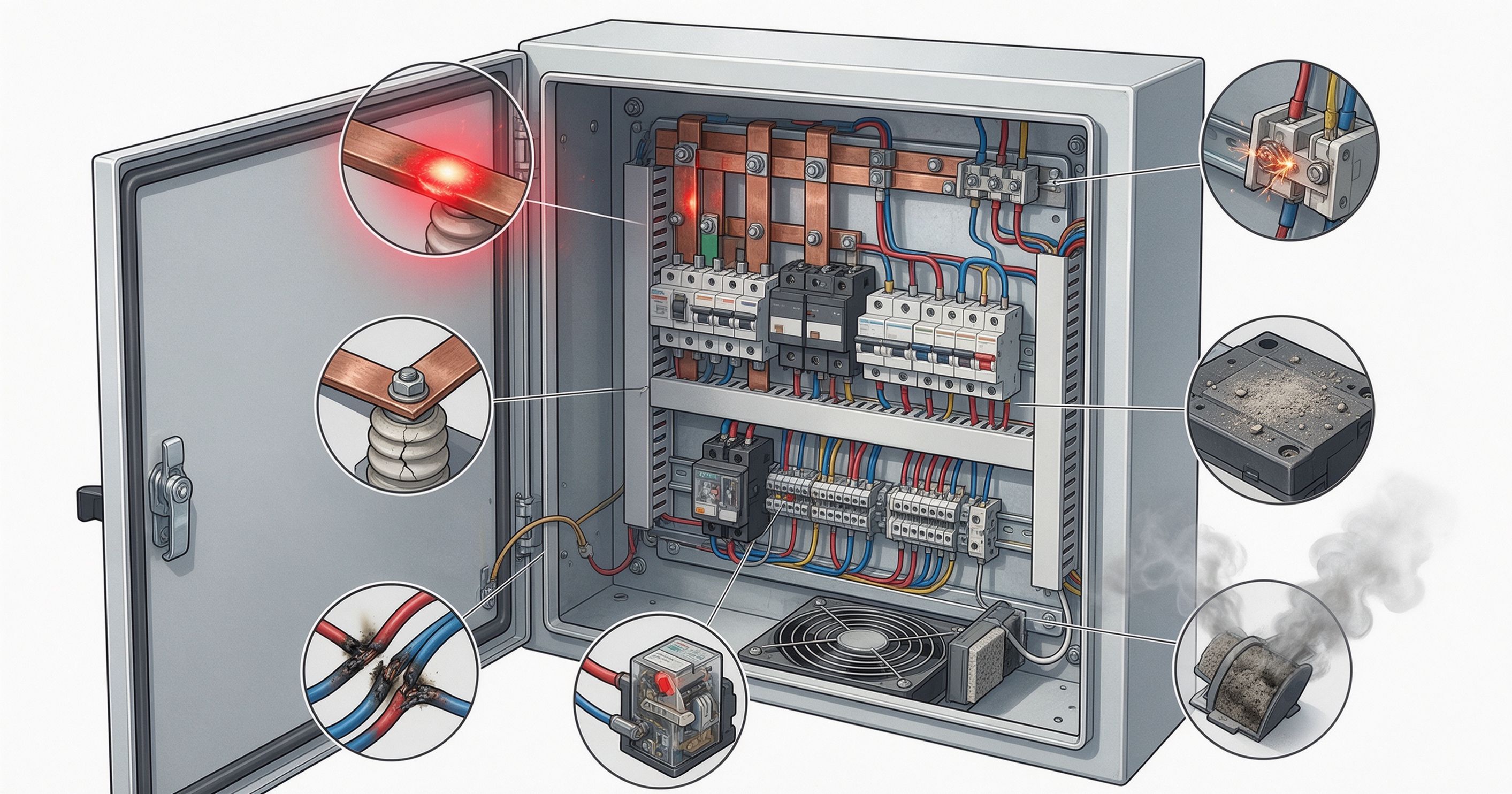
Brown or black varnish on busbars, charred insulation on feeder cables, and copper that has turned dull gray or purple are all evidence that a termination has been running hot. Copper oxidizes at an accelerating rate above roughly 90°C (194°F), and the oxide layer increases contact resistance, which increases heating. The damage compounds itself.
Thermographic surveys under load catch this before visible discoloration appears. NFPA 70B treats infrared inspection as a core predictive maintenance task, and most insurers now require documented thermography on switchgear and motor control centers at least annually. The key phrase is "under load." A scan performed with the cabinet at 20% of rated current will miss loose connections that only heat up near full amperage.
Look also at the plastic: terminal blocks, wire duct, and breaker handles. Yellowed or brittle plastic indicates sustained elevated temperature, even if the metal looks clean.
Takeaway: Schedule infrared scans at 40% or greater load, and log the temperature delta between similar phases. A 15°C (27°F) difference between phases on the same circuit is a loose connection until proven otherwise.
2. Audible Buzzing, Crackling, or Hissing
Stand next to the cabinet with the door closed. Buzzing usually points to a loose lamination in a transformer or contactor, but crackling and hissing are more serious. Crackling often means arcing across a degraded contact surface. Hissing can be steam from overheated insulation or the early stage of a cable fault.
Arcing faults are the leading ignition source in low-voltage switchgear. The energy released in a bolted or parallel arc fault can exceed 10,000 K at the arc root within milliseconds, which is more than enough to ignite adjacent cable insulation and panelboard plastic. A sound that changes with load—louder when a large motor starts, quieter when it stops—is diagnostic of a mechanical or contact-resistance problem rather than an external noise source.
Do not open the door to investigate a hiss. De-energize the cabinet first. If the sound persists after isolation and lockout/tagout, the fault is upstream and the utility or upstream protective device needs to be involved.
Takeaway: Treat any new noise as a work order, not a background annoyance. Record when the noise occurs relative to load changes, and include that observation in the work order. It shortens the diagnostic time significantly.
3. Corrosion, Moisture Intrusion, and Rust
Water and electricity do not mix, but the failure mode is often slower and less obvious than a short circuit. Rust on the enclosure floor, water stains on the backplate, and white or green deposits on terminals are all signs of moisture ingress. The deposits themselves are conductive and hygroscopic—they pull in more moisture and accelerate tracking across insulating surfaces.
Where moisture gets in
Common entry points include failed door gaskets, unsealed conduit entries, condensation from temperature cycling, and washdown spray in food processing or wastewater plants. In cold climates, condensation forms when a warm, humid cabinet cools overnight. The water collects on the coldest metal surfaces, often the busbars and breaker terminals.
According to IEC 60529, an enclosure rated IP54 resists dust and splashing water but not directed jets or immersion. Many cabinets in washdown environments are installed at IP54 when the application requires IP65 or better. Check the nameplate rating against the actual environment, not the original specification.
Takeaway: Install a thermostatically controlled anti-condensation heater in any cabinet subject to temperature swings, and inspect gaskets annually. Replace any gasket that has taken a compression set or shows cracking.
4. Breakers That Trip Repeatedly or Feel Hot
A breaker that trips once may be doing its job. A breaker that trips repeatedly, resets, and trips again is either undersized, misapplied, or failing. Each trip cycle degrades the internal mechanism and the contact surfaces. After a handful of fault interruptions, a molded-case breaker may no longer interrupt at its rated capacity. UL 489 covers molded-case circuit breakers, and the standard's test sequence assumes a limited number of operations under fault conditions—not an indefinite number.
Feel the breaker face with the back of your hand after it has carried load for at least an hour. A warm breaker handle is normal at high ambient temperatures. A hot handle—uncomfortable to touch for more than a second or two—indicates either an overloaded circuit or a failing breaker. Compare against adjacent breakers on similar loads.
Repeated tripping also masks the real question: why is the load drawing more current than the breaker allows? Motor bearing wear, a failing heater element, or a shorted winding will all cause nuisance trips until the underlying fault is corrected.
Takeaway: Log every trip with date, time, load conditions, and ambient temperature. Three trips in a month on the same breaker warrants a current measurement and a breaker replacement if the load is within rating.
5. Overloaded Circuits and Undersized Conductors
Loads grow. A panel installed in 2005 to serve a few office circuits may now feed a server rack, a bank of EV chargers, or a dozen additional workstations. The breaker may hold, but the conductor may be running at 90% or more of its ampacity continuously.
Continuous loading above 80% of a conductor's ampacity accelerates insulation aging. The Arrhenius relationship roughly doubles the chemical degradation rate for every 10°C (18°F) increase in insulation temperature. A conductor rated for 30 years at its design temperature may last less than a decade at 15°C above that temperature.
Check for double-tapped breakers, aluminum conductors under terminals rated only for copper, and feeders that were upsized at the source but not at the load end. These are common in cabinets that have been modified repeatedly without a single-line diagram update. If your facility has no current single-line diagram reflecting the as-built condition, load analysis is guesswork.
Takeaway: Perform a load study every three to five years, or after any significant addition. Clamp-meter each phase on the main and the largest feeders during peak operation, and compare against the conductor ampacity table in NFPA 70 (NEC) Article 310.
6. Damaged or Deteriorated Insulation
Cracked, brittle, or missing insulation on conductors inside the cabinet is a direct path to phase-to-phase or phase-to-ground faults. Insulation degrades from heat, moisture, UV exposure, and mechanical damage during previous service work. Rodent damage is common in cabinets with unused knockouts or gaps at the bottom.
Look for:
- Cable jackets that have hardened and split at bend points
- Heat shrink that has slid back from a lug, exposing bare conductor
- Chewed insulation or nesting material near the enclosure base
- Conductors resting against sharp sheet metal edges without a grommet or edge guard
Insulation resistance testing, often called a megger test, quantifies the problem. A reading below 1 megohm on a 480V circuit is cause for immediate investigation. Values between 1 and 100 megohms require trending—a reading that has dropped by half since the last test is more concerning than a stable low reading.
Takeaway: Megger feeders during scheduled outages and record results in a trend log. Seal all unused openings with listed closure plates, not duct tape or cardboard.
7. No Arc Fault or Thermal Monitoring
The first six signs require someone to look, listen, or measure. The seventh is the absence of a system that does it continuously. Arc fault detection, residual current monitoring, and thermal sensors installed inside the cabinet can detect the conditions that precede a fire—loose connections, insulation breakdown, and early-stage arcing—before visible damage occurs.
Companies including Chilion offer IoT-based electrical safety platforms that combine current, temperature, and arc fault sensing into a single monitoring device installed at the panelboard or switchgear level. These systems alert maintenance staff when a terminal temperature rises above a threshold or when the current signature matches an arc fault profile, typically within seconds of the event.
NFPA 70B now recommends condition-based maintenance rather than purely time-based intervals, and continuous monitoring is the most direct way to implement that approach. For cabinets that are difficult to access, located in remote areas, or serve critical loads, monitoring closes the gap between annual inspections.
Takeaway: Prioritize monitoring for cabinets feeding life safety systems, data centers, and processes where an unplanned outage costs more than the monitoring hardware. Start with the three highest-risk panels identified by your thermographic survey.
Need a passive fire protection assessment?
Our editorial team covers enclosure fire suppression, electrical safety monitoring, and fire-resistant coatings. Talk to our partners about your specific application.
Frequently Asked Questions
How often should electrical cabinets be inspected for fire risk?
NFPA 70B recommends annual visual inspection for most industrial cabinets and more frequent thermographic surveys for critical equipment. High-risk environments—those with moisture, dust, or corrosive atmospheres—warrant inspection every six months. Continuous monitoring reduces the need for manual inspection but does not eliminate it; someone still needs to verify connections and clean ventilation paths.
What temperature indicates a fire risk inside a cabinet?
Terminal temperatures above 60°C (140°F) at ambient conditions below 40°C (104°F) warrant investigation. A rise of 15°C (27°F) above similar terminations on the same circuit is a loose connection indicator. Insulation begins accelerated degradation above 90°C (194°F), and most thermoplastic insulation will deform or emit smoke above 120°C (248°F).
Can I use thermal imaging on a cabinet that is not fully loaded?
Yes, but the results are less reliable. Thermography detects resistance heating, which scales with current squared. A loose connection carrying 30% of rated load may show only a few degrees of temperature rise. For accurate results, scan at 40% load or higher. If that is not possible, note the load level in the report and rescan at higher load when conditions allow.
Does an arc fault detection device prevent cabinet fires?
An arc fault detection device (AFDD) detects the current signature of arcing and trips the circuit before the arc ignites adjacent material. It reduces fire risk but does not prevent loose connections or insulation degradation. AFDDs work best as part of a layered approach that includes thermal monitoring, regular thermography, and corrective maintenance on identified defects.