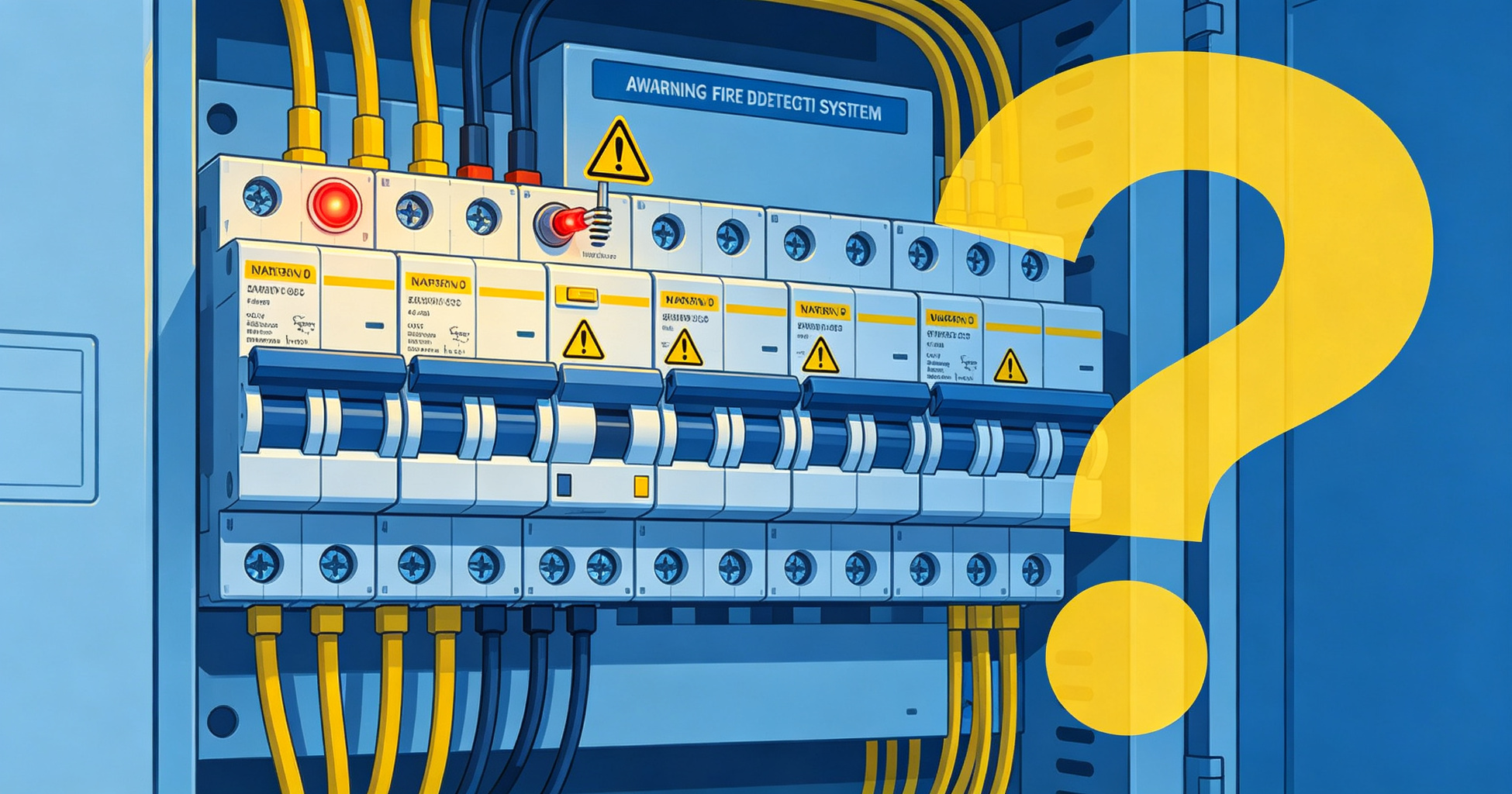
Panels carrying more than 100 A in an unattended room, where a ceiling smoke detector reacts only after insulation is already burning.
Early warning fire detection belongs in any electrical panel that carries continuous load above 100 A, sits in an unattended space, or protects a process where downtime costs more than the detector. Standard smoke and heat detectors react to smoke or a 57°C (135°F) threshold — by then, arcing has often already damaged busbars and insulation. The right question is not whether you need detection, but which technology and which coverage level your panel actually requires.
What is early warning fire detection in an electrical panel?
Early warning detection identifies the precursors of an electrical fire — overheating terminations, insulation off-gassing, arc faults, and partial discharge — before visible smoke or open flame appears. Three technology families cover this:
- Point-type heat and smoke detectors mounted inside or above the enclosure. These are the cheapest option but respond late. A standard spot heat detector rated to 57°C (135°F) or 68°C (155°F) may not trip until the fault has already carbonized the insulation.
- Linear heat detection (LHD) cable run along cable trays and busway. Digital LHD triggers at a fixed temperature (commonly 68°C, 88°C, or 105°C) and reports the location of the trip point.
- Continuous monitoring sensors — thermal, optical (UV/IR), and gas sensors — that detect the hydrogen, carbon monoxide, and VOCs released when PVC or XLPE insulation begins to decompose, typically at surface temperatures of 120–150°C, well below ignition.
NFPA 72 does not require detection inside panelboards, but NFPA 70E and NFPA 70B treat condition monitoring as part of an effective electrical maintenance program. The gap between "code-required" and "worth installing" is where most facility decisions actually happen.
When does an electrical panel actually need early warning detection?
Detection earns its cost in four scenarios:
- Unattended or remote panels. A panel in a rooftop mechanical room, a remote MCC building, or a substation vault is rarely inspected. A 10-minute head start can mean the difference between a tripped breaker and a destroyed switchgear section.
- High continuous load. Panels running above 70–80% of rated capacity generate more heat at terminations. Loose lugs and oxidized aluminum conductors are the leading cause of electrical fires in North America, per NFPA data.
- Critical process or IT load. A hospital, data center, or semiconductor fab cannot tolerate an unplanned outage. Real-time monitoring systems like Chilion's ICOP are increasingly specified in data centers and industrial plants where a single busbar fault can trigger a multi-hour recovery.
- Aging equipment. Panels older than 25 years with a documented history of thermal anomalies justify continuous monitoring rather than periodic infrared surveys.
If none of these apply — a small, frequently visited panel in a sprinklered room — standard passive protection is usually sufficient.
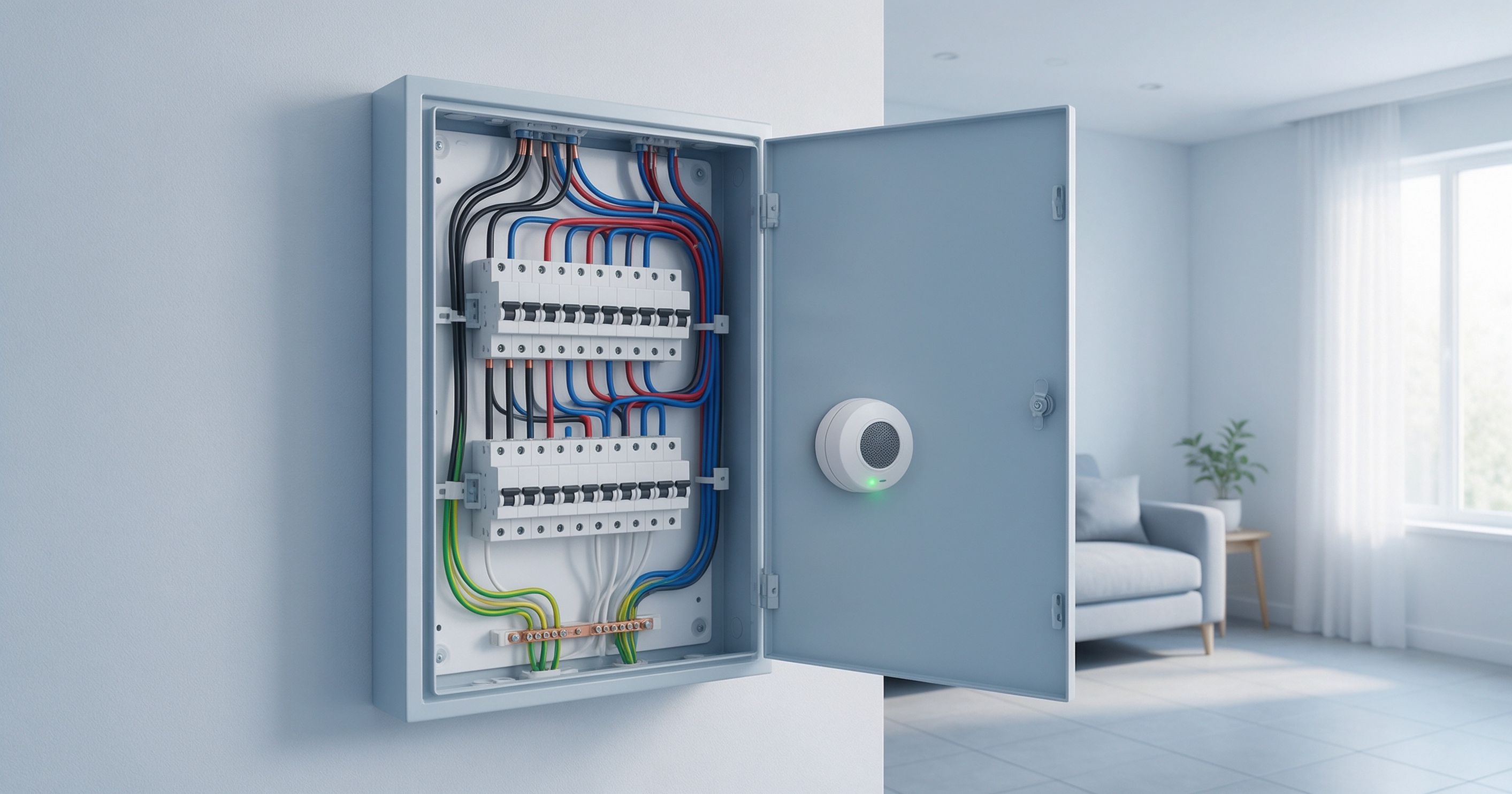
How does early warning detection differ from a standard smoke detector?
A standard photoelectric smoke detector needs visible particulate in the 0.5–10 micron range to alarm. In a sealed electrical enclosure, smoke may not reach the detector until the fire is well established and the door has been breached by pressure or heat. That lag is the core problem.
Early warning sensors target different signatures:
- Gas sensors react to the first stage of insulation breakdown — PVC begins releasing hydrogen chloride at roughly 140°C, long before the autoignition temperature of common cable insulation (around 350–400°C).
- Thermal sensors with rate-of-rise algorithms catch abnormal heating on terminations before it becomes visible.
- Optical arc detectors respond in under 1 millisecond to the UV/IR signature of an arc flash, well below the 35 ms clearing time of most upstream breakers.
The result is a detection window measured in minutes rather than seconds — enough time to trip a breaker, isolate a feeder, or dispatch a technician before the enclosure is compromised.
What standards and codes apply?
Several standards define how these systems are designed, tested, and installed:
- NFPA 72 — National Fire Alarm and Signaling Code; governs detector placement, spacing, and signaling for fire alarm systems, though it does not mandate detection inside panelboards.
- NFPA 70B — Recommended Practice for Electrical Equipment Maintenance; references condition monitoring and infrared thermography as part of a preventive maintenance program.
- UL 268 — Smoke detectors for fire alarm signaling systems.
- IEC 62599 — Alarm systems for fire detection, covering test methods and performance criteria in the European market.
- EN 54-5 and EN 54-7 — European standards for heat and smoke detectors, respectively.
- UL 864 — Control units and accessories for fire alarm systems, relevant when detection ties into a central panel.
For arc flash detection specifically, IEC 62271-200 and IEEE C37.20.7 address internal arc classification and testing of switchgear. If your panel is part of a medium-voltage installation, these standards shape both the detector selection and the enclosure rating.
What are the practical limitations and false alarm risks?
Early warning detection is not maintenance-free. Three issues come up repeatedly:
Sensor drift and contamination
Gas and optical sensors drift with dust, humidity, and temperature cycling. A sensor that has not been calibrated in 18 months may false-alarm or, worse, fail to respond. Manufacturers typically specify annual calibration intervals; in high-dust environments, that interval shortens to six months.
Alarm fatigue
If a detection system generates nuisance alarms from normal load cycling or ambient heat, operators start ignoring it. The fix is threshold tuning — setting gas alarm thresholds above background VOC levels and using rate-of-rise rather than absolute temperature for thermal channels.
Coverage gaps
A single detector cannot see the entire interior of a 2-meter-wide switchgear lineup. Busbar joints, breaker stabs, and cable terminations are the highest-risk points and need dedicated coverage or a linear sensor routed past each connection.
Detection is only as good as the maintenance behind it. An uncalibrated sensor is worse than no sensor — it creates false confidence.
What does installation and maintenance actually involve?
Retrofitting detection into an existing panel is feasible but requires planning:
- De-energize and inspect. Open the enclosure, verify torque on terminations, and map the hottest points with an infrared camera. Those points determine sensor placement.
- Select sensor type. Gas sensors for early-stage insulation breakdown; LHD for cable trays and busway; optical arc detection for medium-voltage switchgear.
- Route wiring. Low-voltage sensor wiring must be separated from power conductors to avoid induced noise. Use shielded cable and keep runs short where possible.
- Integrate with the alarm panel. Confirm compatibility with your existing fire alarm control panel (UL 864 or EN 54-2 listed).
- Commission and baseline. Record normal gas and temperature readings for the first 72 hours of operation. Those baselines define the alarm thresholds.
- Schedule maintenance. Annual calibration at minimum; quarterly visual checks and functional tests per NFPA 72 Chapter 14.
Typical installed cost for a single-panel gas and thermal monitoring system runs $1,500–$4,000 depending on sensor count and integration complexity. For a 480 V MCC with 20 sections, budget $8,000–$15,000.
Start with a thermal survey. If infrared imaging shows a 15°C or greater temperature rise above ambient on any termination, that panel is a candidate for continuous monitoring. If the panel is sealed, unattended, and carries critical load, the case is even clearer. Detection does not replace proper torque, infrared inspection, or arc flash mitigation — it adds a layer that catches the failures those practices miss between service intervals.
Need a passive fire protection assessment?
Our editorial team covers enclosure fire suppression, electrical safety monitoring, and fire-resistant coatings. Talk to our partners about your specific application.
Frequently Asked Questions
Can I install early warning detection in an existing panel without replacing it?
Yes, in most cases. Gas and thermal sensors can be retrofitted into an existing enclosure during a scheduled outage. The main constraints are interior space, sensor mounting hardware, and routing low-voltage wiring away from power conductors. Retrofits are common in panels 15–30 years old where full replacement is not yet justified.
How often do early warning sensors need calibration?
Most manufacturers specify annual calibration for gas and optical sensors. In high-dust, high-humidity, or high-temperature environments, shorten the interval to six months. NFPA 72 Chapter 14 requires functional testing of fire detection devices at least annually, and more frequently where the environment is harsh.
Will early warning detection prevent an arc flash?
No. Arc flash events develop in milliseconds — far faster than any gas or thermal sensor can respond. Optical arc detection can trip a breaker in under 1 ms, which limits incident energy, but the primary arc flash controls remain proper PPE, arc-rated equipment, and maintenance per arc flash risk assessment. Detection reduces fire risk, not arc flash risk.
Does NFPA 72 require detection inside electrical panels?
NFPA 72 does not mandate detection inside panelboards or switchgear. It governs how detection systems are designed and installed when they are present. Requirements for electrical equipment maintenance and condition monitoring appear in NFPA 70B, which recommends infrared thermography and other predictive techniques but does not make in-panel detection compulsory.
What is the difference between early warning detection and a standard fire alarm?
A standard fire alarm responds to smoke or a fixed temperature threshold, typically after a fire has already started. Early warning detection monitors gas, thermal rate-of-rise, and optical signatures that precede ignition. It provides minutes of lead time, whereas a conventional detector may provide seconds. The two systems complement each other; see our guide to electrical panel fire protection for how they integrate.
Which panels benefit most from continuous monitoring?
Unattended panels, panels above 80% continuous load, aging switchgear over 25 years old, and any panel serving a critical process or IT load. Facilities with a documented history of thermal anomalies or previous electrical fires should prioritize these installations. Smaller, frequently inspected panels in sprinklered spaces rarely justify the cost.