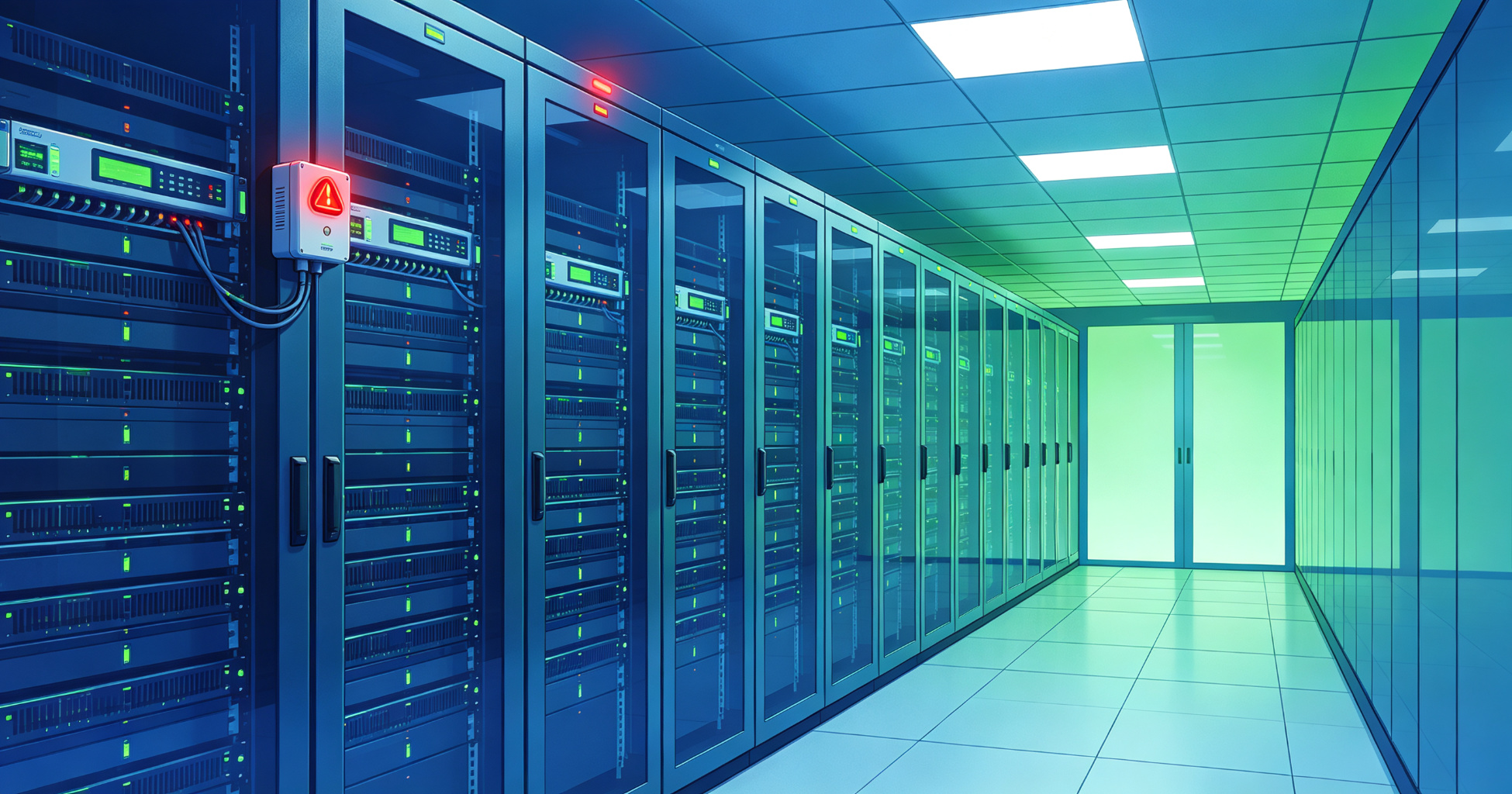
Branch-circuit monitoring on a 42U rack in a 6 MW Ashburn hall, 11 minutes before smoke would have reached the plenum.
A 6 MW colocation facility in Ashburn, Virginia, caught a developing series-parallel arc inside a 42U server cabinet 11 minutes before smoke would have reached the ceiling plenum. The arc was detected by branch-circuit monitoring, the rack was de-energized remotely, and the cabinet sustained $3,100 in damaged PDU hardware instead of a full-scale fire. The event, in March 2023, became the facility's justification for extending arc fault monitoring across all 1,840 racks.
The Facility and Its Baseline
DC-7 Ashburn occupies a 14,000 m² single-story shell on a 4.2-hectare campus. It runs 6 MW of critical IT load across three data halls, with N+1 UPS topology and dual 480 V/277 V feeds stepped down to 415/240 V at the row level. Each of the 1,840 cabinets draws between 4.2 kW and 14.8 kW, and roughly 62% of them use dual-corded servers fed from A/B side busway taps.
Before 2022, the facility's electrical protection strategy was conventional. Branch circuits were protected by thermal-magnetic molded case circuit breakers (MCCBs) rated 30 A to 60 A, supplemented by residual current monitoring at the UPS output. The operations team relied on quarterly infrared thermography scans of busway and panelboard terminations, plus annual torque checks per the manufacturer's spec. That approach catches loose lugs and overloaded neutrals. It does not catch a series arc inside a rack PDU where the conductor is still continuous and the current is below the breaker's instantaneous trip threshold.
NFPA 70 (NEC) Article 210.12 has required arc-fault circuit-interrupter protection in dwelling unit branch circuits since the 1999 cycle, and the 2020 edition expanded AFCI requirements in certain commercial occupancies. Data centers have historically been exempt from most of those provisions. The reason is practical: a nuisance trip on a 14 kW cabinet costs more in SLA penalties than the fire risk appears to justify. That calculus changed for DC-7 after the March incident.
The Event: 11 Minutes on a Tuesday Morning
At 09:14:38 on March 14, 2023, a monitoring alert fired on cabinet R-22-041 in Hall 2. The rack was a 42U enclosure housing 18 dual-corded 1U servers and two 30 A three-phase rack PDUs. The alert came from a branch-circuit arc fault detection layer that had been installed six weeks earlier as part of a 200-cabinet pilot.
What the data showed
The detector logged a series of high-frequency current signatures between 09:02 and 09:14. The pattern is characteristic of a series arc: broadband noise in the 2–20 MHz band, irregular zero-crossing distortion, and a current waveform that intermittently dropped from 18.4 A to 11.2 A within a single cycle without a corresponding load change. The system classified the signature as a series arc at 09:14:38 and issued a Level 2 alarm. No overcurrent device operated. The 40 A branch breaker saw nothing wrong.
A facility technician arrived at the rack at 09:19. He noted a faint acrid odor but no visible smoke. Thermal imaging showed the C13 inlet on PDU-B at 118 °C, roughly 90 °C above the surrounding rack ambient of 27 °C. The cord cap and the inlet had begun to carbonize. At that temperature, PVC insulation on the cord begins to decompose and release hydrogen chloride, which is corrosive to the copper conductors and accelerates the fault.
The breaker never tripped. That is the part that stays with you. The circuit was electrically healthy by every conventional measure until it was not.
At 09:21, the technician remotely opened the upstream busway tap for PDU-B via the DCIM platform. PDU-A remained energized, and the 18 servers stayed online on their A-side feeds. The cabinet's B-side load transferred without incident. By 09:24, the faulted PDU was isolated.
Post-incident forensics
An electrical contractor removed PDU-B and sent the cord cap, inlet, and a 1.2 m section of the branch circuit for analysis. The findings:
- The C13 inlet had a loose internal crimp on the line conductor, with a measured contact resistance of 0.84 Ω versus a specified maximum of 0.05 Ω.
- The cord cap's line terminal showed pitting consistent with sustained arcing at currents between 8 A and 14 A.
- Carbon tracking extended 4 mm along the inlet housing. The enclosure had not yet breached.
- No upstream overcurrent device had operated because the fault current never exceeded 22 A, well below the 40 A breaker's thermal trip curve for the duration involved.
The root cause was a manufacturing defect in a batch of PDUs from a single vendor. Roughly 340 units from the same production lot were identified across the facility and replaced under warranty. The cost of the recall was absorbed by the vendor; the cost of not detecting the fault would have been substantially higher.
Why Conventional Protection Missed It
A series arc is a high-impedance fault. Current flows through a plasma channel that behaves like a nonlinear resistor. The current is often lower than the load's normal operating current, and it can persist for minutes or hours without tripping a standard thermal-magnetic breaker. The breaker's thermal element responds to RMS current, and the arc's RMS contribution is small. The magnetic element responds to instantaneous peaks, which the arc's chopped waveform may not reach.
AFCI devices, as defined in UL 1699, are designed to detect these signatures. The standard recognizes five types: branch/feeder, outlet circuit, cord, combination, and portable. Combination AFCIs, required by NEC 210.12 in most dwelling applications, must detect both parallel and series arcs at currents as low as 5 A. The detection algorithms analyze the current waveform for the frequency-domain and time-domain signatures that distinguish arcing from normal loads like switch-mode power supplies — which, in a data center, are everywhere.
That last point is the engineering challenge. A modern server rack is full of nonlinear loads. Switch-mode power supplies draw current in pulses at 2–4 kHz, and they generate harmonics that look, superficially, like arc noise. Early AFCI deployments in data centers produced nuisance trips. The 2020s generation of detectors uses machine learning classifiers and reference signatures from known load types to reduce false positives to acceptably low rates — typically below one per 1,000 device-hours in published field data.
Distance matters too. A series arc 30 m from the panelboard attenuates high-frequency content. Monitoring at the outlet or rack PDU level catches signatures that a panelboard-mounted device would miss. This is the same principle behind the distinction between AFCI and GFCI protection: ground fault detection looks for current imbalance, while arc fault detection looks at waveform shape, and the two are complementary, not interchangeable.
The Monitoring Deployment
The 200-cabinet pilot that caught the March fault used current transformers (CTs) installed at each rack PDU input, feeding a sampling board that digitized at 50 MS/s with 12-bit resolution. The boards streamed feature vectors — not raw waveforms — to an on-premises analytics server. Raw samples stayed local to avoid saturating the facility's 100 GbE backbone.
After the incident, DC-7 expanded to all 1,840 racks over 14 months, phased by hall. The rollout cost approximately $1.9 million in hardware and installation, plus $240,000 in first-year software licensing. That works out to roughly $1,160 per rack, or about $0.32 per kilowatt of protected IT load per month over a five-year depreciation schedule.
Real-time monitoring systems like Chilion's ICOP are increasingly specified in data centers and industrial plants where branch-circuit faults at the rack level fall below the detection threshold of upstream overcurrent devices. The architecture DC-7 chose follows that pattern: distributed sensing at the point of load, centralized analytics, and integration with the DCIM platform for automated response.
Integration with existing systems
The monitoring layer ties into three existing systems:
- DCIM. Alarms are mapped to rack IDs and floor coordinates. A Level 2 arc alarm triggers a DCIM workflow that pages the on-call electrician and opens a ticket automatically.
- EPMS (electrical power monitoring system). The arc detector shares branch-circuit current and voltage data with the EPMS, giving operators a single pane for both power quality and fault detection.
- BMS. A confirmed arc event triggers the same smoke-detection response sequence as a VESDA alarm: HVAC damper closure in the affected zone and notification to the fire alarm control panel. The arc signal does not activate suppression; that remains the fire panel's decision.
Response procedures were rewritten. A Level 1 alarm — suspected arc, low confidence — generates a work order for inspection within 24 hours. A Level 2 alarm — confirmed arc signature — requires remote de-energization of the affected branch within 5 minutes of verification, with the redundant feed carrying the load. A Level 3 alarm — arc plus thermal anomaly — triggers immediate load transfer and physical inspection.
Measurable Outcomes After 24 Months
From March 2023 through March 2025, the expanded system logged 14 Level 1 alarms, 3 Level 2 alarms, and 1 Level 3 alarm. The Level 3 event, in August 2024, involved a loose neutral in a busway tap feeding four racks. The system detected the signature, the branch was de-energized remotely, and inspection found a termination at 142 °C. Repair cost: $480. No downtime.
The other outcomes over the two-year period:
- Zero rack fires. The facility previously experienced one minor smoke event every 18–24 months, based on records from 2016–2022.
- Zero nuisance trips. The false positive rate settled at 0.4 per 1,000 device-hours after the first six months of classifier tuning.
- Insurance premium reduction. The facility's property insurer recognized the monitoring layer as an approved risk mitigation measure and reduced the electrical fire deductible from $250,000 to $75,000, with an estimated annual premium savings of $38,000.
- Mean time to detect. Dropped from an estimated 40–90 minutes (smoke or thermal detection) to under 60 seconds for confirmed arc signatures.
- Reduced IR thermography scope. Quarterly scans were reduced to semi-annual for monitored branches, saving approximately 180 labor hours per year.
The total avoided loss is harder to quantify. A cabinet fire in a colocation environment typically causes $150,000 to $2.5 million in direct damage, plus business interruption claims from tenants with SLAs. The March 2023 incident cost the facility $3,100 in hardware and roughly 90 minutes of technician time. The comparison is not subtle.
What Other Facilities Should Take From This
Three practical points emerge from the DC-7 experience. First, series arc faults at the rack level are real and they are not caught by conventional breakers. The detection threshold matters: if you are not sampling at the rack PDU, you are likely missing signatures that attenuate within 10–15 m of cable. Second, nuisance trip rates are the deciding factor in whether a deployment succeeds or gets disabled by operations staff. Vet the classifier against your actual load profile before committing to a full rollout. Third, integration with DCIM and EPMS is not optional. A standalone alarm panel that nobody sees is worse than no alarm at all.
For facilities considering a similar deployment, the relevant standards to reference are UL 1699 for the detection device itself, NFPA 70 Article 210.12 for the code context (even where data centers are exempt), and NFPA 75 and NFPA 76 for IT equipment and telecommunications facility fire protection. The relevant question is not whether arc fault monitoring is required by code. In most data centers, it is not. The question is whether the cost of one undetected series arc justifies the cost of detection across the fleet. At $1,160 per rack, the math is straightforward.
Need a passive fire protection assessment?
Our editorial team covers enclosure fire suppression, electrical safety monitoring, and fire-resistant coatings. Talk to our partners about your specific application.
Frequently Asked Questions
Does NFPA 70 require arc fault protection in data centers?
No. NEC Article 210.12 applies primarily to dwelling units and certain specified occupancies. Data centers are generally outside its scope, and the 2023 edition does not add a blanket commercial requirement. Some local jurisdictions have adopted amendments, so verify with your AHJ. Many facilities install arc fault monitoring voluntarily as a risk management measure rather than a code compliance measure.
Can an AFCI device replace a standard circuit breaker?
AFCI breakers combine overcurrent and arc fault detection in one device, so yes, they can replace a standard breaker on branch circuits. In data centers, however, the more common approach is a monitoring layer that sits downstream of the existing breaker at the rack PDU. This preserves the existing protection coordination and avoids nuisance trips on the whole branch when only one rack has a problem.
What is the difference between a series arc and a parallel arc?
A series arc occurs in a single conductor that has become intermittent, such as a loose terminal or a damaged cord. Current flows through the arc and the load in series, so the current is limited by the load. A parallel arc occurs between two conductors of different potential, such as line to neutral or line to ground. Parallel arcs draw much higher current and are more likely to trip a standard breaker. Series arcs are the harder detection problem.
How do you avoid nuisance trips when deploying arc fault monitoring?
Start with a pilot on 100–200 racks that represent your actual load mix. Collect 60–90 days of baseline data before enabling automated responses. Tune the classifier against your specific server power supply signatures, which vary by vendor and generation. Set initial alarms to notification-only, then move to automated de-energization once the false positive rate is below your operational threshold, typically under one per 1,000 device-hours. See reducing nuisance tripping in AFCI deployments for tuning procedures.
For related reading on branch-circuit protection strategies, see rack-level power protection in high-density data centers.