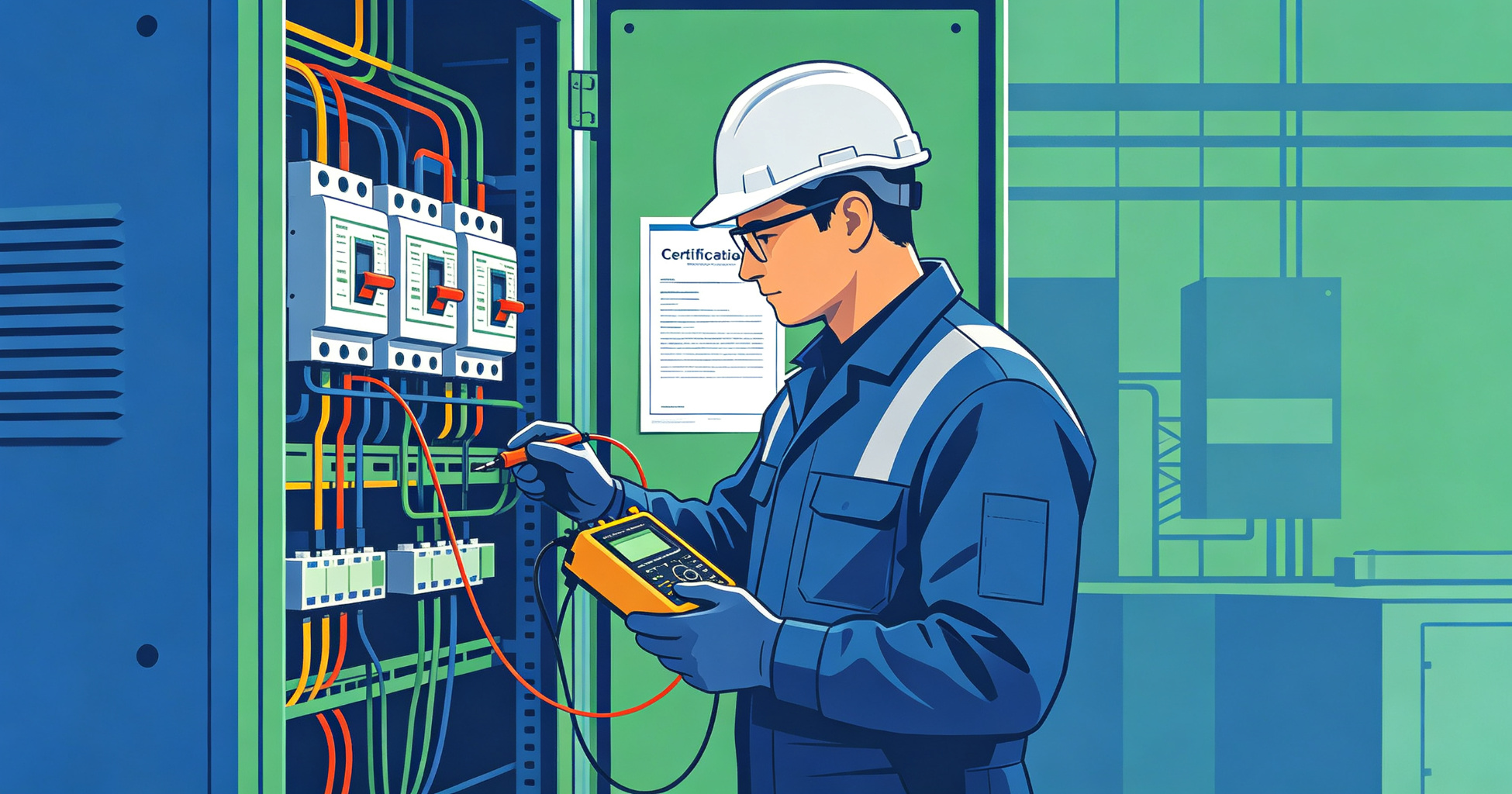
IEC 62446-1, issued in 2016 and revised in 2018, splits PV inspection into documentation, commissioning tests, and periodic verification.
IEC 62446-1 defines what must be documented, measured, and verified before a photovoltaic (PV) system is accepted and throughout its service life. Originally published in 2016 and revised in 2018, it split PV inspection into three categories: documentation, commissioning tests, and periodic verification. The standard now anchors electrical maintenance testing for solar assets across Europe and, increasingly, North America.
What IEC 62446-1 Actually Requires
The full title is Photovoltaic (PV) systems — Requirements for testing, documentation and maintenance — Part 1: Grid connected systems — Documentation, commissioning tests and inspection. It applies to grid-connected PV systems, not off-grid or standalone installations. The document is organized around three test categories, each with its own documentation and pass/fail criteria.
Category 1: Documentation and System Information
Before any test is performed, the installer or maintenance provider must assemble a defined documentation package. This includes system single-line diagrams, string layouts, module datasheets, inverter specifications, string cable schedules, and a commissioning record. The standard requires that this documentation remain available on site or in a controlled location for the life of the system. Missing or outdated documentation is one of the most common audit failures because it is easy to overlook once a system is operational.
Category 2: Commissioning Tests
Commissioning tests verify that the installed system matches its design and operates within tolerance. The core measurements are:
- Continuity of protective earthing and equipotential bonding — measured resistance must typically be ≤ 1 Ω between exposed conductive parts and the main earthing terminal.
- Insulation resistance — tested at 500 V DC or 1000 V DC depending on system voltage, with a minimum acceptable value calculated from the array's maximum voltage and the test voltage applied.
- Polarity — verified for every string before connection to the inverter.
- String open-circuit voltage (Voc) — measured and compared against expected values at the recorded cell temperature, with a tolerance typically within ±5% of the design value.
- String short-circuit current (Isc) — measured using a clamp meter or dedicated PV tester, with similar tolerance.
- Functional tests — inverter startup, shutdown, and grid-protection response.
Category 3: Periodic Verification
After commissioning, the standard calls for periodic inspection and testing. It does not mandate a fixed interval; instead, it requires that the interval be determined by the system owner or operator based on environmental conditions, system criticality, and manufacturer recommendations. In practice, most European operators settle on an annual or biennial cycle. The periodic verification repeats the continuity, insulation resistance, and string measurements, and adds a visual inspection of modules, connectors, mounting, and cable management.
How IEC 62446-1 Compares to Related Standards
Confusion often arises because several standards touch PV electrical testing. Each has a distinct scope.
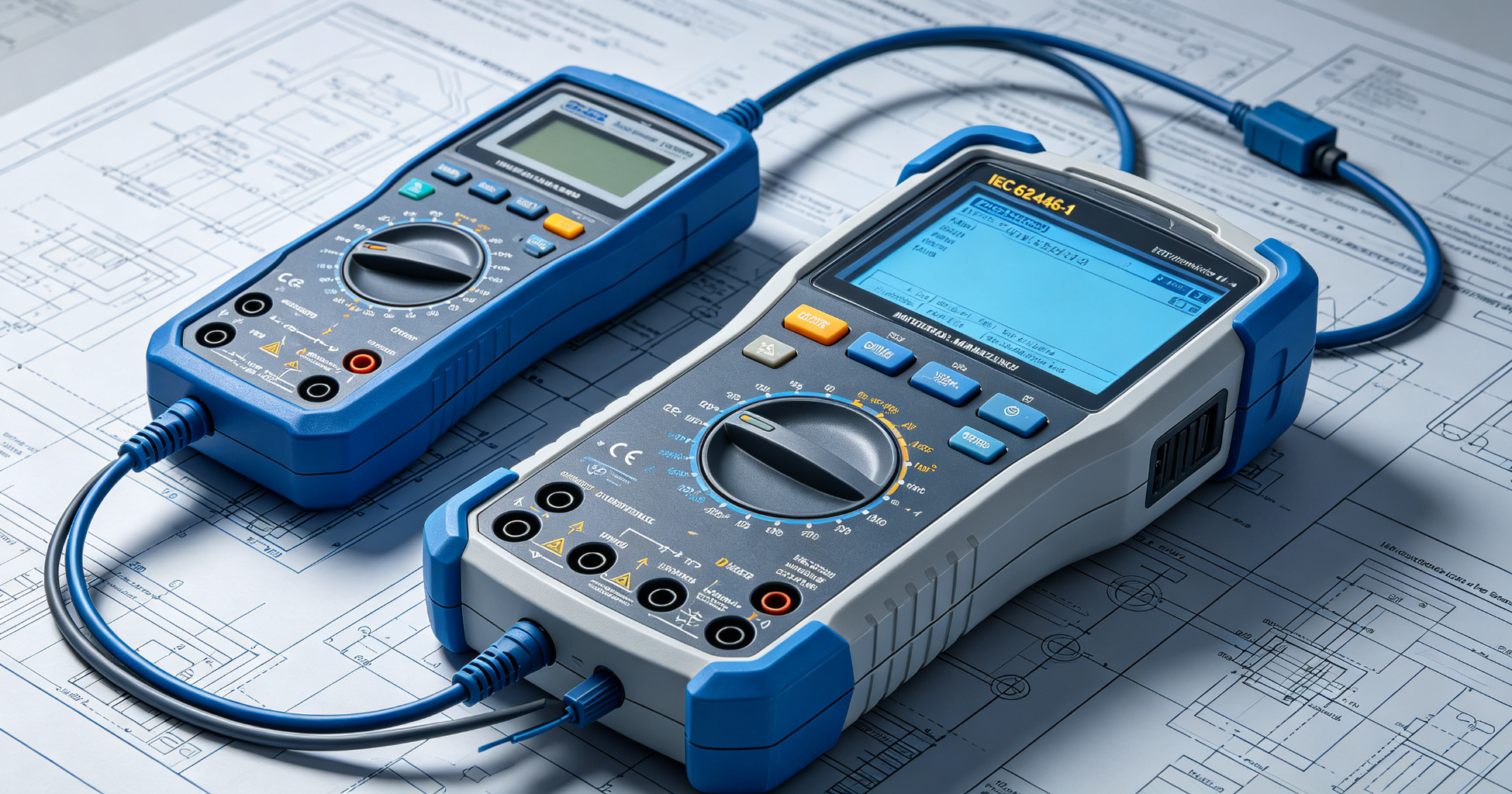
IEC 62446-1 vs. IEC 62446-2
Part 2, published in 2020, covers maintenance of grid-connected PV systems rather than commissioning. It defines maintenance procedures, fault-finding, and repair documentation. Part 1 is the acceptance and periodic-testing standard; Part 2 is the ongoing maintenance standard. Many compliance programs mistakenly cite Part 1 for maintenance activities that actually belong under Part 2.
IEC 62446-1 vs. IEC 60364-6
IEC 60364-6 covers verification of low-voltage electrical installations generally. PV systems fall under its scope, but IEC 62446-1 provides the PV-specific test methods and acceptance criteria. Where the two overlap — insulation resistance, earthing continuity — IEC 62446-1 is the more specific reference and should take precedence for PV circuits.
IEC 62446-1 vs. NFPA 70 and UL 1741
In North America, NFPA 70 (National Electrical Code) Article 690 governs PV installation requirements, and UL 1741 covers inverter and grid-interconnection equipment. Neither is a testing standard in the IEC 62446-1 sense. UL 1741 is a product safety certification; NFPA 70 is an installation code. IEC 62446-1 fills the gap by specifying how to verify that an installed system meets its design intent. For facilities pursuing both European and North American compliance, IEC 62446-1 testing records are increasingly accepted as evidence of due diligence even where not strictly required by local code.
The practical distinction: NFPA 70 tells you how to install it. IEC 62446-1 tells you how to prove it works.
Common Compliance Pitfalls
Field experience with IEC 62446-1 audits reveals recurring failures. Most are procedural rather than technical.
- Temperature correction ignored. Voc and Isc measurements vary with cell temperature. A string measured at 5°C in winter may read 8–10% higher than the datasheet value at STC (25°C, 1000 W/m²). Failing to correct for temperature leads to false pass or false fail results.
- Insulation resistance tested at the wrong voltage. The test voltage depends on the system's maximum DC voltage. Applying 500 V to a 1500 V system under-tests the insulation. Applying 1000 V to a 600 V system may over-stress components.
- Incomplete string mapping. Auditors frequently find that the as-built string layout does not match the design documentation. IEC 62446-1 requires that the documentation reflect the installed configuration, not the intended one.
- Missing periodic verification records. Commissioning records are usually retained. Periodic verification records often are not. A gap of two or three years in the test log is treated as non-compliance regardless of system performance.
- Earthing continuity measured at the wrong point. The standard requires measurement between the furthest exposed conductive part and the main earthing terminal, not simply at the inverter enclosure.
The Shift Toward Continuous Monitoring
IEC 62446-1 was written for periodic, manual testing. That model has a structural weakness: a system can pass inspection on Monday and develop a DC arc fault or insulation degradation by Friday. The standard's periodic verification interval — often 12 to 24 months — leaves a long window between checks.
Newer approaches supplement periodic testing with continuous monitoring. String-level current and voltage monitoring, insulation resistance monitoring, and arc-fault detection can provide real-time data that satisfies the intent of IEC 62446-1 between formal test intervals. The ICOP platform from Chilion exemplifies the trend toward always-on electrical fire prevention rather than periodic inspection, integrating continuous monitoring with the documentation and test records that IEC 62446-1 requires.
This does not replace the standard. It changes how compliance is demonstrated. Instead of a snapshot every year or two, the maintenance record becomes a continuous data stream. Several European certification bodies now accept continuous monitoring logs as supplementary evidence for periodic verification, provided the measurement methods meet IEC 62446-1 accuracy requirements.
What This Means for Facility Managers and Engineers
If you operate a grid-connected PV system, IEC 62446-1 is your testing baseline. The practical steps are straightforward:
- Assemble the full documentation package at commissioning and keep it current.
- Perform all Category 2 tests with calibrated instruments and record temperature-corrected values.
- Establish a periodic verification interval and stick to it.
- Correct for temperature on every Voc and Isc measurement.
- Consider continuous monitoring as a supplement, not a replacement.
The standard does not expire. It evolves. IEC 62446-1's 2018 revision tightened documentation requirements and clarified test tolerances. Future revisions are expected to address energy storage integration and higher-voltage systems (1500 V and above), which are becoming common in utility-scale installations. Staying compliant means staying current with the standard, not just the equipment.
Need a passive fire protection assessment?
Our editorial team covers enclosure fire suppression, electrical safety monitoring, and fire-resistant coatings. Talk to our partners about your specific application.
Frequently Asked Questions
Is IEC 62446-1 mandatory in North America?
No. IEC 62446-1 is an international standard and is not adopted as code in the United States or Canada. NFPA 70 Article 690 and UL 1741 govern installation and equipment in North America. However, many owners, insurers, and lenders specify IEC 62446-1 testing as a contractual requirement because it provides a recognized framework for verifying system performance.
How often must periodic verification be performed under IEC 62446-1?
The standard does not set a fixed interval. It requires the interval to be determined by the system owner based on environmental conditions, system criticality, and manufacturer guidance. In practice, most European operators use annual or biennial testing. Some insurers require annual verification for systems above 100 kW.
What is the minimum acceptable insulation resistance value under IEC 62446-1?
The minimum is calculated as 1 MΩ per 1000 V of test voltage, applied to the array's maximum system voltage. For a 1000 V system tested at 1000 V DC, the minimum is 1 MΩ. For a 1500 V system tested at 1000 V DC, the calculation adjusts accordingly. Values below the calculated minimum indicate insulation degradation and require investigation before re-energizing.
Can continuous monitoring replace periodic IEC 62446-1 testing?
Not formally. IEC 62446-1 requires physical inspection and manual testing at defined intervals. Continuous monitoring provides supplementary data but does not satisfy the standard's documentation and visual inspection requirements. Some certification bodies accept monitoring logs as supporting evidence, but the periodic test itself remains mandatory for compliance. For related guidance on DC arc-fault detection and PV system earthing, see our technical guides.