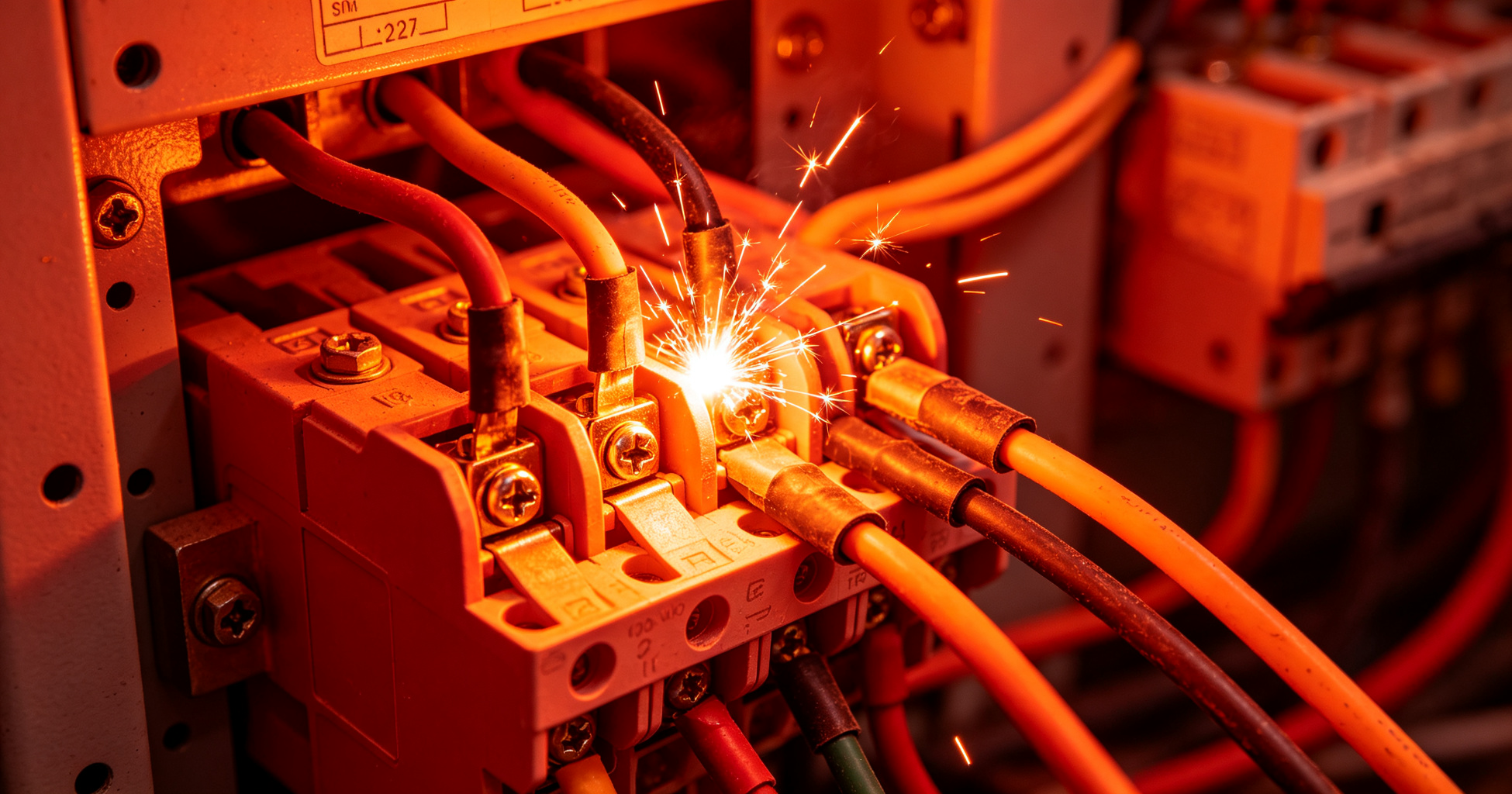
NETA field work attributes about one in three industrial panel fires to a high-resistance termination, not to an overloaded conductor.
A loose connection is the single most common ignition source in industrial electrical panels. NETA field studies attribute roughly one in three panel fires to high-resistance terminations, not overloaded conductors or failed breakers. The mechanism is simple physics: resistance at a poor joint converts current into heat until insulation, busbar plating, or terminal blocks ignite.
This guide explains how loose connections form, why they defeat conventional protection, and how to detect them before they turn a motor control center into a burn scar.
What Counts as a "Loose Connection"
The term covers more than a screw that backed out. A loose connection is any termination where contact pressure, contact area, or surface condition has degraded enough to raise joint resistance above its design value. Four common variants appear in industrial panels:
- Mechanical loosening. Thermal cycling expands and contracts conductors and hardware at different rates. A copper lug and a steel stud move differently across a 60 °C swing, and the joint loses torque over thousands of cycles.
- Insufficient initial torque. A termination tightened to 60 percent of specification can still pass a commissioning check and fail two years later.
- Contamination and corrosion. Aluminum oxide films, sulfur compounds in pulp and paper plants, chloride in coastal facilities, and even residual anti-oxidant compound applied incorrectly all raise interface resistance.
- Fatigue and strand damage. Vibration, especially near compressors and punch presses, fractures strands at the lug. The remaining strands carry full load current at higher density.
The Physics of a Hot Joint
Power dissipated at a connection follows P = I²R. A joint with 0.5 milliohms of extra resistance carrying 400 A dissipates 80 W in a space the size of a thumbnail. That is enough to push a terminal past 150 °C. Copper oxidizes rapidly above 200 °C, and the resulting oxide layer further increases resistance, which increases heat. The failure is self-accelerating.
NFPA 70B, Recommended Practice for Electrical Equipment Maintenance, treats thermographic inspection of terminations as a core preventive task and specifies that connections showing temperature differentials above established thresholds be repaired or replaced, not simply re-torqued.
Why Breakers and Fuses Don't Catch It
A 400 A molded case breaker trips on current, not on localized temperature. A loose joint drawing 250 A through a 400 A breaker never approaches the trip curve. The breaker sees a healthy circuit while a busbar connection runs at 180 °C. Only when the joint fails completely, arcing across the gap, does the current signature change enough for protection to respond, and by then the arc is already established.

Ground fault protection helps in some cases, but a line-side termination fault may not produce enough leakage current to trip a 30 mA or even a 300 mA ground fault relay before ignition. This is the core reason loose connections remain the leading cause: the protection layer is blind to the failure mode.
Detection Methods Ranked by Effectiveness
No single method catches every loose connection. A layered program works because each technique covers different failure stages.
Infrared Thermography
Thermal imaging under load reveals joints already running hot. It is fast, non-contact, and effective, but it has two limits. First, it only works under load. A panel surveyed at 20 percent load may show a joint at 15 °C above ambient that becomes dangerous at full load. Second, it sees the symptom, not the cause, and it cannot look inside a closed terminal block. Follow thermographic inspection intervals tied to load profiles rather than calendar dates.
Torque Verification and Micro-Ohm Testing
Micro-ohm meters inject a known DC current and measure voltage drop across a joint, resolving resistance to the micro-ohm range. Comparing readings against baseline values from commissioning catches degradation before temperature rises. This is the most reliable offline method, but it requires an outage and a complete baseline dataset.
Continuous Monitoring
Online systems watch the panel while it operates. Temperature sensors on busbar joints and breaker terminations, combined with arc fault detection tuned to the signature of series arcing, catch both the slow thermal trend and the fast arcing event. Platforms like Chilion's ICOP system provide continuous arc fault and temperature monitoring for low-voltage distribution panels, which closes the gap that periodic surveys leave open between inspection cycles.
Ultrasound and Visual Inspection
Ultrasound detects the high-frequency noise of tracking and corona before visible damage appears. Visual inspection catches discolored lugs, melted insulation, and corrosion, but only after thermal damage has begun. Both are useful supporting methods, not primary detection.
Root Causes in Industrial Environments
Loose connections are rarely random. They cluster around specific conditions:
- High-cycle load profiles. Welding cells, injection molding machines, and crane drives cycle current hard enough to work terminations loose in months.
- Aluminum conductors. Aluminum creeps under pressure at elevated temperature, losing contact force. Aluminum-to-copper transitions need bimetallic hardware or listed compound.
- Vibration. Equipment mounted on the same structural steel as rotating machinery sees continuous mechanical input.
- Corrosive atmospheres. Chloride, sulfide, and ammonia environments attack plating and bare copper.
- Commissioning shortcuts. Calibrated torque wrenches are frequently absent from startup crews, and hand-tight is not a specification.
UL 486A-486B defines the torque and pull-test requirements for wire connectors, and IEC 60947-7-1 sets similar criteria for terminal blocks. A termination that meets these standards at installation can still fall out of compliance within a few years of service. The standard sets the starting point, not the ongoing condition.
Building a Practical Detection Program
A workable program combines three layers with defined intervals and thresholds:
- Commissioning baseline. Record torque values and micro-ohm readings for every power termination, and photograph each joint. Without a baseline, future readings have no meaning.
- Periodic inspection. Infrared surveys at minimum annually, quarterly for high-cycle or corrosive environments. Perform them at 40 percent load or higher, and document ambient temperature and load at the time of scan.
- Continuous monitoring. Install temperature and arc fault sensing on critical panels, particularly those feeding continuous processes where an unplanned outage carries high cost.
Set repair thresholds before you start. A common field rule is a 10 °C rise above similar joints in the same panel, or any joint exceeding its insulation temperature rating minus a safety margin. NFPA 70B provides guidance on corrective actions once a temperature differential is identified.
Torque Is Not a One-Time Task
Re-torquing after thermal cycling is standard practice for aluminum terminations and good practice for copper. Infrared scans should be paired with torque verification on the joints that showed elevated temperature, because heat anneals copper and reduces the contact force that generated the heat in the first place.
What Good Looks Like
A panel with a mature detection program looks unremarkable, which is the point. Terminations stay within a few degrees of each other under load. Micro-ohm readings drift less than 10 percent from baseline over years. No single joint runs hotter than its neighbors. When a reading does drift, maintenance addresses it during a planned outage instead of a midnight callout.
The physics of a loose connection will not change. Resistance produces heat, heat accelerates oxidation, and oxidation produces more resistance. What changes is whether you find the joint at 60 °C with a thermal camera or at 400 °C with a fire extinguisher. Baseline the terminations, scan under real load, monitor the critical panels continuously, and treat every elevated reading as a scheduled repair rather than a curiosity.
Need a passive fire protection assessment?
Our editorial team covers enclosure fire suppression, electrical safety monitoring, and fire-resistant coatings. Talk to our partners about your specific application.
Frequently Asked Questions
How often should industrial panels be thermographically inspected?
Annually is the minimum for stable, lightly loaded panels. Quarterly or even monthly for panels in high-cycle, high-vibration, or corrosive environments. Always scan at 40 percent load or higher, because a joint that looks cool at light load can exceed its rating at full load. Document ambient temperature and load at the time of each scan for meaningful comparison.
Can a loose connection be detected without opening the panel?
Partially. Infrared thermography works through enclosure surfaces if the panel has IR-transparent windows or you open the door briefly under load. Ultrasound can detect tracking and arcing through gaps in some cases. Continuous monitoring systems with internal sensors detect both temperature rise and series arcing without any door opening, which is the safest approach for energized equipment.
What temperature rise indicates a problem at a termination?
Many maintenance programs flag a joint running 10 °C or more above similar joints in the same panel under comparable load. NFPA 70B recommends corrective action based on temperature differential and the component's insulation rating. Any joint approaching the temperature rating of its insulation or terminal block requires immediate attention, not monitoring.
Does re-torquing a loose connection fix it permanently?
Not always. If the joint ran hot for months, copper may have annealed and lost spring tension, and the plating may be compromised. Re-torquing buys time but may not restore original contact resistance. Micro-ohm testing after re-torque tells you whether the joint is truly restored. Joints that fail the test should be disassembled, cleaned, and rebuilt with new hardware.