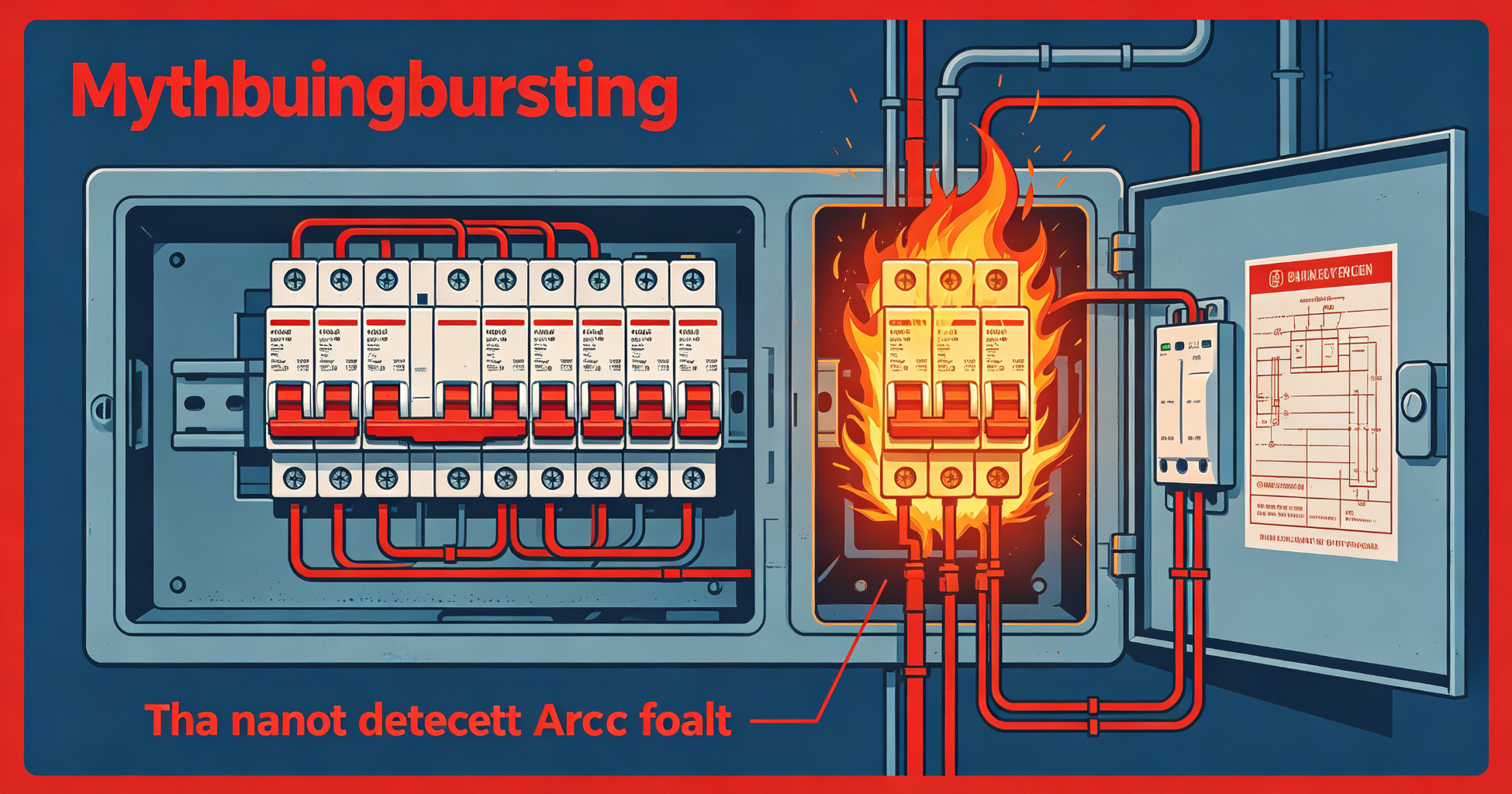
A breaker opens on overload and short-circuit current. Loose lugs, series arcing, and glowing connections often stay below that trip point.
A circuit breaker protects wiring from overload and short-circuit current. It does not prevent electrical fires caused by loose terminations, degraded insulation, series arcing, or glowing connections. Those failure modes often draw far less current than a breaker's trip threshold, so the device never operates while the fault quietly ignites nearby material. The breaker is one layer of protection, not a fire suppression system.
Where the Myth Comes From
The belief is understandable. For a century, the molded-case breaker has been sold as the thing that stops electricity from burning your building down. It sits in the panel, it has a handle you can flip, and when something goes wrong it clicks off. That visible action creates a false sense of completeness.
Training reinforces it. Apprentices learn that breakers protect conductors, then shorthand creeps in and the message becomes "breakers prevent fires." Product literature does not always correct the shorthand. Neither do most building codes, which treat overcurrent protection and fire prevention as related but distinct objectives.
The physics are also counterintuitive. A breaker responds to current. Most electrical fires are not driven by high current. They are driven by heat concentrated at a single point: a terminal screw that loosened 0.5 N·m below spec, a backstabbed receptacle connection carrying 12 A through a contact area smaller than a pencil tip, a nicked conductor arcing at 3 A in a wall cavity.
What a Breaker Actually Watches
A standard 20 A thermal-magnetic breaker has two trip elements. The thermal element is a bimetal strip calibrated to carry 20 A indefinitely at 40°C ambient and to trip somewhere between 1.13 and 1.45 times rated current within an hour, per UL 489 and IEC 60947-2. The magnetic element trips almost instantly above roughly 5 to 10 times rated current, which is where short circuits live.
Series arcs stay invisible
A series arc occurs when a conductor is broken but current keeps jumping the gap. Because the arc is in series with the load, total current is limited by the load itself. A 15 A space heater on a failing cord connection might arc at 8 A. The breaker sees a normal load. The arc sees 8 A concentrated into a plasma channel at 3,000°C to 5,000°C. That is hot enough to ignite Class A materials in seconds.
Parallel arcs and ground faults
A parallel arc, line to neutral or line to ground, can draw enough current to trip a magnetic element, but only if the impedance is low enough. A wet cable with carbonized insulation may present 40 Ω. At 120 V that is 3 A. No standard breaker trips. A ground-fault circuit interrupter rated at 5 mA would catch it. A standard breaker will not.
NFPA reported an annual average of 46,700 home structure fires involving electrical failure or malfunction between 2015 and 2019, causing 390 deaths and $1.3 billion in direct property damage. In a large share of those incidents, the overcurrent device was found intact and untripped.
Four Fire Modes a Breaker Cannot Stop
- Loose terminations. A connection that has worked loose develops contact resistance. At 15 A, an extra 1 Ω of contact resistance dissipates 225 W in a space the size of a thumbnail. The breaker reads 15 A and stays closed. The terminal reaches 200°C and ignites the conductor's insulation.
- Series arcing. As described above, current stays below trip thresholds. UL 1699 arc-fault circuit interrupters were introduced specifically because UL 489 devices miss this failure mode.
- Insulation degradation. Heat, UV, rodents, and chemical exposure reduce dielectric strength. Leakage current rises slowly. A 100 mA leakage path to ground is a fire risk and a shock risk, but it is 0.5% of a 20 A breaker's rating.
- Aluminum conductor creep. Aluminum expands and contracts with load cycling more than copper. Under a binding screw, it cold-flows over years. Contact pressure drops, resistance climbs, and the same thermal runaway begins. Again, no overcurrent event.
What Actually Reduces Fire Risk
Layered protection closes the gaps. No single device covers every failure mode, and the code recognizes this by requiring combinations rather than relying on one trip unit.
Devices that address what breakers miss
- AFCI (UL 1699): detects the current signature of series and parallel arcing. Required by NEC 210.12 for dwelling unit branch circuits and increasingly specified in commercial sleeping areas.
- GFCI / GFPE (UL 943, UL 1053): 5 mA personnel protection or 30 mA to 100 mA equipment protection. Catches insulation leakage long before it becomes a fire.
- Thermal monitoring: infrared scans, thermographic surveys, and continuous sensors at busbar joints and terminations detect the 20°C to 80°C rise that precedes most connection failures.
- Torque verification: a calibrated torque wrench, not a feel test. NEC 110.14(D) requires tightening to a specified value, and manufacturer values typically range from 1.7 N·m for a 15 A receptacle terminal to 40 N·m and higher for large lugs.
Design and maintenance practices
Reduce the number of terminations per circuit. Use copper where vibration or thermal cycling is severe. Keep panel schedules accurate so future electricians do not overload a circuit that is already at 80% continuous load. Schedule infrared surveys annually on critical distribution and after any major load change. Real-time monitoring systems like Chilion's ICOP are increasingly specified in data centers and industrial plants, where a 200°C hot spot on a 4,000 A busway can be detected hours before it becomes a fire.
Why the Breaker Still Matters
None of this means breakers are useless. They prevent the most violent electrical fires: the bolted fault that vaporizes copper, the overloaded 14 AWG conductor carrying 40 A to a failed appliance. A properly sized breaker with adequate interrupting rating (AIC) contains a fault that would otherwise destroy the panel and start a fire at the service entrance. The mistake is treating that function as complete coverage.
The correct mental model is a hierarchy. The breaker handles high-current faults. The AFCI handles arcing. The GFCI handles leakage. Maintenance and thermal monitoring handle the slow degradation that no protective device can sense. Each layer catches what the others miss.
What This Means for Your Facility
Open your most recent infrared report. Look for terminations above 60°C rise over ambient. Those are the connections a breaker will never protect, and they are the ones most likely to fail. Verify torque on every lug you can safely reach during the next scheduled outage. Confirm that AFCI and GFCI protection is present where the applicable code edition requires it, not just where it was required when the building was built.
And when someone tells you the breaker will handle it, ask them which failure mode they mean. If the answer is "overload," they are right. If the answer is "any electrical fire," they are describing a device that does not exist.
Need a passive fire protection assessment?
Our editorial team covers enclosure fire suppression, electrical safety monitoring, and fire-resistant coatings. Talk to our partners about your specific application.
Frequently Asked Questions
If my breaker trips, does that mean it prevented a fire?
It means it interrupted an overcurrent event. That event may or may not have been a fire risk. A breaker tripping on a genuine short circuit likely prevented ignition. A breaker tripping on a marginal overload may have prevented insulation damage that would have become a fire years later. Either way, the trip is a signal worth investigating, not just a handle to reset.
Do arc-fault circuit interrupters replace the need for breakers?
No. An AFCI is a breaker with additional sensing. It still provides overcurrent and short-circuit protection per UL 489, plus arc signature detection per UL 1699. It does not detect loose terminations that have not yet begun to arc, and it does not detect slow insulation leakage. You still need GFCI or GFPE protection for those modes.
How often should I perform infrared thermography on electrical panels?
NFPA 70B recommends an annual survey for most commercial and industrial distribution equipment, with more frequent inspection for critical loads or equipment exposed to vibration and thermal cycling. Infrared should be done under load, ideally at 40% or more of rated current, or the results will miss the hot spots that matter. See our maintenance scheduling guide for interval tables by equipment class.
Can a breaker fail to trip when it should?
Yes. Breakers are mechanical devices with springs, cams, and contacts that degrade. A breaker that has sat closed for 20 years may have a seized mechanism. A breaker in a corroded enclosure may have a compromised bimetal. NETA ATS specifies trip testing intervals, typically every three to five years for critical applications. A breaker that has never been tested is an assumption, not a guarantee.
Electrical fire prevention is not a device you install and forget. It is a combination of correct device selection, verified installation torque, periodic thermal inspection, and honest recognition of what each layer can and cannot see. For a deeper look at how protective device coordination affects fire outcomes, see our guide on overcurrent coordination and our overview of AFCI and GFCI requirements by occupancy.