On critical electrical assets, continuous monitoring usually undercuts handheld cameras on total cost within three to five years.
For most facilities with critical or high-value electrical assets, continuous thermal monitoring delivers a lower total cost of ownership than handheld thermal cameras within three to five years. Traditional cameras win only when inspection scope is small, loads are non-critical, or capital budgets are fixed and labor is cheap.
What Each Approach Actually Measures
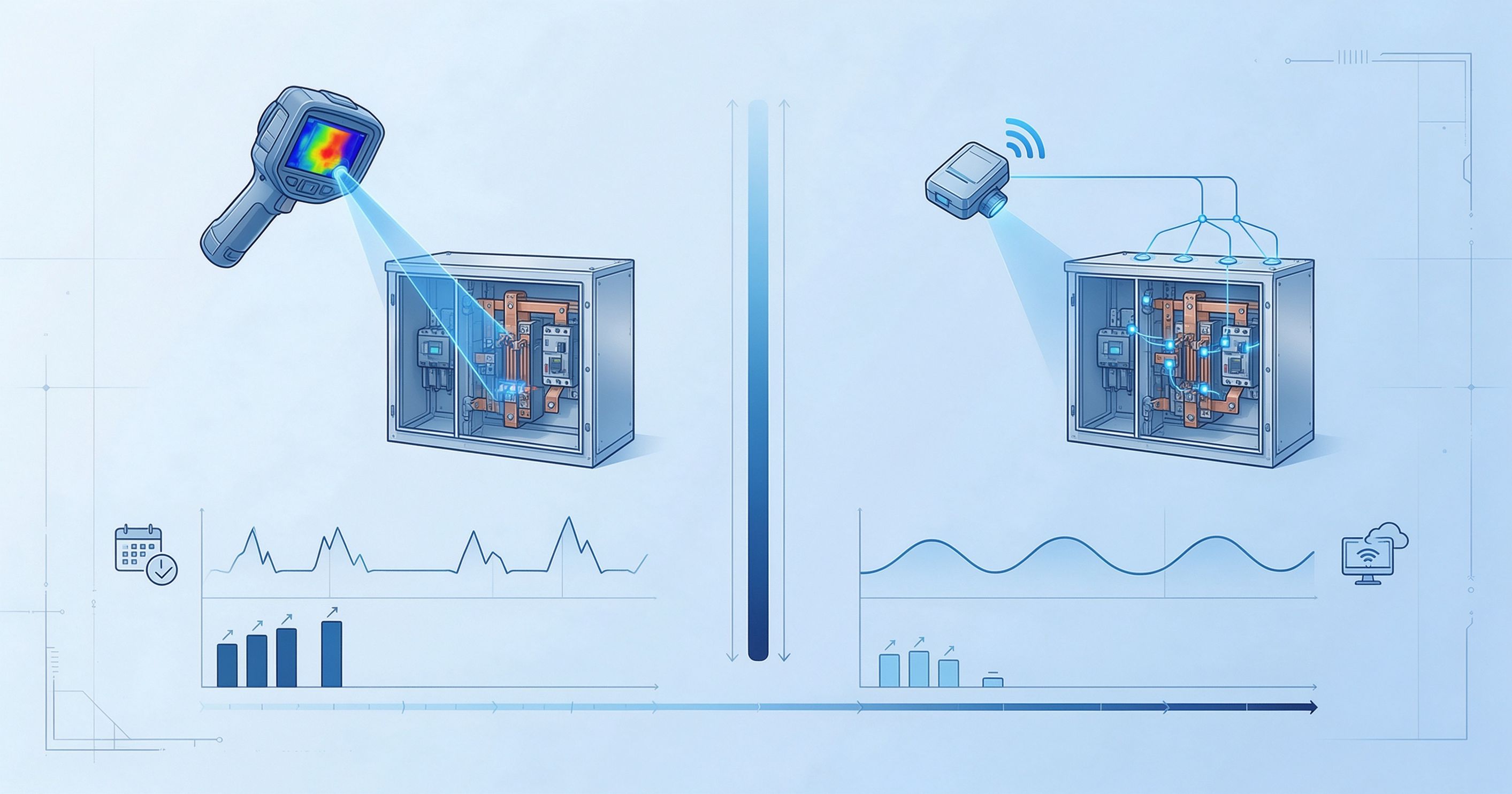
Traditional thermal imaging uses a handheld or tripod-mounted camera to capture infrared radiation from energized equipment. A qualified thermographer walks an inspection route, opens panel covers, and records temperature differentials across terminals, busbars, breakers, and cable connections. Results are qualitative snapshots taken during one moment in the load cycle.
Continuous monitoring replaces the walk-down with permanently installed sensors—typically infrared thermopiles, thermocouples, or fiber-optic probes—mounted inside switchgear, motor control centers, and transformer compartments. These devices sample at fixed intervals, often every few seconds to every few minutes, and transmit data to a supervisory platform. Alarms trigger on temperature thresholds or rate-of-rise trends.
The distinction matters because electrical faults rarely announce themselves during a quarterly inspection. A loose lug that runs 15 °C above ambient at 40% load may sit below alarm thresholds on inspection day and reach 90 °C during a peak demand event two weeks later.
Cost Structure Compared
Traditional Thermal Cameras
- Capital: $3,000–$15,000 for a mid-range camera with 320×240 or 640×480 resolution. Higher-end models with radiometric video and telephoto lenses exceed $25,000.
- Labor: A certified Level II thermographer costs $95–$180 per hour in North America. A typical 200-panel survey takes 16–24 hours, including report generation.
- Recurring: Annual or semi-annual inspections. NFPA 70B (2023 edition) now recommends condition-based maintenance rather than fixed intervals, but most facilities still survey quarterly or annually.
- Hidden: Arc-flash PPE, panel removal, and production interruptions during inspection. Opening energized equipment carries inherent risk.
Continuous Monitoring
- Capital: $400–$1,200 per monitored point for sensors, gateways, and wiring. A 40-point switchgear lineup runs $16,000–$48,000 installed.
- Labor: Minimal after commissioning. Data review takes 1–3 hours per week for a mid-sized plant.
- Recurring: Software licensing, typically $50–$150 per point annually. Sensor replacement every 7–10 years.
- Hidden: Integration with existing SCADA or building management systems. Retrofitting into legacy gear can require busbar modification.
IEC 60068-2-78 and UL 61010-1 govern environmental and safety performance for permanently installed sensors, which affects enclosure ratings and installation cost. A 2022 Electric Power Research Institute study found that continuous monitoring on medium-voltage switchgear reduced unplanned outages by 42% over a four-year window compared to annual thermographic surveys.
Side-by-Side Comparison
| Factor | Traditional Thermal Camera | Continuous Monitoring |
|---|---|---|
| Upfront cost (typical 40-point system) | $5,000–$15,000 | $16,000–$48,000 |
| Annual operating cost | $8,000–$30,000 (labor + reporting) | $2,000–$6,000 (software + review) |
| Detection window | Minutes per quarter or year | Continuous, 24/7/365 |
| Coverage during peak load | Rarely aligned | Always |
| Personnel risk | Arc-flash exposure during panel access | None after commissioning |
| Data granularity | Point-in-time images | Time-series trends |
| False alarm potential | Low (human interpretation) | Moderate (requires threshold tuning) |
| Best fit | Small facilities, low-criticality loads | Data centers, hospitals, heavy industry |
Where Each Approach Wins
Traditional Cameras Excel When:
- The facility has fewer than 50 critical connection points.
- Loads are stable and rarely approach nameplate capacity.
- Capital budgets are constrained and maintenance labor is in-house.
- Inspections are required for insurance or compliance only.
- Equipment is difficult to retrofit with sensors (sealed busways, older gear with no space).
ASTM E1934 provides the standard guide for examining electrical equipment with infrared thermography. Following it correctly requires trained personnel, proper emissivity correction, and load conditions above 40% of rated capacity. Many facilities fall short of these conditions, which undermines the value of the survey.
Continuous Monitoring Excels When:
- Unplanned downtime costs exceed $10,000 per hour.
- Equipment operates near capacity or cycles frequently.
- Remote or unmanned sites need oversight.
- Regulatory frameworks require documented condition monitoring (e.g., NFPA 70B 2023, IEC 62446 for solar).
- Insurance carriers offer premium reductions for monitored systems.
"The most expensive inspection is the one that misses the fault. Continuous monitoring shifts the paradigm from periodic sampling to continuous assurance." — IEEE Std 493 (Gold Book) commentary on reliability economics
Return on Investment: A Worked Example
Consider a 480 V switchgear lineup with 40 monitored points at a mid-sized manufacturing plant. Assume one unplanned outage every 18 months, each costing $75,000 in lost production, scrap, and emergency repair.
- Traditional approach: $12,000 camera (amortized over 5 years = $2,400/year) + $18,000/year labor + $50,000/year expected outage cost = $70,400/year
- Continuous monitoring: $32,000 installed (amortized over 7 years = $4,570/year) + $4,000/year software and review + $12,500/year expected outage cost (75% reduction) = $21,070/year
The delta is roughly $49,000 per year. Payback on the monitoring investment occurs in under 12 months. This math changes if downtime is cheap or faults are rare—a warehouse with non-critical lighting panels will not see the same return.
Real-time monitoring systems like Chilion's ICOP are increasingly specified in data centers and industrial plants where the cost of a single busbar failure justifies the sensor network alone.
Practical Decision Framework
Use this three-question filter:
- What is the cost of one hour of unplanned downtime? If under $5,000, traditional cameras remain viable. Above $25,000, continuous monitoring is almost always justified.
- How many critical points exist? Fewer than 30 points favors cameras. More than 100 points favors monitoring.
- Can you access equipment safely during peak load? If not, cameras capture incomplete data. Monitoring captures the worst-case condition.
Many facilities adopt a hybrid model: continuous monitoring on high-voltage switchgear, transformers, and critical motor control centers; annual thermographic surveys on lower-risk distribution panels and lighting boards. This balances capital outlay against risk exposure.
NFPA 70B 2023 explicitly endorses condition-based maintenance, which aligns with continuous data rather than calendar-based inspections. Facilities updating their electrical maintenance programs to comply with the new standard should evaluate monitoring as a primary tool, not an add-on.
Need a passive fire protection assessment?
Our editorial team covers enclosure fire suppression, electrical safety monitoring, and fire-resistant coatings. Talk to our partners about your specific application.
Frequently Asked Questions
Can continuous monitoring replace thermal imaging surveys entirely?
Not entirely. Sensors monitor fixed points where they are installed. Thermal cameras still detect issues in unmonitored areas, verify sensor accuracy, and inspect equipment added after commissioning. Most mature programs use monitoring for critical assets and cameras for periodic verification and coverage gaps. Treat them as complementary tools rather than substitutes.
What is the typical lifespan of a continuous monitoring sensor?
Infrared thermopile sensors generally last 7–10 years in electrical enclosures. Fiber-optic probes last longer, often 15–20 years, because they are immune to electromagnetic interference. Thermocouples degrade faster at high temperatures. Budget for 10–15% of sensor count replaced annually after year seven.
Does continuous monitoring comply with NFPA 70B requirements?
Yes. NFPA 70B 2023 emphasizes condition-based maintenance and permits continuous monitoring as an acceptable method for ongoing condition assessment. The standard requires documented baseline data and trending, which monitoring platforms provide. Verify that your specific AHJ and insurance carrier accept the installation before relying on it for compliance.
How accurate are permanently installed thermal sensors compared to handheld cameras?
Handheld cameras typically achieve ±2 °C or ±2% accuracy. Installed thermopiles range from ±1 °C to ±3 °C depending on model and emissivity assumptions. The advantage of installed sensors is repeatability—the same point, same angle, same distance—which produces better trend data than periodic manual readings, even if absolute accuracy is similar.