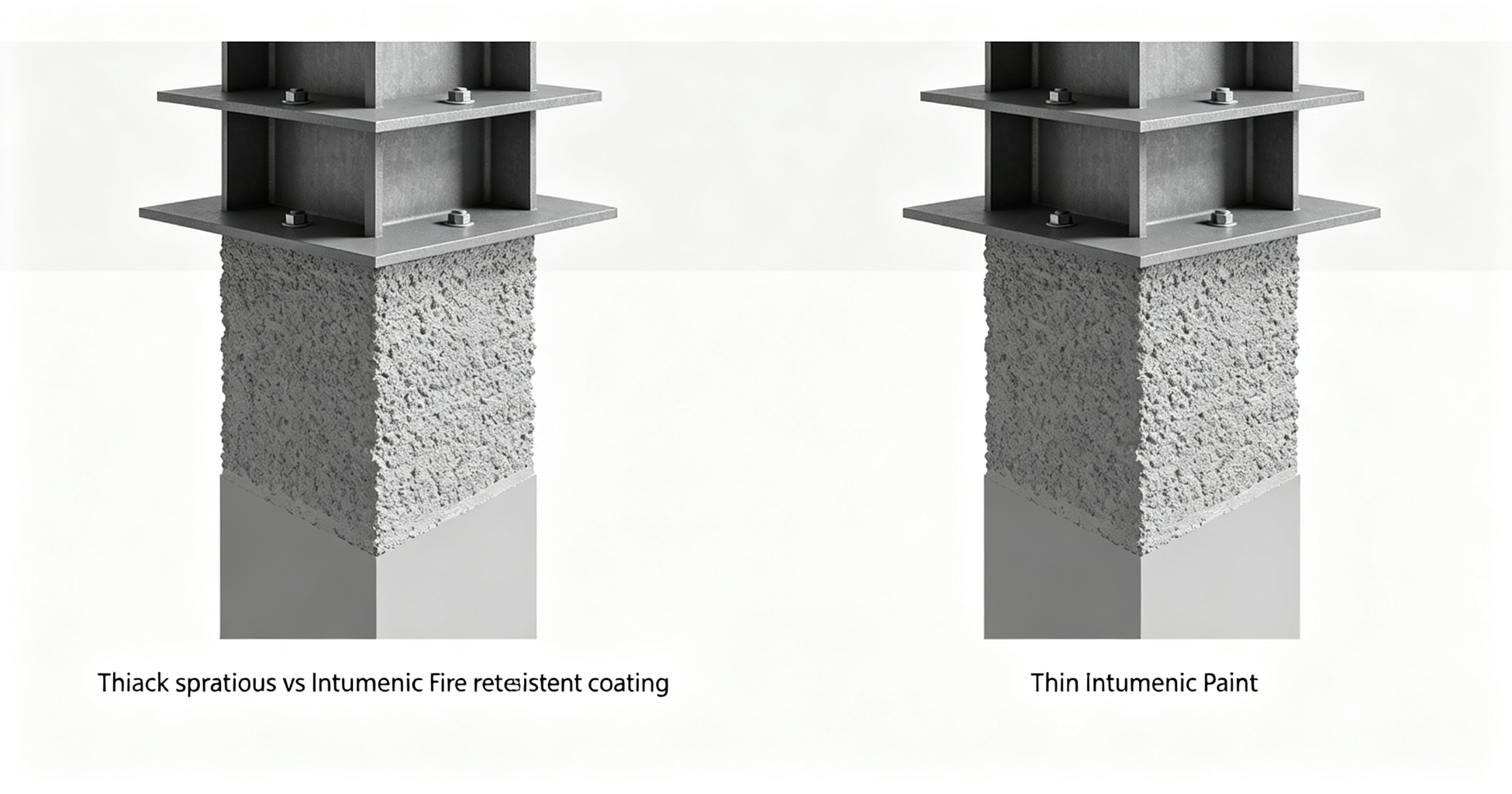
Cementitious coatings suit a 2–4 hour rating and exterior steel. Intumescent coatings stay thin where appearance and weight matter.
Neither coating type wins outright. Cementitious coatings excel on structural steel needing 2–4 hour ratings and exterior durability; intumescent coatings dominate where low thickness, aesthetics, and weight matter. Choose based on fire rating, environment, substrate, and inspection access — not on price alone.
How Each Coating Works
Cementitious fireproofing is a passive barrier. Formulations blend gypsum, portland cement, vermiculite, or perlite into a spray-applied or troweled layer typically 10 mm to 50 mm thick. When a fire develops, the chemically bound water in the gypsum matrix releases as steam between roughly 100 °C and 140 °C, absorbing heat while the low-density aggregate insulates the steel beneath. The coating does not change chemically in a useful way — it simply delays heat transfer long enough for the steel to keep its load-bearing capacity.
Intumescent coatings work on a different principle. They are thin-film organic paints, usually 0.3 mm to 5 mm dry film thickness, loaded with an acid source (often ammonium polyphosphate), a carbon source (pentaerythritol or a similar polyol), and a blowing agent (melamine). At roughly 200 °C to 250 °C the coating begins to soften and react. By 350 °C to 450 °C it has expanded 15 to 50 times its original thickness into a carbonaceous char. That char insulates the substrate, and the endothermic decomposition reactions absorb additional heat. The Chilion Polymer range demonstrates how polymer science improves char layer stability in fires, though the underlying chemistry is shared across the industry.
Side-by-Side Comparison
| Property | Cementitious | Intumescent |
|---|---|---|
| Typical dry thickness | 10–50 mm | 0.3–5 mm |
| Fire rating range | Up to 240 min (4 h) | Up to 120 min (2 h) typical |
| Added dead load | High (5–40 kg/m²) | Low (0.5–5 kg/m²) |
| Exterior durability | Excellent with sealer | Requires topcoat, re-inspection |
| Appearance | Textured, industrial | Smooth, paintable any color |
| Application method | Spray, trowel, cast | Spray, brush, roller |
| Solvent content | Water-based | Water-based or solvent-based |
| Relative cost per m² | Lower material, higher labor | Higher material, lower labor |
| Damage resistance | Good, can chip | Moderate, scratches easily |
| Inspection | Thickness gauge, visual | DFT gauge, char test samples |
Fire Performance: Where the Ratings Diverge
Both technologies are tested to the same standards. In North America, UL 263 and ASTM E119 govern beams, columns, and floor assemblies. In Europe, EN 13381-4 (passive protection of steel members), EN 13381-8 (reactive coatings), and EN 13501-2 classification apply. A coating is only valid for the specific section factor it was tested against, expressed as Hp/A in metric units or W/D in US units.
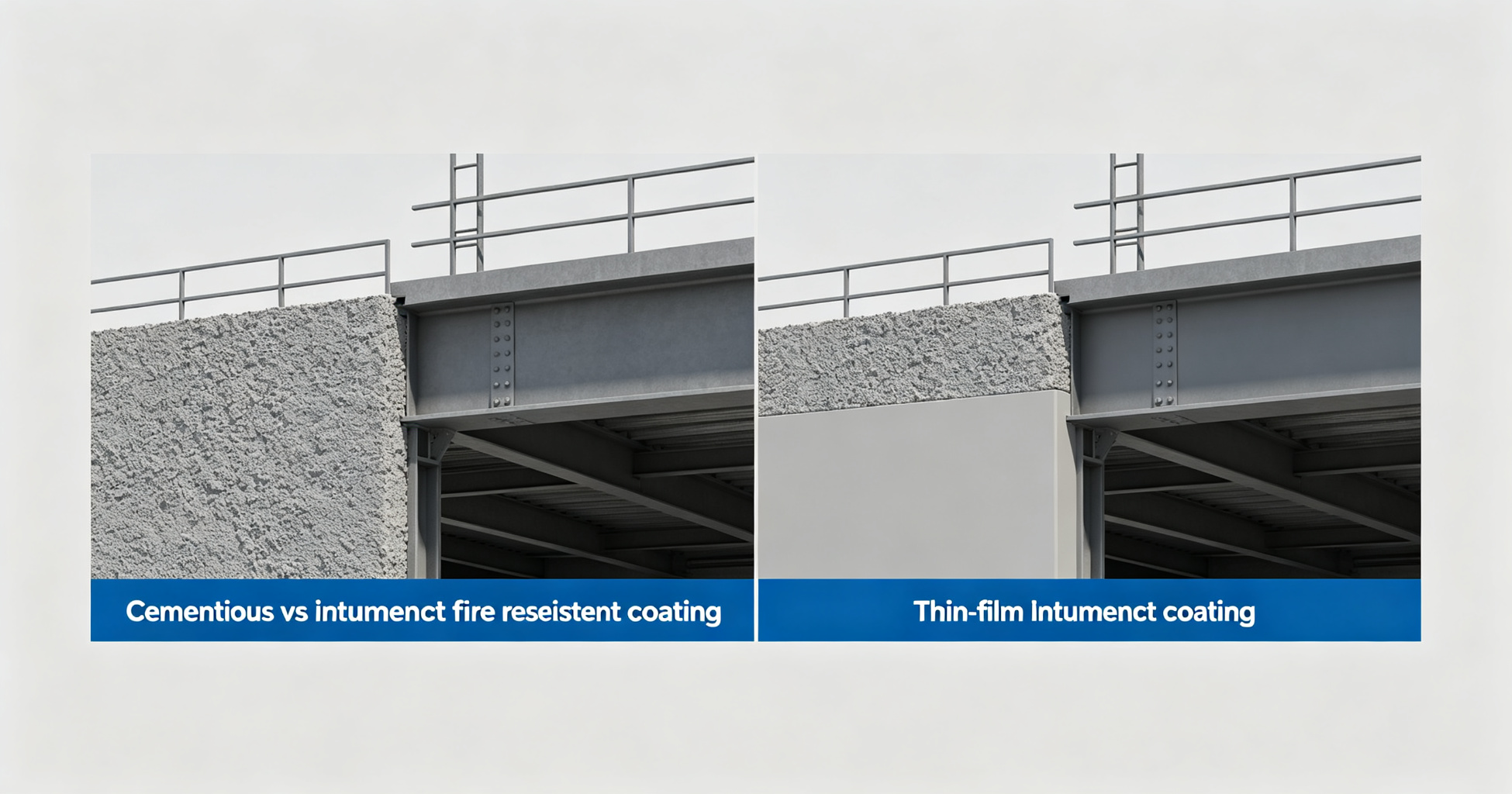
Cementitious strengths
Cementitious systems reach 3-hour and 4-hour ratings routinely. Hydrocarbon fire scenarios — refineries, petrochemical plants, tunnel fires following the RWS or HC curve — almost always use cementitious because the insulation mass handles the faster heat ramp. A 50 mm layer on a 200 mm column can hold steel below 550 °C for over three hours under cellulosic exposure. Cementitious coatings also tolerate substrate movement, corrosive atmospheres, and mechanical impact better than thin films.
Intumescent strengths
Intumescent coatings hold the advantage where the section factor is low to moderate. On a heavily proportioned column with Hp/A below 100 m⁻¹, a 1.5 mm film can deliver 90 minutes of protection. The same column might need 25 mm of cementitious material. That weight and thickness difference affects foundation loads, cladding depth, and available floor area. Intumescents also bond directly to primed steel, so they suit exposed architectural steel in atria, airports, and stadiums where the coating has to disappear into the design.
Ratings are not interchangeable across products. A 90-minute rating from one manufacturer's test does not transfer to another's coating, even at identical thickness. Always verify the specific assessment or listing for your section factor and fire curve.
Cost, Installation, and Site Conditions
Material cost for intumescent coatings runs roughly two to five times higher per liter than cementitious mixes, but the labor picture reverses. Cementitious spray requires masking, containment, and often multiple passes to build thickness, with drying time between lifts. A crew applying 30 mm to a large warehouse frame may take days. Intumescent application is faster per square meter and produces less overspray, but it demands tighter climate control: most products require ambient temperatures above 5 °C to 10 °C and relative humidity below 85% during cure. Cementitious materials tolerate cold and damp better, though freezing before set ruins the bond.
Site logistics matter as much as chemistry. Cementitious mixes arrive as dry bags and need mixing, water, and disposal of empty packaging. Intumescents ship as sealed pails with limited shelf life — often 12 months — and require solvent cleanup in some formulations. On retrofit projects inside occupied buildings, low-odor water-based intumescents are usually the only practical option.
Durability and Long-Term Maintenance
Cementitious coatings are essentially mineral and do not degrade under UV. Exterior applications need a sealer or topcoat to shed water and prevent freeze-thaw spalling, but with that protection they last decades. Damage from impact is localized and repairable with patching compound.
Intumescents are more sensitive. Exterior exposure requires a compatible topcoat to block moisture, because water uptake degrades the intumescent reaction. Even indoors, humidity, chemical exposure, and physical abrasion shorten service life. Any repair must use the same manufacturer's product, applied to the same dry film thickness, or the rating is void. Facilities teams should budget for periodic thickness surveys — every 5 to 10 years is common practice — and keep spare material on site. The inspection intervals guide covers how to set up a maintenance schedule that keeps the rating intact.
Selection Guidance by Application
Choose cementitious when:
- The required rating exceeds 120 minutes
- The fire curve is hydrocarbon or RWS (tunnels, process plants)
- Steel is outdoors, in wet areas, or exposed to chemicals
- Weight and thickness are not constrained
- Mechanical damage from vehicles or operations is likely
- Budget pressure favors lower material cost over speed
Choose intumescent when:
- Steel is architecturally exposed and must look painted
- Added dead load must stay minimal (long-span roofs, retrofit)
- Rating is 120 minutes or less on low section factors
- Application happens in occupied or clean environments
- Thickness affects cladding, ceiling voids, or floor area
- Fast turnaround shortens the construction schedule
Mixed systems are common on large projects. A terminal building might use intumescent on exposed atrium columns and cementitious on back-of-house columns and roof trusses. That approach is legitimate provided each product is specified against its own tested rating. For more on matching coatings to exposure conditions, see the selection criteria guide.
Need a passive fire protection assessment?
Our editorial team covers enclosure fire suppression, electrical safety monitoring, and fire-resistant coatings. Talk to our partners about your specific application.
Frequently Asked Questions
Can intumescent coatings achieve a 3-hour fire rating?
Rarely. Most intumescent products top out at 120 minutes, and 180-minute listings exist only for specific low section factors with thick films. For 3-hour or 4-hour requirements on structural steel, cementitious coatings remain the practical choice. Always confirm the actual assessment for your steel's Hp/A value rather than assuming a generic rating applies.
Which coating is cheaper overall?
Material cost favors cementitious, often by a factor of two to five. Installed cost depends on access, containment, and labor rates. On large, simple frames with generous space, cementitious usually wins. On tight retrofits or exposed architectural steel, intumescent labor savings and thinner profiles often offset the higher material price.
Do intumescent coatings need a topcoat?
Indoors in dry, controlled environments, many products perform without one. Outdoors, in humid spaces, or where chemical exposure occurs, a compatible topcoat is required to protect the intumescent chemistry. Skipping the topcoat can void the manufacturer's warranty and degrade the fire performance over time.
How is coating thickness verified on site?
Cementitious thickness is checked with a penetrating gauge or by measuring a core sample. Intumescent dry film thickness is measured with a magnetic or eddy-current gauge calibrated to the specific product. Both methods follow ASTM or EN procedures, and inspectors typically require readings at defined grid intervals per thickness testing protocols.