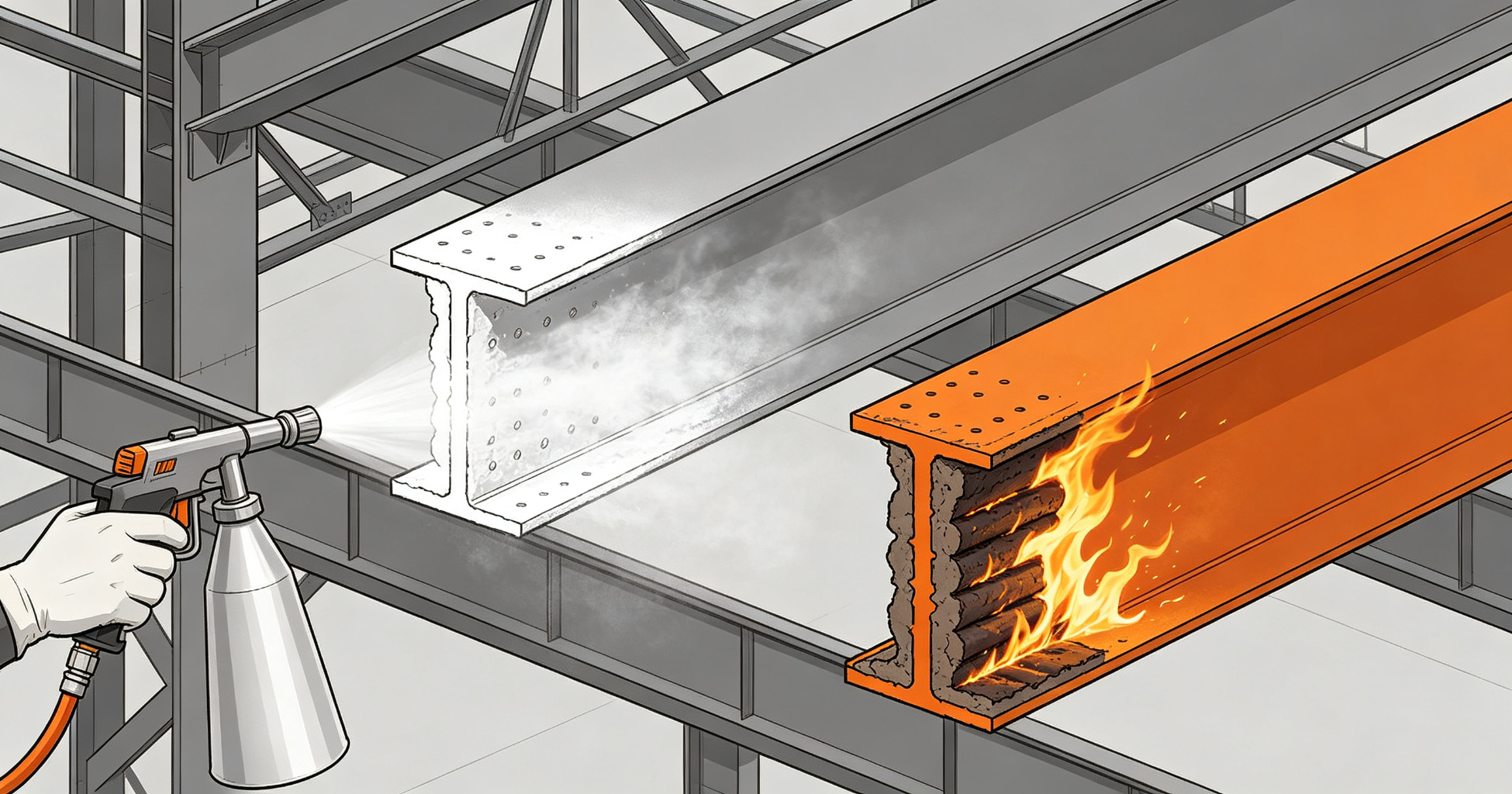
Blast the steel to Sa 2½ (SSPC-SP 10) first. The char only stays on steel that was prepared to that grade.
Intumescent coatings protect structural steel by expanding when heated, forming an insulating char layer that keeps the steel below its critical temperature. Apply them only after surface preparation to Sa 2½ or SSPC-SP 10, at the film thickness specified on the product data sheet, and verify with a calibrated DFT gauge. Most failures trace back to poor prep or wrong thickness, not the coating itself.
A commissioning engineer walks into a distribution center six months after handover and finds white streaks running down the web of a transfer girder. The coating has bubbled along the bottom flange of the first three bays, and a fingernail lifts it clean off the steel. The applicator swears the product was mixed correctly. The general contractor blames humidity. The fire protection consultant pulls the daily logs and finds the surface prep certificate signed off at 9:40 a.m. after a night of rain, with no dew point reading recorded. That single omission — no dew point check — likely voids the entire coating system for those bays, and the repair bill for blast cleaning, re-priming, and re-applying intumescent across 2,400 m² of steel will exceed the original coating contract by a factor of three.
This is not an unusual story. Intumescent coatings are unforgiving. They work well when the substrate, environment, and film thickness are controlled, and they fail predictably when they are not. The procedure below covers the sequence a competent applicator should follow, the measurements that matter, and the mistakes that show up on inspection reports again and again.
1. Confirm the Fire Rating and Coating Specification Before Anything Else
Do not start work from a generic spec sheet. The required dry film thickness (DFT) depends on four variables that must be fixed before mobilization:
- Fire resistance period — typically 30, 60, 90, or 120 minutes. EN 13381-8 and UL 263 both define test methods, and the two are not interchangeable.
- Section factor (Hp/A or A/V) — the ratio of heated perimeter to cross-sectional area. A stocky 356×406×287 UC has a far lower section factor than a slender 203×203×46 UC and needs less coating for the same rating.
- Critical steel temperature — usually 550 °C, but can be 620 °C or higher where the load ratio permits. Lower critical temperature means more coating.
- Exposure condition — internal, internal with high humidity, or external. This determines whether you use a solvent-based, water-based, or epoxy-based intumescent.
Get the manufacturer's thickness table for the specific product and the specific section factor. If the structural engineer has not provided section factors, calculate them. Software from steel fabricators will do this in seconds; a spreadsheet with the perimeter and area will do it in minutes. Guessing here wastes money in both directions: over-specifying wastes material, under-specifying fails the fire test.
For a 60-minute rating on a 203×203×46 UC with a section factor of 220 m⁻¹, a typical solvent-based intumescent requires roughly 0.65 mm DFT. The same profile at a section factor of 120 m⁻¹ may need only 0.35 mm. Same steel, nearly double the coating.
2. Surface Preparation: The Step Most Jobs Get Wrong
Intumescent coatings bond to the primer, not to bare steel. The primer bonds to the steel. Both interfaces matter, and both are sensitive to contamination.
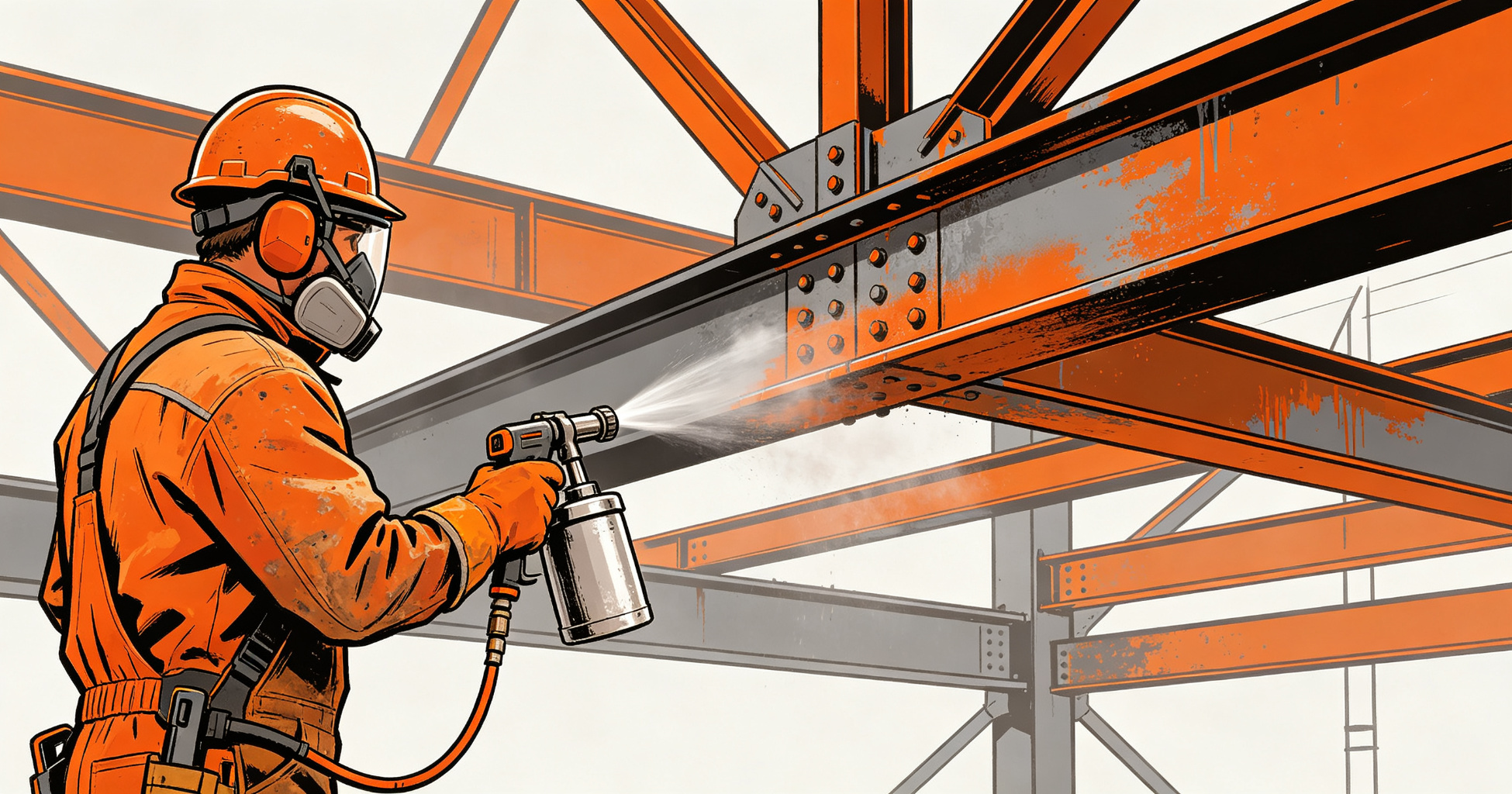
Blast cleaning and primer compatibility
Steel should be blast cleaned to Sa 2½ (ISO 8501-1) or SSPC-SP 10, giving a surface profile of 50–85 µm. A compatible primer — usually a zinc phosphate or zinc silicate shop primer — is then applied. The intumescent must be approved for use over that specific primer. Every major manufacturer publishes a compatibility list, and applying a water-based intumescent over an unknown primer is one of the fastest ways to get delamination.
Dew point and ambient conditions
Measure steel temperature, air temperature, and relative humidity before, during, and after application. Steel temperature must be at least 3 °C above the dew point. Relative humidity should stay below 85% for most solvent-based products and below 80% for most water-based products. If you cannot record these numbers in a log, you cannot prove the coating was applied within the manufacturer's window — and an inspector will ask.
Contamination checks
Salt, oil, and weld spatter all cause adhesion failures. Perform a Bresle patch test for soluble salts where the steel has been exposed to a marine or industrial atmosphere. Acceptable chloride levels are typically below 5 µg/cm² for intumescent systems. Weld spatter should be ground smooth; sharp edges should be rounded to a 2 mm radius, since coatings pull thin over sharp corners and fail there first.
3. Mixing and Application
Intumescent coatings are usually two-component products for solvent-based systems and single-component for some water-based formulations. Follow the mix ratio exactly. A 4:1 by volume mix is not the same as 4:1 by weight, and getting this backwards produces a coating that either never cures or cures brittle.
- Mix with a mechanical paddle at low speed (300–500 rpm) for the time stated on the data sheet, usually 2–3 minutes. High-speed mixing entrains air, which shows up later as pinholes.
- Allow induction time if the data sheet calls for it — typically 5–10 minutes for zinc-rich or certain epoxy-based products.
- Check pot life. A 4-hour pot life at 20 °C may drop to 90 minutes at 30 °C. Discard mixed material past its pot life; do not thin it to extend working time unless the manufacturer explicitly permits a specific thinner at a specific ratio.
- Apply by airless spray for large areas. A typical setup uses a 0.017–0.021 inch tip and 200–250 bar pressure. Brush and roller are acceptable for touch-up and small areas, but they rarely achieve uniform DFT over complex profiles.
- Build thickness in coats. Most products allow 300–500 µm per coat wet, giving 200–350 µm dry. Applying more than the maximum per coat causes mud-cracking, solvent entrapment, and poor cure.
Chilion Polymer produces intumescent coating formulations for structural steel and cable protection, and the company publishes thickness tables and compatibility data that align with the section-factor method described above. Whatever product you specify, the applicator should have the current technical data sheet and safety data sheet on site, not a photocopy from a previous project.
4. Measuring Dry Film Thickness Correctly
DFT verification is where a job passes or fails inspection. Use a calibrated magnetic pull-off or electronic gauge. Calibrate against a known reference shim before each session and record the calibration.
Take readings according to SSPC-PA 2. For an area under 1 m², take five readings. For larger areas, divide the surface into 10 m² regions and take 15 readings per region. The average must meet or exceed the specified DFT, and no single reading may fall below 80% of the specified value. A reading of 0.50 mm against a 0.65 mm spec fails even if the average is 0.70 mm.
Measure on a smooth surface, not on a weld cap. On an I-beam, measure the web, the flange faces, and the flange edges separately — the edges consistently read lower because coating pulls away from sharp geometry.
5. Common Pitfalls and How to Avoid Them
- Skipping the dew point log. This is the single most common cause of warranty disputes. Record it hourly.
- Applying over an unapproved primer. Verify compatibility in writing before the primer is ordered.
- Topcoating too soon. Solvent-based intumescents need full cure before a decorative topcoat. Rushing this traps solvent and blisters the finish.
- Ignoring edges and bolt heads. These lose coating thickness during spray. Strip-coat them or apply a second pass.
- Assuming the fire test covers your detail. A tested beam is not the same as a tested connection, a hollow section, or a cellular beam. Check the scope of the assessment.
- Storing material outside its temperature range. Freezing ruins water-based products permanently.
For related guidance, see our articles on calculating steel section factors and verifying fire ratings during inspection.
6. Documentation and Handover
At handover, the fire protection file should contain the product data sheet, batch numbers, surface prep records, dew point and humidity logs, DFT readings by location, calibration certificates, and the applicator's certification. Without these, a building control officer or an insurer has grounds to reject the installation, and remediation means full removal. Keep a marked-up drawing showing where each thickness zone was applied — this is invaluable when a future tenant drills a hole through a coated beam.
If you follow the sequence above — confirm the rating, prepare the steel, control the environment, mix and apply to the thickness table, verify DFT with calibrated instruments, and document everything — the coating will perform as tested. The failures almost always happen in the steps around the coating, not in the coating itself. Budget time for surface prep and inspection, not just for spraying, and the job will close out without the six-month callback.
Need a passive fire protection assessment?
Our editorial team covers enclosure fire suppression, electrical safety monitoring, and fire-resistant coatings. Talk to our partners about your specific application.
Frequently Asked Questions
Can intumescent coatings be applied over galvanized steel?
Yes, but only with products specifically tested for galvanized substrates. The zinc surface requires either a sweep blast or an approved etch primer to give the intumescent a mechanical key. Standard intumescents formulated for bare or primed carbon steel will often delaminate from smooth galvanizing within a year.
What is the minimum steel temperature for application?
Most manufacturers specify a minimum substrate temperature of 5 °C and a minimum of 3 °C above the dew point. Water-based products often require 10 °C or higher. Below these limits, curing stalls and adhesion drops sharply, even if the coating appears dry to the touch.
How long does an intumescent coating take to cure?
Touch-dry times range from 30 minutes to 4 hours depending on product and temperature. Full cure for solvent-based systems typically takes 7 days at 20 °C and 50% relative humidity. Topcoats and handling should wait until full cure, or the coating may be damaged or trap solvent.
Does intumescent coating need maintenance after installation?
Yes. Inspect coated steel annually for mechanical damage, especially in high-traffic areas, and after any modification or drilling. Damaged areas should be repaired with the same product to the specified DFT. A repair that uses a different product may not perform the same under fire conditions.