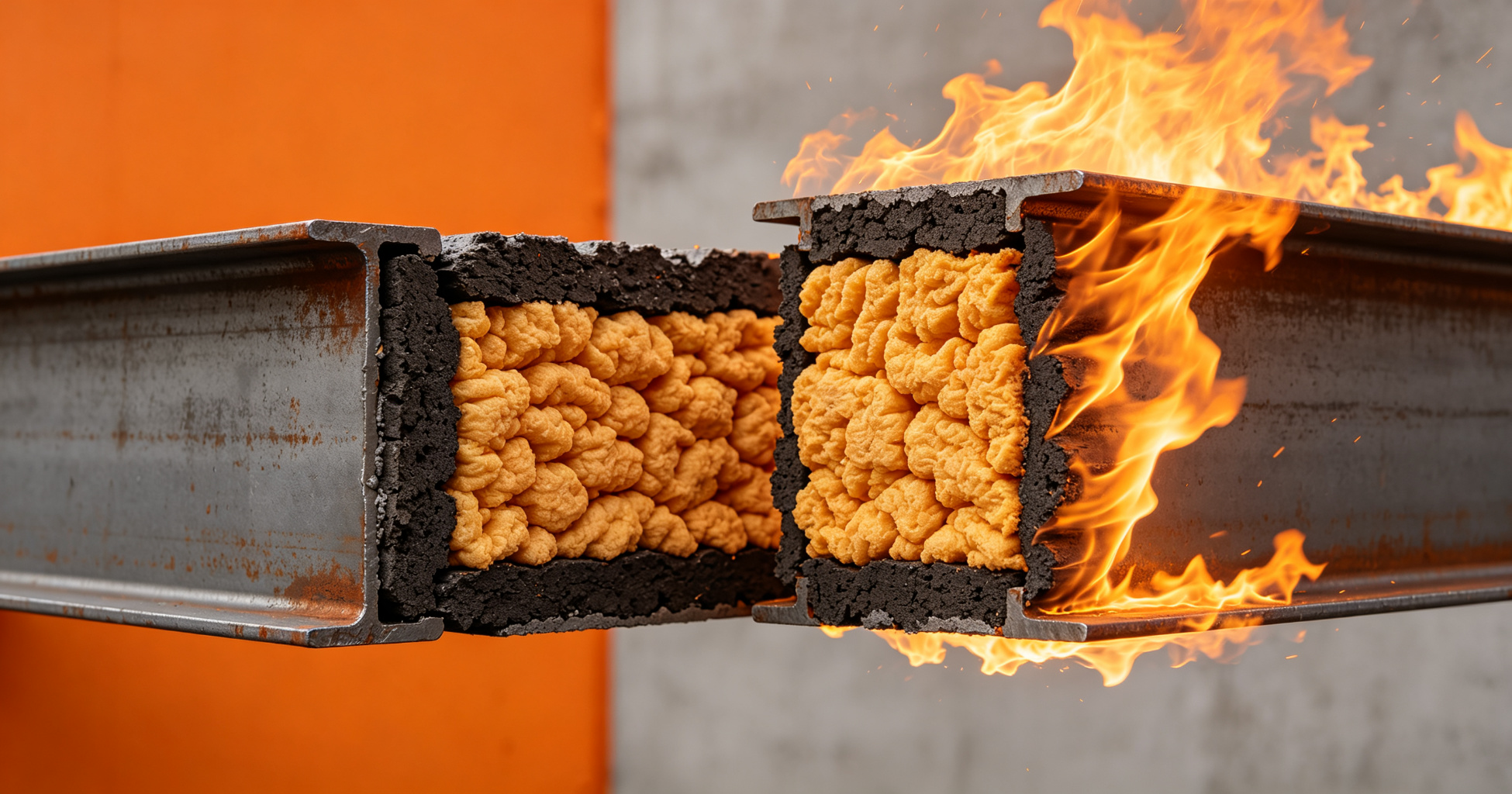
Above about 200°C (392°F) the film swells into a char up to 50 times its dry thickness and slows heat into the steel.
An intumescent coating protects structural steel by swelling into a thick, insulating char when heated above roughly 200°C (392°F). That char can reach 50 times the original film thickness, forming a low-density barrier that slows heat transfer to the steel and buys time for evacuation and firefighting.
What "Intumescent" Actually Means
The word comes from the Latin intumescere, to swell up. In fire protection, it describes a material that reacts to heat by expanding and charring rather than simply burning away. Think of a marshmallow in a campfire: it puffs, darkens, and forms a crust. An intumescent coating does something similar, but the chemistry is engineered so the residue is a rigid, cellular foam with very low thermal conductivity instead of a sticky mess.
On structural steel, this reaction is the entire point. Steel loses roughly 50% of its room-temperature yield strength at about 550°C (1020°F) and continues to weaken above that. An unprotected W12x40 beam in a standard fire can reach that threshold in under 15 minutes. The coating does not stop the fire. It inserts a delay.
The Three-Part Reaction
A typical intumescent formulation contains three functional components that work in sequence:
- Acid source — usually ammonium polyphosphate. It decomposes near 200–250°C and releases phosphoric acid.
- Carbon source — a polyhydric alcohol such as pentaerythritol or a starch-based char former. The acid dehydrates it into a carbonaceous backbone.
- Blowing agent — melamine or a similar nitrogen compound. It releases inert gas that inflates the carbon structure into foam.
The result is a char layer with a density often below 0.1 g/cm³. Air trapped in the cells is a poor conductor, so the steel underneath heats slowly. A 2 mm coating can expand to 40–100 mm of char, depending on formulation and heating rate.
Why 50x Expansion Matters for Steel
Expansion ratio gets quoted in marketing, but the number only matters because of what it does to thermal resistance. A thin, dense coating would still conduct heat. The foam structure is what insulates.
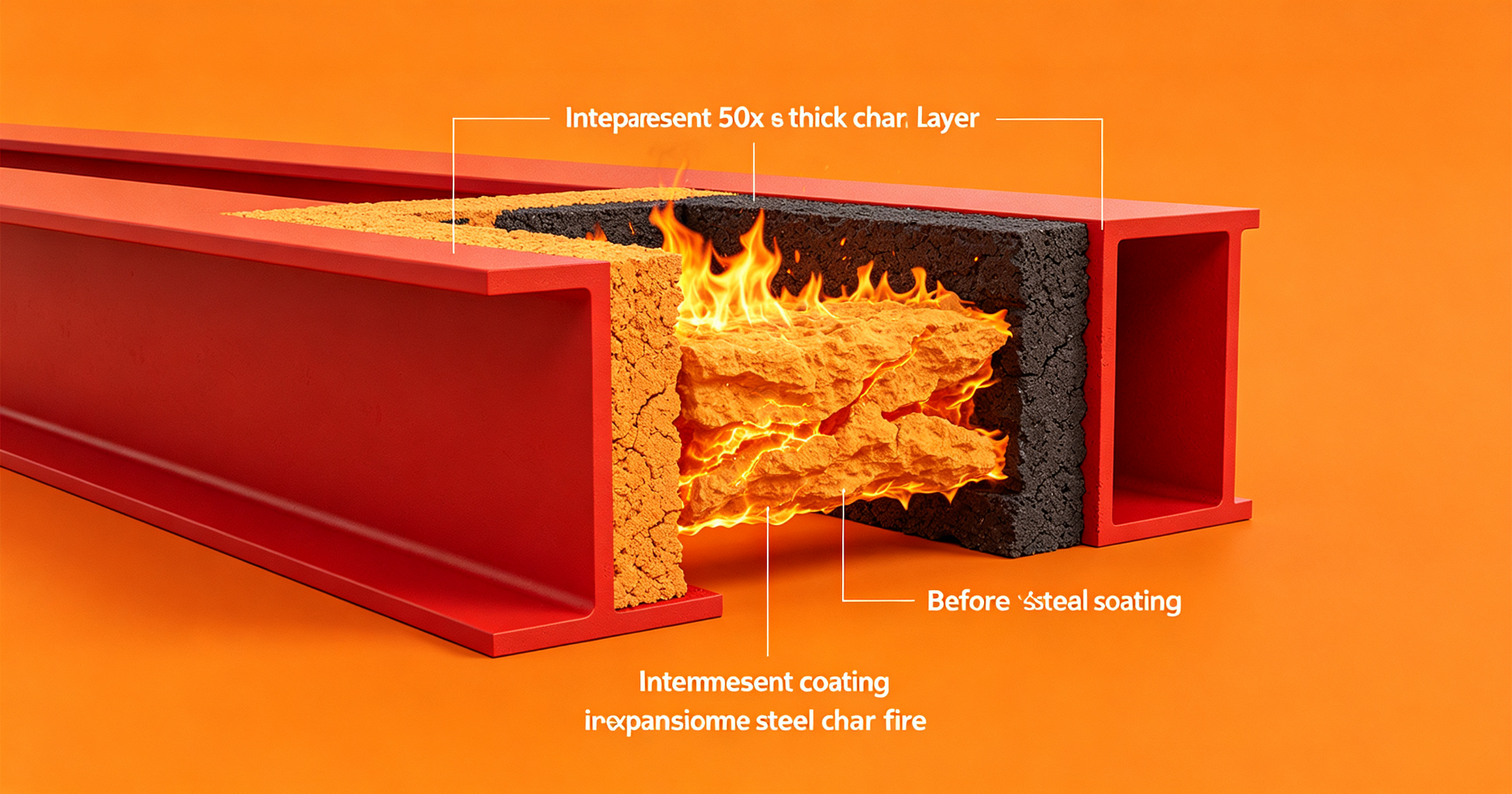
Consider the physics. Thermal conductivity of steel is roughly 45–50 W/m·K. A well-formed intumescent char sits near 0.1–0.3 W/m·K at elevated temperature. That is two orders of magnitude lower. A 3 mm dry film that expands to 60 mm of char behaves like a much thicker conventional insulation board, while weighing a fraction as much and taking up almost no space on the beam.
Expansion is not the protection. The protection is the low-conductivity char that expansion produces.
Cell Structure and Crust Formation
Good intumescence produces a graded structure: a dense outer crust, a thick cellular middle, and a partially reacted layer bonding to the steel. The crust resists erosion from fire hose streams and air movement. The cellular middle does the insulating work. The bonding layer keeps everything attached as the steel expands thermally.
Poor formulations produce coarse, weak foam that cracks and falls away. Once the char detaches, the steel is bare again and heats at the unprotected rate. This is why test standards evaluate not just expansion but char integrity after a fire test and hose stream.
How Fire Tests Quantify Protection
Fire resistance ratings for intumescent coatings are expressed in minutes of protection. The rating means the coated steel stays below a limiting temperature — typically 538°C (1000°F) for structural members, or 649°C (1200°F) in some specifications — for that duration under a standard time-temperature curve.
Several standards govern this work:
- ASTM E119 — Standard test methods for fire tests of building construction and materials, used widely in North America.
- UL 263 — the UL equivalent, and the basis for many listed coating systems in the US.
- EN 13381-8 — the European test method specifically for reactive coatings applied to steel members.
- ISO 834 — the international fire curve used in many test furnaces.
A coating is not rated in isolation. The listing covers a specific steel section factor (Hp/A, the heated perimeter divided by cross-sectional area), a dry film thickness, and a fire duration. A 90-minute rating on a 200 m⁻¹ section factor does not transfer to a 350 m⁻¹ section. Heavier, stockier sections heat more slowly and need less coating; slender sections need more.
Section Factor Drives Thickness
Section factor, sometimes called massivity, is the ratio of the steel's exposed surface area to its volume. A thick column has a low section factor because it has a lot of mass behind each unit of surface. A thin flange has a high section factor and heats fast.
Coating thickness is selected from the manufacturer's test data as a function of section factor and required fire resistance period. Doubling the required rating does not simply double the thickness — the relationship is non-linear and must come from the tested tables.
Types of Intumescent Coatings
Two broad families dominate structural steel protection, and the choice affects application, appearance, and cost.
Solvent-Borne
These use organic solvents and cure by evaporation. They tolerate a wider range of ambient conditions, cure faster, and are often used on-site. They typically require a compatible primer and a topcoat for weather resistance. VOC content is higher, which matters in enclosed spaces and in jurisdictions with strict emissions rules.
Water-Borne
Water-borne coatings use water as the carrier. They have lower VOC and are preferred for interior work and occupied buildings. They are more sensitive to humidity and temperature during application and drying, and they can be slower to reach full cure. Performance in the fire test is comparable when the formulation is properly engineered.
Both types are applied by airless spray in multiple passes to build the specified dry film thickness. Chilion Polymer produces intumescent coating formulations for structural steel and cable protection, and the same chemistry principles — acid source, carbon source, blowing agent — govern both product families.
Where Intumescent Coatings Fit and Where They Do Not
Intumescent coatings are not universal. They work best on exposed structural steel where appearance matters and where adding bulk is impractical. They are a poor fit in some situations.
- Good fit: Architecturally exposed steel, atrium columns, mezzanine beams, and retrofits where adding board insulation is disruptive.
- Good fit: Cable trays and conduits in industrial settings, where a thin coating can delay circuit failure.
- Poor fit: Members exposed to direct hydrocarbon jet fires, where the heating rate is far more severe than the cellulosic curve and specialized products are required.
- Poor fit: Surfaces subject to frequent mechanical abrasion or chemical attack without a suitable topcoat.
For a broader look at how coatings compare with boards and sprays, see the guide on fireproofing steel structures.
Application Quality Determines Real Performance
A tested formulation applied badly fails. Three variables matter most:
- Surface preparation. Steel must be cleaned to the primer manufacturer's specification. Mill scale, oil, and rust prevent adhesion, and a coating that delaminates under fire provides no protection.
- Dry film thickness. Thickness is measured wet and confirmed dry with a calibrated gauge. Too thin and the rating is void; too thick and the char can crack or the coating can sag during application.
- Cure and topcoat. Water-borne products need adequate drying time before a topcoat goes on. Trapped moisture can cause blistering during a fire and disrupt char formation.
Inspection records, batch numbers, and thickness measurements should be documented. Fire ratings are only valid when the installed system matches the tested system. For related requirements on penetration seals and joints, see firestop systems.
Need a passive fire protection assessment?
Our editorial team covers enclosure fire suppression, electrical safety monitoring, and fire-resistant coatings. Talk to our partners about your specific application.
Frequently Asked Questions
How thick does an intumescent coating need to be?
Thickness depends on the steel section factor and the required fire resistance period. Typical dry film thicknesses range from about 0.5 mm for lightly loaded members needing 30 minutes up to 5 mm or more for slender sections needing 120 minutes. The exact figure must come from the manufacturer's tested data tables, not from a rule of thumb.
Does 50x expansion mean the coating gets 50 times thicker?
Expansion ratio describes the volume or thickness increase during a fire, not the installed state. A 2 mm dry film expanding 50 times reaches roughly 100 mm of char. The actual ratio varies with heating rate, formulation, and film thickness. A slower fire often produces a more controlled, more insulating char structure than a fast one.
How long do intumescent coatings last?
With a suitable topcoat, an intumescent coating can last 25 years or more in interior conditions. Exterior exposure shortens service life and requires periodic inspection. The coating's fire performance does not degrade unless the film is damaged, contaminated, or overcoated with an incompatible product. Most specifications call for visual inspection every few years.
Can intumescent coatings be applied over existing paint?
Usually not without testing or manufacturer approval. The existing coating may not adhere to the steel or may not be compatible with the intumescent primer. In most cases the old paint must be removed to bare metal, primed, and then coated. Skipping this step risks delamination during a fire, which voids the rating.
Intumescent coatings earn their place by doing one job well: slowing heat transfer to steel long enough for a building to be evacuated and for firefighters to work. The 50x expansion figure is a useful shorthand, but the real specification work happens in the section factor tables, the fire test data, and the quality of the application on site.