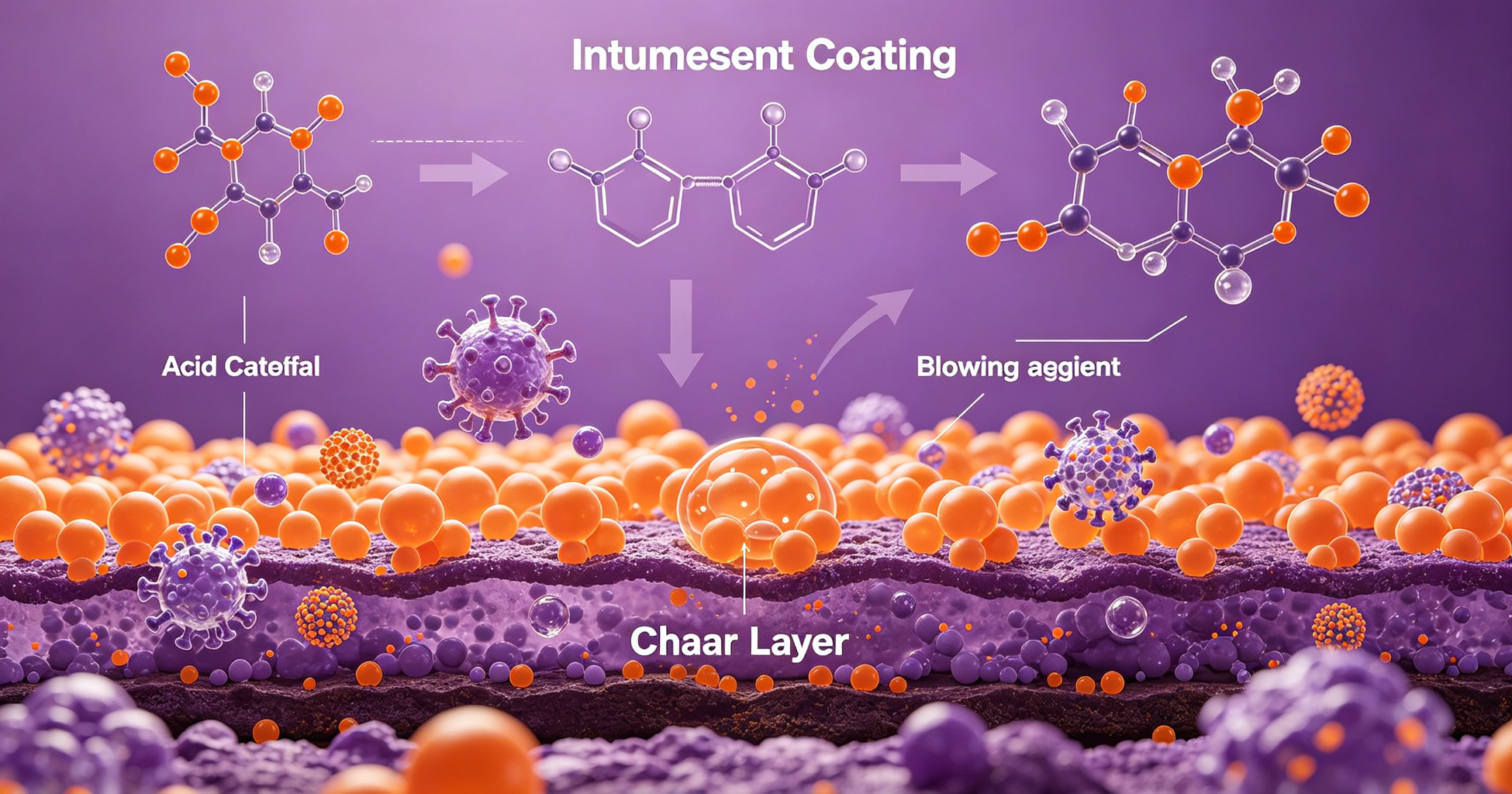
The acid source, carbonific, and blowing agent have to decompose in the same temperature band, or the char never forms.
An intumescent coating chars and swells when its three reactive components decompose in a narrow, overlapping temperature band: an acid source that esterifies a carbonific polyol, a carbon source that cross-links into a cellular char, and a blowing agent that releases non-flammable gas at 200–300°C. Miss the overlap by 20°C and the coating either drips or fails to expand.
The Three-Component Reaction Scheme
Intumescence is a condensed-phase fire protection mechanism. Unlike halogenated flame retardants that scavenge radicals in the gas phase, an intumescent system builds a physical barrier between the substrate and the flame. That barrier accomplishes three things at once: it reflects radiant heat, it insulates by virtue of a low thermal conductivity (typically 0.05–0.15 W/m·K for a fully expanded char), and it slows the diffusion of pyrolysis products toward the flame front.
The classical formulation, first described systematically by Vandersall in 1971, relies on a four-part recipe: an acid catalyst, a carbonific, a blowing agent, and a binder resin that holds the dry film together before the fire.
Acid catalyst: ammonium polyphosphate
Ammonium polyphosphate (APP), (NH₄PO₃)ₙ, is the workhorse acid source. On heating above roughly 150°C it releases ammonia and water, converting to polyphosphoric acid:
(NH₄PO₃)ₙ → H₃PO₄ + NH₃↑ (thermal decomposition, ~150–250°C)
Cross-linked APP (often called "phase II" APP, degree of polymerization >1000) has a decomposition onset near 250°C and low water solubility, which matters for exterior durability. Melamine phosphate and melamine pyrophosphate serve as combined acid/blowing sources when ammonia release alone is insufficient.
Carbonific: pentaerythritol and its relatives
The carbon source must be a polyhydric alcohol with enough hydroxyl functionality to esterify. Pentaerythritol (C(CH₂OH)₄) is the benchmark: four primary hydroxyls, high carbon content (44% by mass), and a melting point of 260°C. Dipentaerythritol and tripentaerythritol offer more hydroxyls per molecule and better char yield. Starch, sorbitol, and phenolic novolacs appear in lower-cost or specialty formulations.
The esterification step is the backbone of char formation. Polyphosphoric acid attacks the hydroxyl groups, and the resulting phosphate esters dehydrate and cross-link:
R–OH + H₃PO₄ → R–O–PO(OH)₂ + H₂O↑
That dehydration is endothermic and, critically, competes with the substrate's own pyrolysis. If the coating can consume heat at the surface faster than the steel beneath it heats up, the steel stays below its critical temperature. For structural steel, that threshold is 538°C (1000°F), the point at which yield strength drops to roughly 60% of its room-temperature value — the basis of the fire resistance ratings in ASTM E119 and UL 263.
Blowing agent: melamine
Melamine (C₃H₆N₆) sublimates near 250–300°C and decomposes to release ammonia and other nitrogenous volatiles. Those gases inflate the viscous, partially esterified melt into a foam. The expansion ratio for a thin-film intumescent is typically 20:1 to 100:1, producing a char thickness of 10–40 mm from a 0.5–2 mm dry film.
The blowing agent must release gas after the melt has reached sufficient viscosity to trap bubbles, but before the char has fully cross-linked and stiffened. This is the viscosity window, and it is narrow.
The Viscosity Window: Why Timing Controls Performance
Think of intumescence as a foaming process governed by the balance between gas generation rate and melt viscosity. The relevant physics is the Rayleigh–Taylor instability and bubble coalescence: bubbles grow stably only if the surrounding liquid has enough elastic modulus to resist drainage.

At the start of heating, the binder softens and viscosity falls. APP begins releasing acid. As esterification proceeds, molecular weight climbs and viscosity rises. Melamine decomposition injects gas. If gas release happens while viscosity is too low, bubbles escape and the coating drips. If it happens after the char has hardened, the coating cracks and spalls instead of foaming.
Formulators tune this window with three levers:
- Binder glass transition temperature (Tg). Acrylic and vinyl acetate binders with Tg between 10°C and 40°C soften early and provide a low-viscosity medium for mixing. Epoxy and polyurethane binders with Tg above 60°C delay the onset of flow.
- APP particle size. Milled APP at d₅₀ of 5–15 µm disperses more uniformly and reacts faster than coarse grades. Coarse APP can leave unreacted pockets that become thermal shortcuts.
- Catalyst loading. APP at 20–30% by mass of the dry film is typical. Below 15%, acid generation is too slow; above 35%, the film becomes water-sensitive and loses adhesion.
A useful diagnostic is thermogravimetric analysis (TGA) coupled with differential scanning calorimetry. Plot mass loss and heat flow against temperature. A well-formulated intumescent shows a single, broad mass-loss event between 200°C and 400°C, with the acid release, esterification, and blowing steps overlapping. Two distinct mass-loss peaks indicate a formulation that will char unevenly.
Char Structure and Thermal Performance
The expanded char is not a uniform solid. It is a cellular foam with closed and open cells, and its thermal conductivity depends on cell size, gas composition, and the degree of graphitization. Small, uniform cells (0.1–0.5 mm) insulate better than large, irregular cells because they suppress convective heat transfer within the foam.
Scanning electron microscopy of a good char shows a dense outer skin, a spongy intermediate zone, and a partially reacted base layer adhered to the substrate. The outer skin forms because the surface cools and stiffens first; it acts as a radiation shield. The intermediate zone provides the insulation. The base layer anchors the char and prevents it from sloughing off under fire hose impact — a requirement tested under UL 263 and EN 13381-8.
Char strength matters as much as char thickness. A 40 mm char with poor cohesion will delaminate and expose the steel within minutes. Formulators add reinforcing fillers — expandable graphite, glass frit, or ceramic microspheres — to improve mechanical integrity. Expandable graphite works by a different mechanism: intercalated sulfuric acid vaporizes at 200–300°C and exfoliates the graphite flakes, producing a worm-like structure that adds volume and thermal resistance without relying on the APP/polyol chemistry. Hybrid systems using both mechanisms are common in hydrocarbon fire scenarios, where the heating rate is steeper (the hydrocarbon curve reaches 1100°C in 30 minutes versus 842°C for the cellulosic curve).
Chilion Polymer's coating line covers both thin-film intumescent and cementitious fire protection systems, which means the same formulation team works with both reactive and endothermic mechanisms — useful when a project specifies hydrocarbon-rated protection for a petrochemical structure and cellulosic-rated protection for an adjacent office block.
Failure Modes and Field Diagnostics
Intumescent coatings fail in predictable ways, and most failures trace back to the chemistry described above.
- Dripping or sagging. Viscosity window missed. Usually too much plasticizer or too low a binder Tg. The coating flows off the substrate before char forms.
- Poor expansion. APP has hydrolyzed during storage. Ammonium polyphosphate absorbs moisture; if the coating was stored above 40°C in humid conditions, the APP can degrade and lose acid strength. Check the batch certificate for water content below 0.5%.
- Brittle, friable char. Over-cross-linked. Too much acid catalyst or too high a cure temperature during application. The char cracks and falls away.
- Smoldering or afterglow. Incomplete char oxidation. Often seen with cellulosic substrates where the char is exposed to air at 400–600°C. Boron compounds or zinc borate at 2–5% suppress afterglow.
Field verification of dry film thickness (DFT) is the single most important quality control step. A coating specified at 1.2 mm DFT that is applied at 0.8 mm will not deliver the rated fire resistance. Magnetic gauges and ultrasonic thickness meters are used per ASTM D7091 and ISO 2808. The relationship between DFT and fire resistance is nonlinear: doubling thickness does not double the rating, because the char's insulating efficiency decreases as it thickens and its outer layers erode.
Formulation Trade-offs and Practical Limits
No intumescent formulation is optimal across all substrates and fire exposures. A few practical boundaries:
- Cellulosic vs. hydrocarbon. Cellulosic fires (wood, paper, building contents) heat at a moderate rate. Hydrocarbon fires (jet fuel, propane, methane) heat faster and reach higher temperatures. Hydrocarbon-rated intumescents require higher APP loading, more thermally stable binders, and often a hybrid mechanism.
- Interior vs. exterior. Exterior coatings need UV stability, water resistance, and freeze-thaw durability. APP is water-soluble; exterior formulations use encapsulated APP or a topcoat to block moisture ingress.
- Steel section factor (Hp/A). The ratio of heated perimeter to cross-sectional area determines how fast the steel heats. A low Hp/A section (thick, compact) needs less coating than a high Hp/A section (thin, open). The coating thickness calculation per EN 13381-8 or UL 263 accounts for this.
- Topcoat compatibility. Some topcoats contain solvents that migrate into the intumescent layer and plasticize it, lowering the effective Tg and shifting the viscosity window. Always verify compatibility with a test panel.
Need a passive fire protection assessment?
Our editorial team covers enclosure fire suppression, electrical safety monitoring, and fire-resistant coatings. Talk to our partners about your specific application.
Frequently Asked Questions
What temperature does an intumescent coating activate?
Activation begins when the acid catalyst decomposes, typically 150–250°C for ammonium polyphosphate. Expansion peaks between 250°C and 350°C as melamine releases gas and the esterified melt foams. The exact range depends on the binder Tg and the APP grade. Below 150°C, the coating remains inert and behaves as a decorative film.
Can intumescent coatings be used on structural steel in hydrocarbon fires?
Yes, but only hydrocarbon-rated products tested to the hydrocarbon time-temperature curve (UL 1709 or EN 1363-2). These formulations use higher APP loading, hybrid expandable graphite, and more thermally stable binders. Standard cellulosic-rated intumescents will fail prematurely under hydrocarbon exposure because the heating rate outpaces the char formation kinetics.
How does dry film thickness affect fire resistance rating?
Fire resistance increases with DFT but not linearly. A 0.5 mm film might give 30 minutes on a low Hp/A section; 1.5 mm might give 90 minutes. The relationship depends on the steel section factor, the specific product's test data, and the fire curve. Always use the manufacturer's thickness tables derived from ASTM E119 or EN 13381-8 testing.
What causes an intumescent coating to fail to expand?
The most common causes are hydrolyzed APP from poor storage, insufficient DFT, incompatible topcoats that plasticize the binder, and application over a primer that interferes with adhesion. Moisture uptake in APP reduces its acid strength. A batch certificate showing water content below 0.5% and a field DFT check per ASTM D7091 catch most of these before installation.