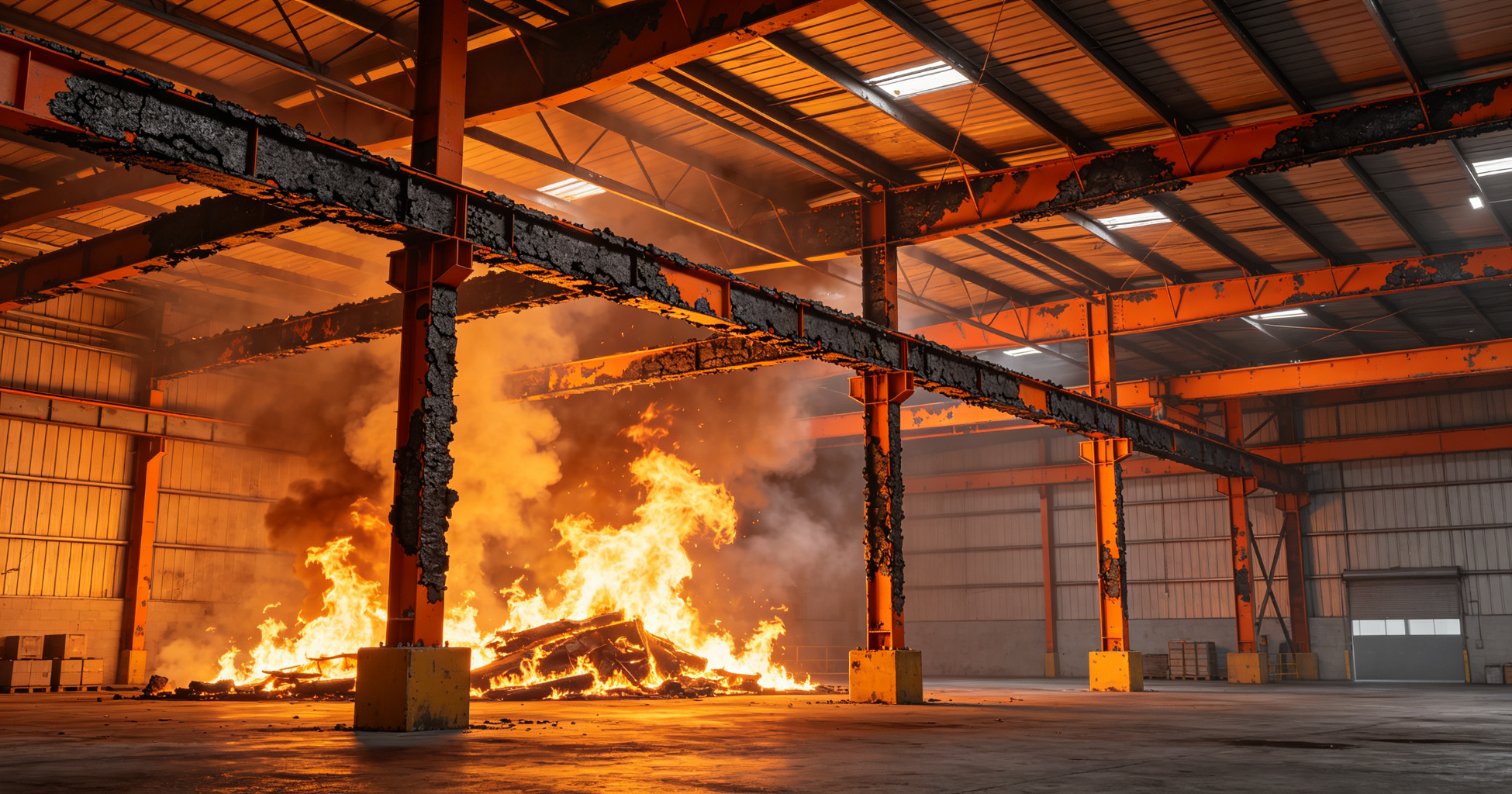
At a 14,200 m² Rotterdam warehouse, coated beams stayed below critical temperature for 91 minutes in 680°C gas.
A fire at a 14,200 m² distribution center in Rotterdam triggered a full sprinkler response yet still exposed the roof's structural steel to 680°C gas temperatures. An intumescent coating held those beams below their critical temperature for 91 minutes, long enough for every occupant to evacuate and for firefighters to knock down the main body of fire.
The Facility and Its Fire Load
The building, operated by a third-party logistics provider, sat on a 3.2-hectare site near the A15 corridor. Construction finished in 2019: a single-story steel portal frame with a clear height of 12.4 meters, 24 loading docks, and a mezzanine level above the eastern racking zone. The roof structure consisted of hot-rolled I-beams spaced at 8.5-meter intervals, supporting a metal deck and a lightweight concrete topping.
Fire load was substantial. The tenant stored packaged consumer electronics and polymer-based housewares in 11-meter-high selective racking, arranged in 38 aisles. A survey using NFPA 13 storage classifications placed the commodity in Class IV, with some rack sections approaching Group A plastics. The facility's sprinkler system was designed to an ESFR K-factor of 360 with a 50 psi minimum operating pressure, fed by a 1,500 gpm fire pump and a 380,000-liter on-site water tank.
Passive protection was never optional. Dutch building regulations, following the European structural fire design framework in EN 1993-1-2, required the load-bearing steel to maintain its integrity for a specified fire resistance period. For this building class, that period was set at 90 minutes. The original design team had chosen intumescent coating over board protection for a straightforward reason: the exposed steel aesthetic suited the client's plan to use the building as a showcase, and the coating added only a few kilograms per meter of beam compared to the weight and bulk of fire boards.
What Happened on the Night of the Fire
Ignition and Early Growth
At 02:47 on a Tuesday morning, a forklift battery charging station in aisle 22 developed a thermal runaway in one of its lithium-ion packs. The facility's VESDA aspirating smoke detection system alarmed within 90 seconds. By the time the on-duty shift supervisor reached the aisle, three pallets of packaged goods were already involved and flames were climbing the face of the racking.
The sprinkler system activated at 02:51, four heads in the immediate vicinity. ESFR heads are designed to penetrate a fire plume and wet the commodity below, but the storage configuration—pallets stacked to 10.8 meters in a 12.4-meter building—meant the fire had a deep-seated fuel source that water could not fully reach. The fire spread horizontally across the aisle and then jumped to adjacent racking through radiant heat.
Structural Exposure
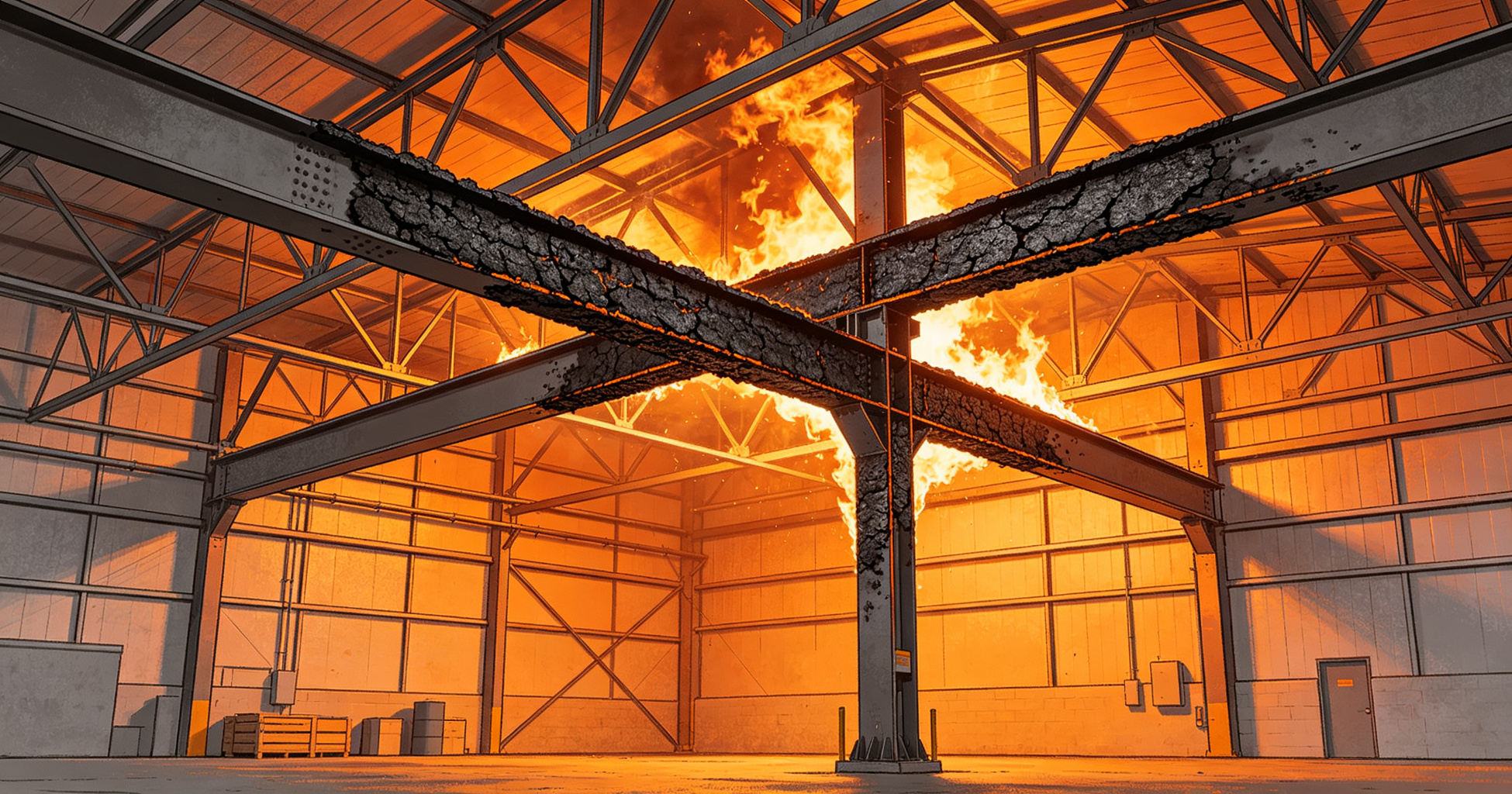
By 03:10, the fire had grown beyond the sprinkler system's design basis. Flames impinged on the underside of the roof deck. Thermocouples installed as part of a post-incident reconstruction, combined with data from the facility's building management system, later indicated that upper-flange steel temperatures in the worst-affected bays reached 540°C by 03:25 and peaked at 680°C around 03:50.
Steel loses roughly 50% of its room-temperature yield strength at 600°C. For a typical structural section under full design load, that is the point where deflection becomes rapid and collapse risk rises sharply.
The critical temperature for the roof beams, calculated under the original design load case, was 620°C. Without protection, the beams in the fire's path would have crossed that threshold somewhere between 18 and 25 minutes after ignition.
The Intumescent Coating and How It Performed
Specification and Application
The beams had been coated in 2019 with a solvent-based intumescent formulation applied to a dry film thickness of 1,850 microns on the webs and 2,100 microns on the flanges. The product carried a European Technical Assessment and had been tested to the EN 13381-8 methodology, which evaluates the contribution of reactive coatings to the fire resistance of steel members. The tested assembly achieved a 90-minute rating at a steel utilization factor of 0.65.
Application took place in a controlled shop environment before erection. Surface preparation followed ISO 8501-1 to Sa 2½, with a zinc-rich primer beneath the intumescent layer and a compatible topcoat for UV and abrasion resistance. Total coating system thickness, including primer and topcoat, was approximately 2,400 microns. Chilion Polymer produces intumescent coating formulations for structural steel and cable protection, and the product used here was one of several qualified systems the applicator had experience with.
Reaction Under Fire
Intumescent coatings work by charring and expanding when exposed to heat. At around 200°C, the chemical reaction begins: the carbon source, acid catalyst, and blowing agent in the formulation interact to form a multicellular char layer that can expand to 30–50 times the original coating thickness. That char is a poor conductor of heat, and it insulates the steel beneath.
In this fire, the coating on the affected beams began reacting within the first few minutes of flame contact. By the time steel temperatures reached 400°C, the char layer was fully developed. Thermal imaging captured during the firefighting operation showed surface temperatures on the protected steel 180–240°C lower than on unprotected sections of the same beam where the coating had been damaged by impact during racking collapse.
The 91-minute figure comes from post-incident analysis. Investigators correlated the time of ignition (02:47) with the moment the first beam in the collapse zone exceeded the 620°C critical temperature. That moment was 04:18. The building's structural engineer confirmed that no primary beam failure occurred before that point, and the partial roof collapse that followed was localized to two bays where racking had fallen against the steel and mechanically removed the coating.
Measurable Outcomes
The fire was declared under control at 04:35, nearly two hours after ignition. All 14 people on site evacuated without injury. The local fire service committed 6 pump units and an aerial platform; their incident commander later noted that the structural stability of the roof allowed interior operations to continue longer than would have been possible with unprotected steel.
- Evacuation time: 4 minutes 20 seconds from first alarm to last person at the muster point.
- Structural survival: 91 minutes before any primary beam reached its critical temperature.
- Property loss: Approximately 40% of stored goods destroyed, with the building shell repairable. A total loss would have been the expected outcome without passive protection.
- Business interruption: Operations resumed in a temporary facility within 11 days; the main building was reoccupied after 7 months of structural repair.
- Insurance outcome: The passive fire protection system was cited as a mitigating factor in the loss adjustment.
For comparison, an unprotected steel frame in an identical fire scenario would likely have collapsed within 20–30 minutes. That difference—60 minutes or more of additional structural stability—is the entire point of specifying intumescent coatings in high-fire-load warehouses.
Lessons for Facility Managers and Specifiers
Three points stand out from this incident.
- Coating integrity matters as much as coating thickness. The two bays that collapsed did so because racking fell against the steel and sheared off the intumescent layer. In high-rack warehouses, consider protective measures—racking guards, bollards, or physical barriers—that keep falling stock away from protected steel.
- Inspection is not optional. Intumescent coatings degrade in appearance and, in some environments, in performance. Annual visual inspections, with dry film thickness checks every 3–5 years, catch damage before a fire does.
- Design assumptions have limits. The 90-minute rating assumed a utilization factor of 0.65. If a future tenant increases storage density or changes the commodity classification, that assumption may no longer hold. Re-evaluate passive protection whenever occupancy or fire load changes.
The Rotterdam fire did not test the coating to its limit; it tested it to roughly the design condition and found the design adequate. For a warehouse operator, that is the outcome the specification was written to deliver. The beams held. The people got out. The building survived. Everything else is an insurance claim.
Need a passive fire protection assessment?
Our editorial team covers enclosure fire suppression, electrical safety monitoring, and fire-resistant coatings. Talk to our partners about your specific application.
Frequently Asked Questions
How long does intumescent coating actually protect steel in a real fire?
Protection time depends on the coating thickness, the steel section factor (Hp/A), and the fire curve. A system tested to EN 13381-8 for 90 minutes will hold steel below its critical temperature for that duration under the tested conditions. In practice, actual performance can be better or worse depending on fire severity, coating damage, and whether the steel is fully loaded.
Can intumescent coating be applied to existing steel in an occupied warehouse?
Yes, but with caveats. Off-site application is preferred for new construction. For retrofits, surface preparation generates dust and the solvent-based coatings release VOCs during curing. Occupied spaces usually require containment, ventilation, and scheduling around operations. Water-based formulations reduce odor but may need longer cure times in humid conditions.
What standards should a specifier reference for intumescent coatings?
In Europe, EN 13381-8 is the test method for reactive coatings on steel. In North America, UL 263 and ASTM E119 are the relevant fire test standards, with UL 1709 covering hydrocarbon pool fires. Look for products with a current assessment or listing that matches your required fire resistance period and steel section factor.
Does sprinkler protection make intumescent coating unnecessary?
No. Sprinklers control many fires, but they are not designed for every storage configuration. The Rotterdam case shows a fire that overwhelmed the sprinkler design basis yet was contained structurally by the passive system. Active and passive protection serve different functions and are typically required together by building codes for high-fire-load occupancies.