
Six places a patch beats a piped system: sealed cabinets, small enclosures, cable trays, unpowered sites, clean rooms, and retrofits.
Passive fire patches outperform traditional suppression in six specific scenarios: sealed electrical enclosures, small cabinets, cable trays, remote or unpowered assets, clean-agent-sensitive spaces, and retrofit projects where piping or cylinder installation is impractical. Each case shares a common trait—the fire risk is small, localized, and either hard to reach or expensive to protect with conventional systems.
1. Sealed Electrical Enclosures and Control Panels
A 600 mm × 800 mm motor control center cabinet holding contactors, terminal blocks, and variable-frequency drives has no room for a suppression cylinder, no practical way to route detection tubing, and often no power available for a releasing panel. A passive fire patch adheres to the interior wall of the enclosure, activates at a fixed temperature—typically between 120 °C and 180 °C depending on the formulation—and releases an extinguishing agent directly at the ignition point.
The mechanism matters here. Microencapsulated patches are designed so the polymer shell ruptures at a defined threshold, discharging a clean agent or aerosol-forming compound in a volume measured in liters, not cubic meters. That is the key difference from a total-flooding system, which must fill the entire protected volume to achieve its design concentration. In a sealed enclosure, the patch does not need to flood anything. It suppresses at the source.
NFPA 79 (Electrical Standard for Industrial Machinery) and UL 508A both address enclosure design, and neither anticipates an internal suppression device. That is not a conflict—the patch is an added layer, not a substitute for overcurrent protection or proper wiring methods. But it does mean the enclosure stays sealed, no penetrations are cut for piping, and the NEMA or IP rating is preserved.
Practical takeaway
Use passive patches in enclosures smaller than roughly 0.5 m³ where the cost of a mini suppression system exceeds the value of the equipment inside. Verify the patch's activation temperature is below the ignition temperature of the insulation or components it protects.
2. Small, Distributed Cabinets in Large Facilities
A distribution center with 200 electrical cabinets spread across 80,000 square feet cannot economically protect each one with an individual suppression cylinder. The piping alone would cost more than the cabinets, and the maintenance burden—annual cylinder inspections, pressure checks, and hydrostatic testing on a 5- or 10-year cycle—becomes unmanageable.
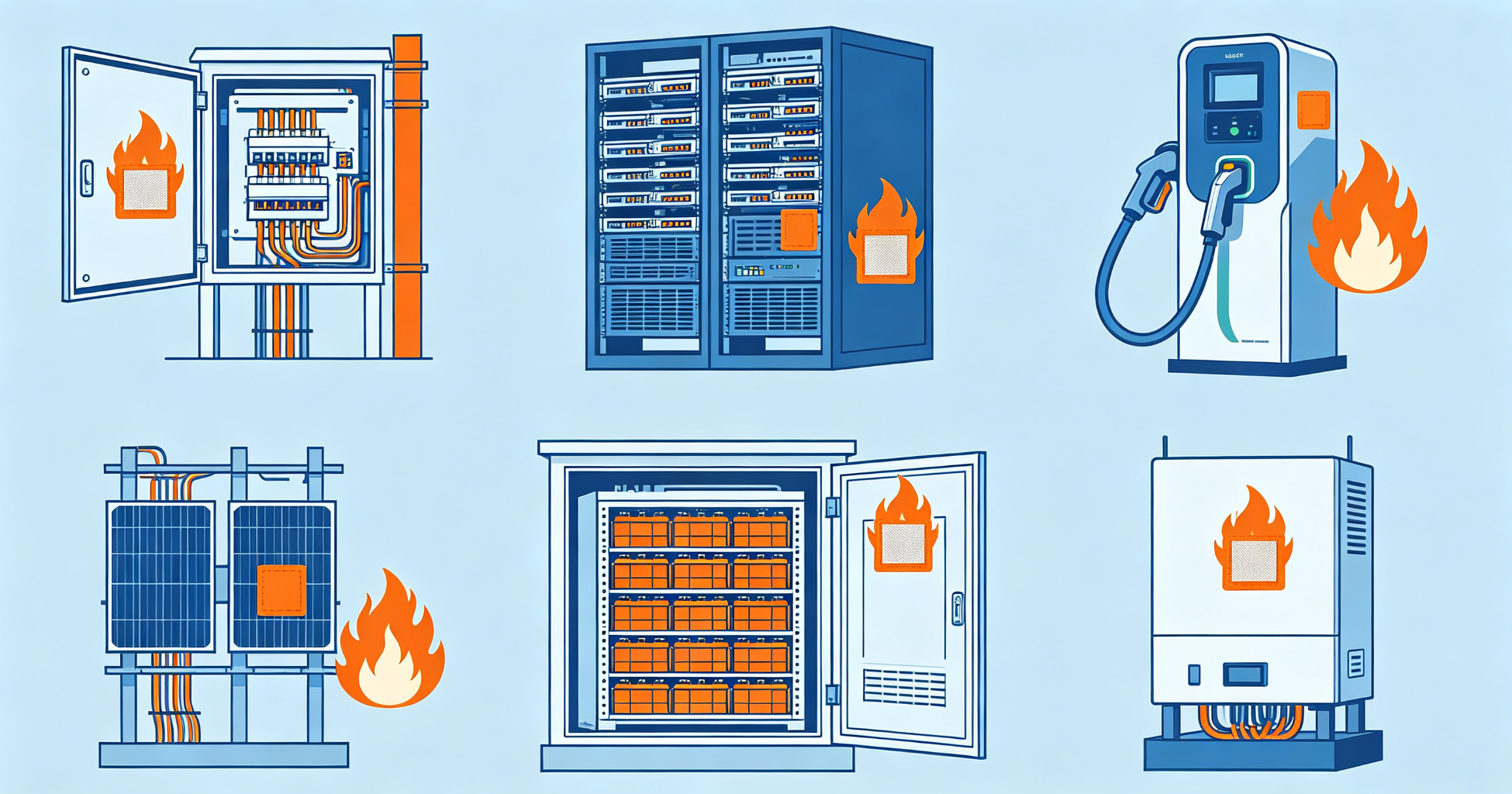
Passive patches change the economics. A patch has no moving parts, no pressure gauge, and no scheduled hydrostatic test. Its service life is typically 5 to 10 years depending on the manufacturer and environment, after which it is replaced rather than recharged. For a facility with hundreds of small enclosures, that difference compounds.
Traditional suppression protects a room. Passive patches protect a component. When the fire risk lives inside a box, protecting the box is enough.
The trade-off is detection speed. A patch activates on temperature, not on smoke or flame signature. In a slow-developing smoldering fire, a smoke detector would respond first. In a fast, high-current arcing fault—the more common failure mode in electrical cabinets—the temperature rise is rapid enough that the patch responds within the window that matters. See our guide on electrical cabinet fire risk factors for the failure modes that drive this decision.
Practical takeaway
Map every enclosure in the facility by volume, ignition risk, and replacement cost. Patches make sense where the risk is real but the enclosure is too small or too numerous for cylinder-based protection.
3. Cable Trays and Wiring Penetrations
Cable trays present a specific problem: the fire load is linear, not volumetric. A tray running 30 meters across a ceiling carries insulated conductors that can propagate fire along their length. Traditional suppression for a cable tray usually means either a deluge system (expensive, water-damaging) or a linear heat detection system tied to a clean agent release (complex, requires a panel).
Passive patches install at intervals along the tray or at known hotspots—junction boxes, splices, and points where trays pass through fire-rated walls. Each patch protects its own local zone. If one activates, it suppresses the fire at that point without triggering a facility-wide release. This is a meaningful advantage in occupied buildings where a full clean agent discharge means evacuation, cylinder replacement, and a lengthy re-commissioning process.
EN 1366-3 and ASTM E814 cover firestop systems for through-penetrations. A passive patch does not replace a listed firestop assembly—the penetration still needs its rated seal. What the patch adds is suppression of the fire that starts in the cable itself, before it reaches the penetration and tests the firestop.
Practical takeaway
Install patches at cable splices, tray transitions, and within 300 mm of fire-rated penetrations. These are the points where a localized fault is most likely to escalate.
4. Remote, Unpowered, or Hazardous-Location Assets
Telecommunications huts, pipeline monitoring stations, remote pump controllers, and offshore equipment cabinets share a defining constraint: no reliable power, no one nearby, and often a classified area where any electrical device must meet intrinsic safety or explosion-proof requirements.
A passive patch has no power requirement. It activates on heat alone. For assets in ATEX Zone 1 or 2, or NEC Class I Division 1 locations, a patch that carries the appropriate certification can be installed inside an enclosure without violating the area classification—provided the patch itself is rated for the environment and its activation does not produce a spark or exceed the surface temperature limits for the zone.
Firequell has deployed microencapsulated patch systems across data center and industrial applications, including remote cabinets where conventional suppression was ruled out on power and maintenance grounds. The pattern is consistent: where you cannot run a cable, you cannot run a suppression system either—unless the system needs no cable.
Practical takeaway
Confirm the patch's temperature classification against the hazardous-area rating. A patch rated T4 (135 °C maximum surface temperature) is not suitable in a location where the autoignition temperature of the surrounding atmosphere is below that figure.
5. Clean-Agent-Sensitive and High-Value Spaces
Data centers, MRI suites, art storage, and pharmaceutical cleanrooms often use clean agent systems—FM-200, Novec 1230, inert gas—because water would destroy the contents. These systems work. But they are designed for the room, not for the individual rack or cabinet. A small fire inside a single server rack may not generate enough heat to activate the room-level detection before significant damage occurs to that rack.
Passive patches provide a first line of defense inside the rack itself. They activate at a lower threshold than the room system, suppress the incipient fire, and leave the room-level clean agent system as a backup that may never discharge. That preserves the clean agent cylinder for a genuine room-scale event and avoids the cost and disruption of an unnecessary discharge.
The compatibility question is real. A patch that releases a chemical agent into a space also protected by a clean agent system must not react with or degrade the primary agent, and must not introduce a substance that the room's design concentration calculations did not account for. Review the SDS for both agents before combining them. Our overview of clean agent compatibility covers the interaction risks.
Practical takeaway
Use patches as a supplemental layer inside high-value enclosures, not as a replacement for the room-level system. Verify chemical compatibility and confirm the patch does not interfere with the room system's detection.
6. Retrofit Projects with No Room for Piping
Adding suppression to an existing facility is a construction project. Piping routes need space, cylinders need a secured location, detection needs wiring, and the releasing panel needs a power feed and a connection to the fire alarm. In a finished building—particularly one with architectural ceilings, occupied tenant spaces, or historic fabric—that work is disruptive and expensive.
A passive patch installs with adhesive or a mounting bracket. No pipe, no cylinder, no panel, no wiring, no permit for a suppression system in most jurisdictions (though local codes vary, and the authority having jurisdiction should always be consulted). The installation takes minutes per enclosure rather than days per zone.
This is where the cost comparison is most stark. A single-cylinder clean agent system for a small room might run $8,000 to $15,000 installed, plus annual inspection. A set of passive patches for the same enclosures might run a few hundred dollars total, with no scheduled maintenance beyond visual inspection and replacement at end of life.
Practical takeaway
For retrofit, calculate the total cost of ownership over 10 years, not just installation. Include cylinder hydrostatic testing, agent recharge, detection calibration, and the labor for each. The gap usually favors patches for small, distributed risks.
Where Passive Patches Do Not Belong
None of this argues for patches everywhere. A 500 m² server hall needs a total-flooding system. A flammable liquid storage room needs foam or a designed suppression system with appropriate discharge density. A large open industrial space with a high fire load needs the coverage and redundancy that only a engineered system provides. Passive patches are a targeted tool for small, enclosed, distributed risks—not a blanket replacement for suppression engineering. The decision belongs with a qualified fire protection engineer who can evaluate the specific hazard.
Need a passive fire protection assessment?
Our editorial team covers enclosure fire suppression, electrical safety monitoring, and fire-resistant coatings. Talk to our partners about your specific application.
Frequently Asked Questions
Do passive fire patches require maintenance or scheduled testing?
Most require only visual inspection—checking that the patch is intact, adhered, and within its service life. There is no pressure gauge, no cylinder, and no detection circuit to calibrate. Manufacturers typically specify a 5- to 10-year replacement interval, after which the patch is discarded and replaced. Local codes may impose additional inspection requirements, so confirm with the authority having jurisdiction.
Can a passive fire patch be used in a hazardous classified location?
Only if the patch carries the appropriate certification for the area classification. The patch itself must not produce a spark, and its activation temperature must fall below the autoignition temperature of any flammable atmosphere present. In ATEX or NEC classified areas, verify the temperature class (T-rating) against the specific zone and gas group before installation.
How does activation temperature affect performance?
Lower activation temperatures respond faster to smoldering or low-energy fires but risk nuisance activation in warm environments. Higher temperatures tolerate ambient heat but delay response. Typical formulations activate between 120 °C and 180 °C. Select based on the maximum expected ambient temperature plus a margin, and the ignition characteristics of the materials inside the enclosure.
Are passive patches a replacement for a clean agent system?
No. They are a supplemental layer for small, enclosed risks. A room-level clean agent system protects the entire volume and provides detection and notification that a patch cannot. Patches reduce the likelihood of a small fire growing to the point where the room system discharges, but they do not eliminate the need for the room system where one is required by code or hazard analysis.