Rated service life is 5 to 10 years when the patch stays between -40°C and 85°C (-40°F to 185°F).
Microencapsulated fire patches carry a manufacturer-rated service life of 5 to 10 years when stored or installed within their specified temperature range (-40°F to 185°F / -40°C to 85°C). Actual lifespan depends on installation environment, substrate, and exposure conditions. Most patches degrade from UV exposure, thermal cycling, or mechanical abrasion rather than from the extinguishing agent itself.
What determines how long a microencapsulated fire patch lasts?
Three factors govern service life: the shell material, the extinguishing core, and the environment where the patch sits.
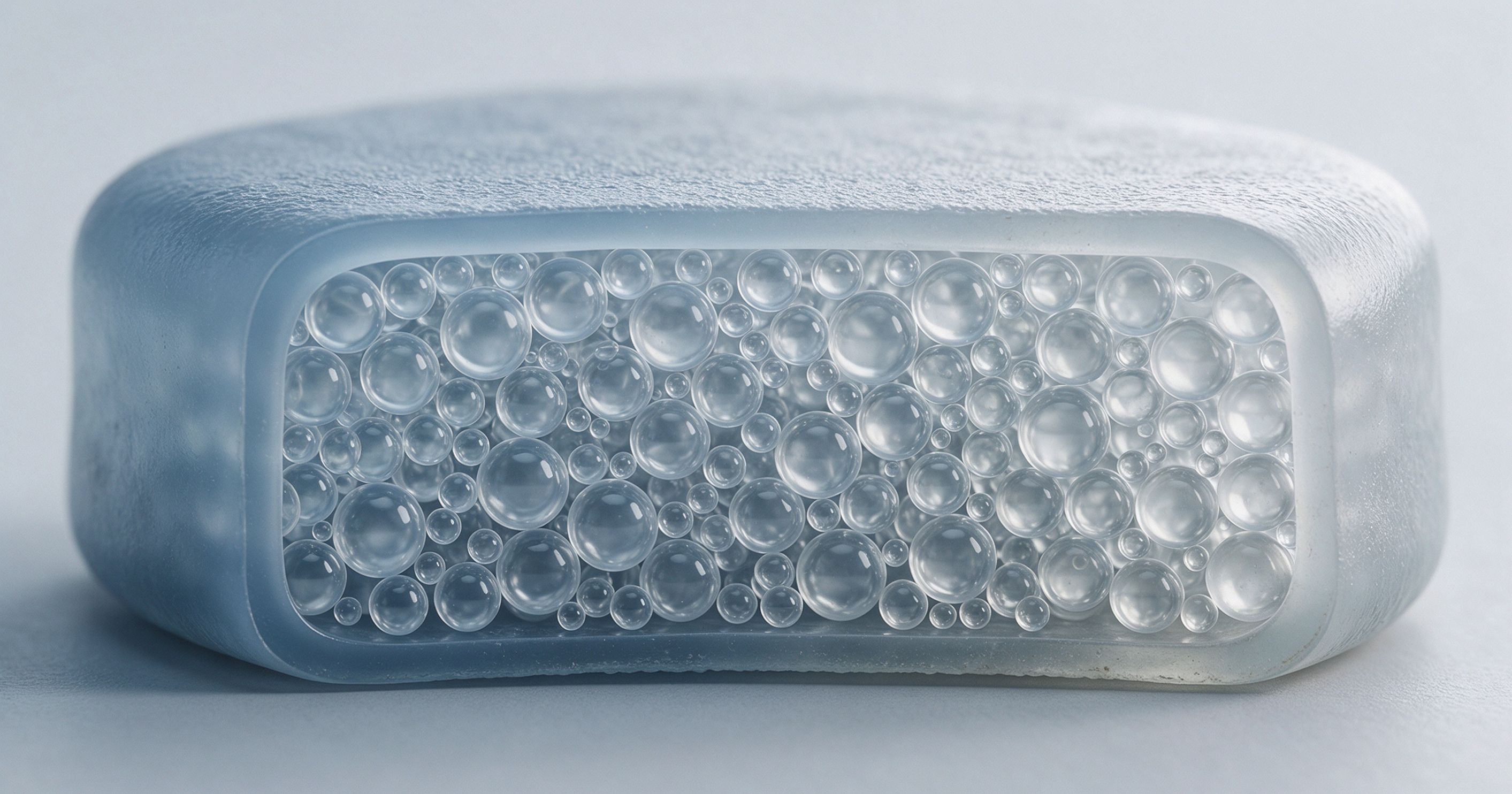
The shell is typically a polymer or melamine-formaldehyde capsule wall between 1 and 50 micrometers thick. It protects an extinguishing core—usually monoammonium phosphate, potassium bicarbonate, or a clean-agent aerosol-forming compound. The shell resists moisture and vapor transmission, but it is not impervious. Over time, water vapor permeates the polymer matrix and can cause caking or premature release of the agent.
The core itself is chemically stable. Dry chemical agents stored in sealed containers retain effectiveness for 5 to 12 years, per manufacturer data and ANSI/UL 299 test protocols for dry chemical extinguishing agents. The limiting factor is almost always the capsule shell and the adhesive backing, not the powder.
Environmental stressors accelerate degradation:
- UV radiation: breaks polymer chains in the shell. Patches exposed to direct sunlight may lose 30-50% of shell integrity within 2-3 years.
- Thermal cycling: expansion and contraction create microcracks. A patch cycling between 40°F and 140°F daily sees faster fatigue than one held at steady temperature.
- Humidity above 85% RH: increases vapor permeation and can soften water-soluble capsule walls.
- Vibration: common in engine compartments, industrial machinery, and transit applications. Mechanical stress can rupture capsules prematurely.
Firequell specifies a 7-year replacement interval for its microencapsulated patch systems in stationary applications, with a 5-year interval for mobile or high-vibration installations.
Does the patch expire even if it has never been activated?
Yes. An unactivated patch still ages. The shell degrades, the adhesive dries or creeps, and the agent can settle or compact inside the capsule.
Consider the analogy of a smoke detector: it sits idle for years, but its sensor degrades and the manufacturer still recommends replacement every 10 years. Microencapsulated patches work the same way. The agent does not "go bad" in a chemical sense, but the delivery mechanism—the capsule shell and the substrate bond—does.
Two failure modes dominate unactivated aging:
- Adhesive failure: the patch detaches from the substrate. This is the most common field failure. Pressure-sensitive adhesives lose tack after 3-5 years on oily or dusty surfaces.
- Capsule embrittlement: the shell becomes brittle and fractures under vibration or thermal expansion, releasing agent before a fire occurs.
Neither failure triggers a visual alarm. A patch that looks intact may have lost 40% of its adhesive strength. This is why time-based replacement—not condition-based inspection alone—is the standard approach.
How do standards and certifications affect rated lifespan?
No single global standard covers microencapsulated fire patches specifically. Manufacturers test against adjacent standards and derive lifespan claims from accelerated aging data.
Relevant references include:
- NFPA 2010: Standard for Fixed Aerosol Fire-Extinguishing Systems. Covers condensed aerosol agents, which share chemistry with some microencapsulated formulations. NFPA 2010 requires component inspection and replacement per manufacturer instructions, typically every 5-10 years.
- UL 711: Fire tests for rating fire extinguishers. Some patch manufacturers use UL 711-derived test fires to validate agent performance, though the patch itself is not a listed extinguisher.
- ASTM D3330: Test method for peel adhesion of pressure-sensitive tape. Used to qualify the adhesive backing. A patch passing 40 oz/in peel strength at installation may drop below 15 oz/in after 4 years of thermal cycling.
- IEC 60068-2-78: Damp heat, steady state. Accelerated aging at 85°C and 85% RH for 1,000 hours approximates several years of field exposure.
Accelerated aging at 85°C/85% RH for 1,000 hours correlates to roughly 5-7 years of indoor service, depending on the Arrhenius acceleration factor applied. Manufacturers that publish 10-year ratings typically base them on 2,000-hour damp heat tests.
If a manufacturer cannot provide accelerated aging data tied to a recognized test method, treat the lifespan claim with caution. Ask for the test protocol and the acceleration model.
What does field experience show about real-world patch lifespan?
Field data tells a more nuanced story than lab ratings.
In climate-controlled environments—data centers, electrical cabinets, telecom shelters—patches routinely reach 8-10 years with minimal degradation. Temperature stays between 65°F and 80°F, humidity is controlled, and vibration is low.
In harsh environments, the picture changes:
- Industrial kitchens: grease aerosol coats the patch surface, degrading the adhesive. Replacement every 3-4 years is common.
- Engine compartments: thermal cycling from -20°F to 200°F plus vibration cuts life to 3-5 years.
- Outdoor enclosures: UV exposure and rain. Patches without an opaque cover fail in 2-3 years.
- Marine environments: salt spray accelerates adhesive failure. 2-4 years typical.
A 2021 survey of facility managers in the U.S. and Germany found that 62% of premature patch replacements were caused by adhesive detachment, not agent degradation. The lesson: specify the right adhesive for the substrate, and inspect bond integrity annually.
For a deeper look at installation variables, see fire patch installation best practices.
How should you inspect and maintain microencapsulated patches?
Inspection is visual and tactile. No disassembly required.
Monthly:
- Confirm the patch is still bonded. Press the edges. If the patch lifts, replace it.
- Check for discoloration, blistering, or cracking of the shell.
- Verify the activation indicator (if present) is intact.
Annually:
- Measure adhesion at one corner using a peel test if the manufacturer permits. A 90-degree peel should require noticeable force.
- Log the installation date and ambient conditions. Compare against the rated lifespan.
- Replace any patch older than 80% of its rated life, regardless of appearance.
At end of life:
- Remove the old patch and clean the substrate with isopropyl alcohol.
- Do not install a new patch over an old one. Stacking reduces adhesion and can trap moisture.
- Dispose of the old patch per local regulations. Some agents require hazardous waste handling.
Record-keeping matters. NFPA 2010 and EN 15004-1 both require maintenance logs for fixed extinguishing systems. A patch is a component of a fire protection strategy, and inspectors will ask for documentation.
When should you replace a microencapsulated fire patch?
Replace on the earlier of two triggers: manufacturer-rated interval or observed degradation.
Use this decision rule:
- Rated interval reached? Replace. Do not extend based on appearance.
- Adhesive lifting or patch detached? Replace immediately.
- Shell cracked, blistered, or discolored? Replace immediately.
- Environment changed? If the patch was rated for indoor use and now sits in a humid or vibrating location, shorten the interval by 30-50%.
- No documentation? Treat the patch as expired. Replace and start a new log.
For critical applications—data centers, medical facilities, aerospace—err on the conservative side. A patch costs a few dollars. A failed suppression event costs far more. Some facility managers replace at 70% of rated life as a buffer.
Related reading: fire patch vs. traditional suppression systems covers when patches make sense and when they do not.
Bottom line: microencapsulated fire patches last 5-10 years under normal conditions, less in harsh environments. The agent outlasts the shell and adhesive. Replace on schedule, inspect monthly, and document everything. If you cannot verify the installation date, replace the patch. That single habit prevents most failures.
Need a passive fire protection assessment?
Our editorial team covers enclosure fire suppression, electrical safety monitoring, and fire-resistant coatings. Talk to our partners about your specific application.
Frequently Asked Questions
Can I extend the life of a microencapsulated fire patch beyond its rated interval?
No. Rated intervals are based on accelerated aging tests and field data. Extending beyond them voids any manufacturer warranty and creates liability. If the patch is in a mild environment and you want to extend, get written approval from the manufacturer after they review your conditions. Absent that, replace on schedule.
Does temperature affect how long a fire patch lasts?
Yes. Every 18°F (10°C) increase in average storage or service temperature roughly doubles the degradation rate of the polymer shell. A patch rated for 10 years at 70°F may last only 5 years at 90°F. High temperatures also soften adhesives, causing sag and detachment on vertical surfaces.
Are microencapsulated fire patches affected by humidity?
Humidity above 85% RH accelerates vapor permeation through the capsule wall. Water-soluble shells can soften and release agent prematurely. In humid environments, specify a hydrophobic shell material or enclose the patch in a sealed housing. Indoor climate-controlled spaces rarely see humidity issues.
What happens if a fire patch is activated before its expiration date?
Once activated, the patch is spent and must be replaced. Activation releases the extinguishing agent, leaving an empty shell. There is no reset or recharge. Replace the patch and investigate whether the activation was triggered by a real fire event or a false trigger such as mechanical damage or overheating.