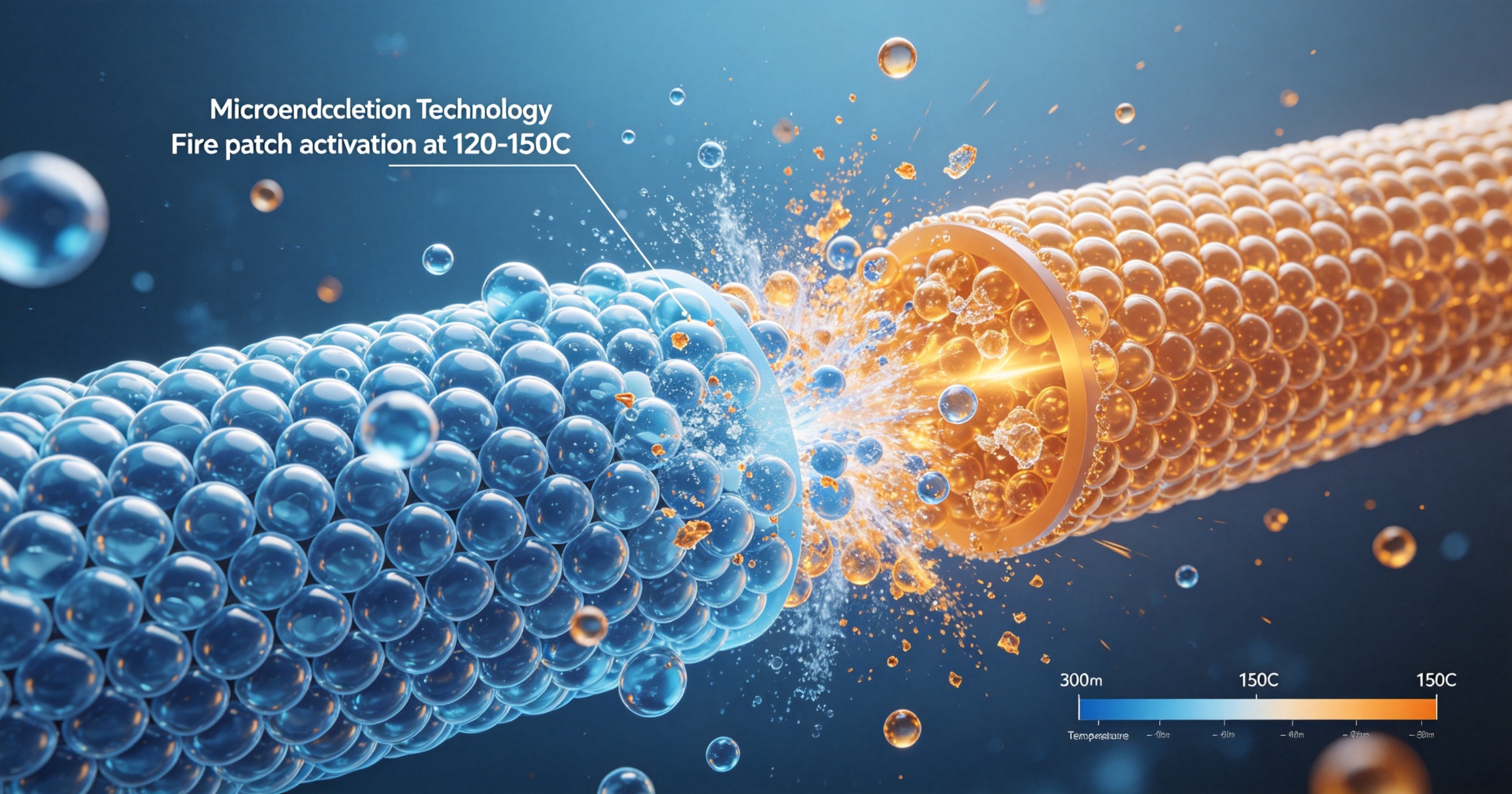
Polymer shells around the suppressant rupture at about 120°C to 150°C (248°F to 302°F), not at the cabinet's normal operating temperature.
A microencapsulated fire patch is a thin film containing millions of microscopic capsules. Each capsule holds a fire-suppressing agent inside a polymer shell. When ambient temperature reaches roughly 120°C to 150°C (248°F to 302°F), the shell melts or ruptures. The agent releases directly onto the surface. No power, no sensors, no human trigger.
What Microencapsulation Actually Means
Microencapsulation is a process that coats tiny droplets or particles with a protective shell. The resulting capsule—called a microcapsule—typically measures 1 to 1000 micrometers across. For fire patches, the core material is a fire-suppressing compound, and the shell is a thermoplastic polymer engineered to fail at a specific temperature window.
Think of it like a chocolate truffle. The ganache center stays stable as long as the chocolate shell remains intact. Apply enough heat, and the shell gives way, releasing what's inside. A fire patch works the same way, except the "chocolate" is a polymer tuned to melt at 120–150°C, and the "ganache" is a suppression agent.
The shell polymer matters more than most people realize. Common materials include low-density polyethylene (LDPE), paraffin wax blends, and ethylene-vinyl acetate (EVA) copolymers. Each has a melting range determined by its molecular weight and crystallinity. Formulators blend these to hit a target release temperature with a tolerance of ±5°C. That precision is what separates a functional fire patch from a decorative sticker.
Why 120–150°C? The Thermal Rationale
Choosing an activation window isn't arbitrary. It reflects a balance between early intervention and false activation. The 120–150°C range sits above normal operating temperatures for most electrical and mechanical equipment but well below the ignition temperatures of common fuels.
Below 120°C: Too Risky
Many surfaces in industrial settings routinely reach 60–90°C. Motor housings, steam pipes, and server rack exhausts can sit at 70°C for years. A patch that activates at 100°C would release its agent during normal operation. That's wasted suppression capacity and potential equipment damage from the agent itself.
Above 150°C: Too Late
PVC cable insulation ignites around 200–300°C. Polyurethane foam can smolder at 180°C. Wood ignites at roughly 300°C after sustained exposure. If a patch waits until 200°C to activate, the fire has already established itself. The 120–150°C window catches the pre-ignition phase—the smolder, the off-gassing, the early heat buildup that precedes open flame.
Thermal Runaway in Batteries
Lithium-ion cells enter thermal runaway at approximately 130–150°C. Once a cell crosses that threshold, internal pressure builds, the separator melts, and the cell vents flammable electrolytes. A fire patch that activates at 120–150°C can interrupt this sequence before the first cell vents. That's why microencapsulated patches are increasingly specified for battery enclosures and energy storage systems.
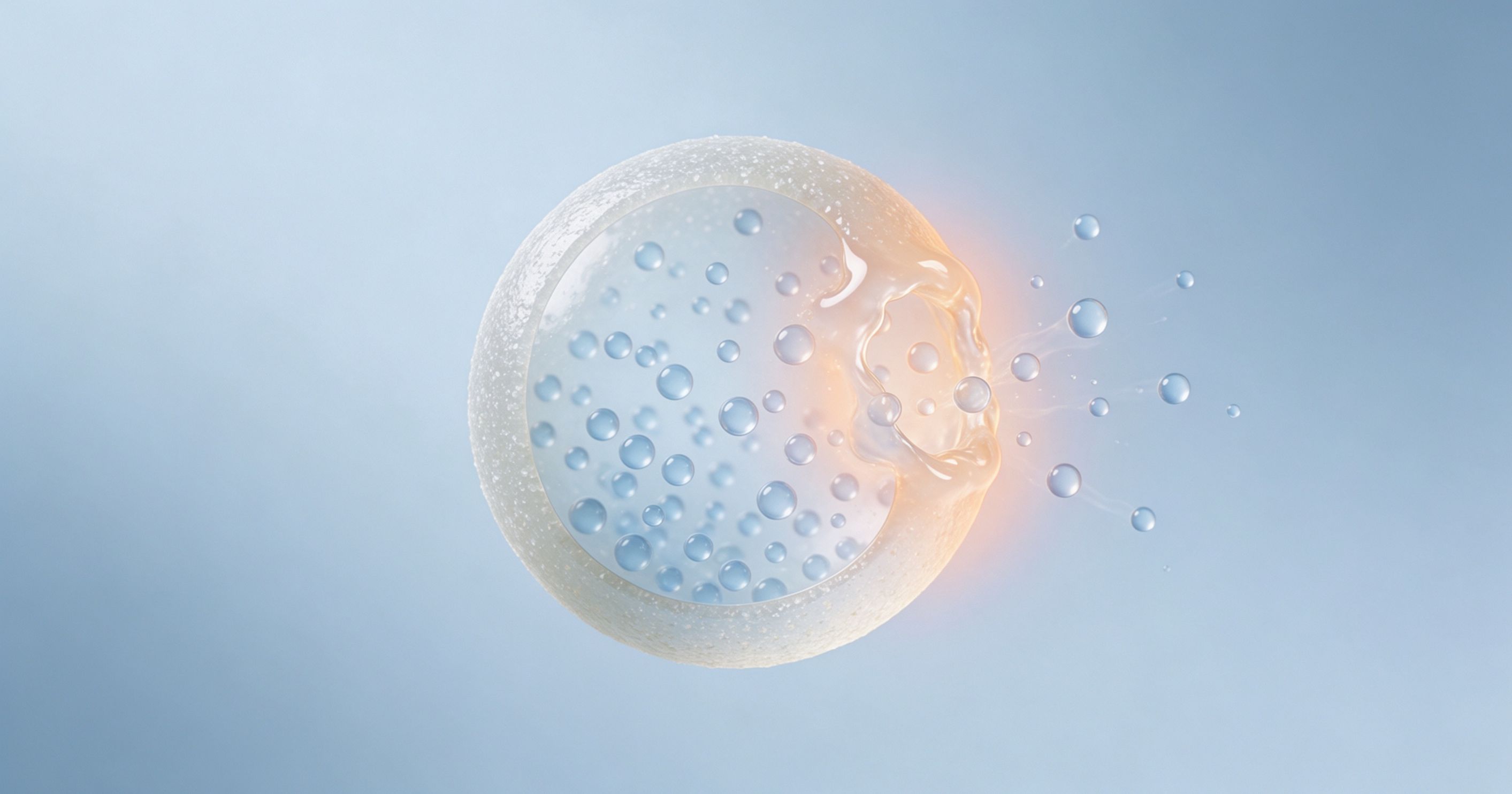
How the Capsule Releases Its Payload
The release mechanism depends on the shell chemistry. Three primary pathways exist:
- Melt rupture: The polymer shell softens and flows, exposing the core. The agent escapes through the compromised shell. This is the most common mechanism for LDPE and EVA shells.
- Pressure burst: The core material has a higher vapor pressure than the shell can contain once the shell weakens. The capsule pops like an overinflated balloon. Paraffin shells often work this way.
- Dissolution: The shell dissolves in a solvent released by the heat-affected material. Less common, but useful when the target surface emits specific solvents during decomposition.
In practice, most fire patches combine melt rupture with pressure burst. The shell softens first, then the internal pressure from the expanding core finishes the job. Release happens within 2–5 seconds of the capsule reaching its activation temperature.
The suppression agent itself varies. Common options include:
- Potassium bicarbonate (a dry chemical that interrupts free-radical chain reactions)
- Monoammonium phosphate (smothers and cools)
- Perfluorohexanone (a clean agent that vaporizes and displaces oxygen)
- Intumescent graphite (expands to form a char barrier)
Some patches use a single agent. Others combine two or three for synergistic effect. The choice depends on the fire class and the surface being protected.
Why Microencapsulation Beats Conventional Delivery
You could spray a fire-suppressing coating directly onto a surface. So why encapsulate?
Stability. Many suppression agents degrade when exposed to air, moisture, or UV light. The shell isolates the core from the environment. A microencapsulated patch can sit on a shelf for 5–10 years without losing efficacy. Sprayed coatings often lose potency within 12–18 months.
Controlled release. A sprayed coating releases its agent continuously—or not at all. Microcapsules release only when the shell fails. That means the agent stays put until it's needed.
Surface compatibility. Some agents corrode metal or damage electronics. Encapsulation lets you apply those agents to sensitive surfaces without direct contact.
Thin profile. A microencapsulated patch is typically 0.5–2 mm thick. It conforms to curved surfaces, fits inside tight enclosures, and adds negligible weight. That matters in electric vehicle battery packs, where every millimeter and gram counts.
ASTM E1354 (cone calorimeter) testing shows that microencapsulated patches can delay time-to-ignition by 40–60% compared to untreated surfaces, depending on heat flux and agent loading.
Products like Firequell's passive fire patches use this approach—activating automatically when surface temperatures reach the engineered threshold, without wiring, batteries, or control panels.
Design Considerations for Specifiers
If you're evaluating fire patches for a project, these variables determine performance:
Activation Temperature Tolerance
A patch rated for 130°C should activate between 125°C and 135°C. Wider tolerances mean inconsistent performance. Ask for the manufacturer's differential scanning calorimetry (DSC) data. It shows the exact melting peak of the shell polymer.
Agent Loading
Agent loading is the percentage of patch mass that is active suppression material. Typical values range from 30% to 60%. Higher loading means more suppression capacity per unit area, but it can weaken the shell and reduce shelf life. There's a trade-off.
Adhesion
The patch must stay bonded to the substrate through thermal cycling, vibration, and humidity. Acrylic adhesives work well for metal and plastic. Silicone adhesives handle higher temperatures but cost more. Surface preparation matters—clean, degreased surfaces bond 2–3 times better than untreated ones.
Coverage Area
One patch does not protect an entire room. Coverage depends on the fire scenario, ventilation, and agent type. For electrical cabinets, a common rule is one patch per 0.1–0.2 m² of potential fire surface. For battery modules, manufacturers often specify patches per cell group. Always follow the listing or approval documentation.
Standards and Listings
In North America, look for UL 94 flammability ratings and NFPA 2001 compliance for clean agent systems. In Europe, EN 13501-1 provides reaction-to-fire classification. IEC 60695-11-10 covers test flames for small-scale fire testing. A patch without third-party listing is a patch you can't specify with confidence.
Where Microencapsulated Patches Fit Best
These patches aren't a replacement for sprinklers, clean agent systems, or fire extinguishers. They're a supplemental layer—a first-response measure that buys time.
Best applications include:
- Electrical control panels and junction boxes
- Lithium-ion battery modules and energy storage cabinets
- Server racks and telecom equipment
- Vehicle engine compartments
- Cable trays and conduit runs
In each case, the patch provides localized suppression at the point of origin. It doesn't wait for a detector to trigger a system. It doesn't need a control panel to decide. It responds to the heat it feels, right where the heat is.
For related guidance on placement and system integration, see fire patch installation guide and thermal runaway battery protection.
Need a passive fire protection assessment?
Our editorial team covers enclosure fire suppression, electrical safety monitoring, and fire-resistant coatings. Talk to our partners about your specific application.
Frequently Asked Questions
Can a fire patch activate accidentally in direct sunlight?
No. Direct sunlight raises surface temperatures to roughly 60–80°C at most, well below the 120°C activation threshold. The shell polymer remains solid. Even black patches on metal roofs in summer stay below 90°C. The activation window is deliberately set above any realistic ambient condition.
How long do microencapsulated fire patches last?
Most manufacturers rate shelf life at 5–10 years when stored below 30°C and 70% relative humidity. Once installed, the patch is exposed to thermal cycling. Expect 5–7 years of service life in typical indoor environments. High-temperature or UV-exposed locations may shorten that to 3–5 years. Check the datasheet.
Do fire patches work on vertical surfaces?
Yes, provided the adhesive is rated for the substrate and the patch is applied correctly. Pressure-sensitive acrylic adhesives hold well on clean metal, plastic, and painted surfaces. The agent releases as a vapor or fine powder, so gravity doesn't significantly affect distribution. For rough or oily surfaces, use a primer.
What happens after a patch activates?
The patch is spent. The shell ruptures, the agent releases, and the patch cannot be reused. Replace it after any activation event. Even if the fire was extinguished quickly, the thermal exposure likely compromised neighboring patches. Inspect and replace all patches within 300 mm of the activation zone. See inspection and replacement for details.