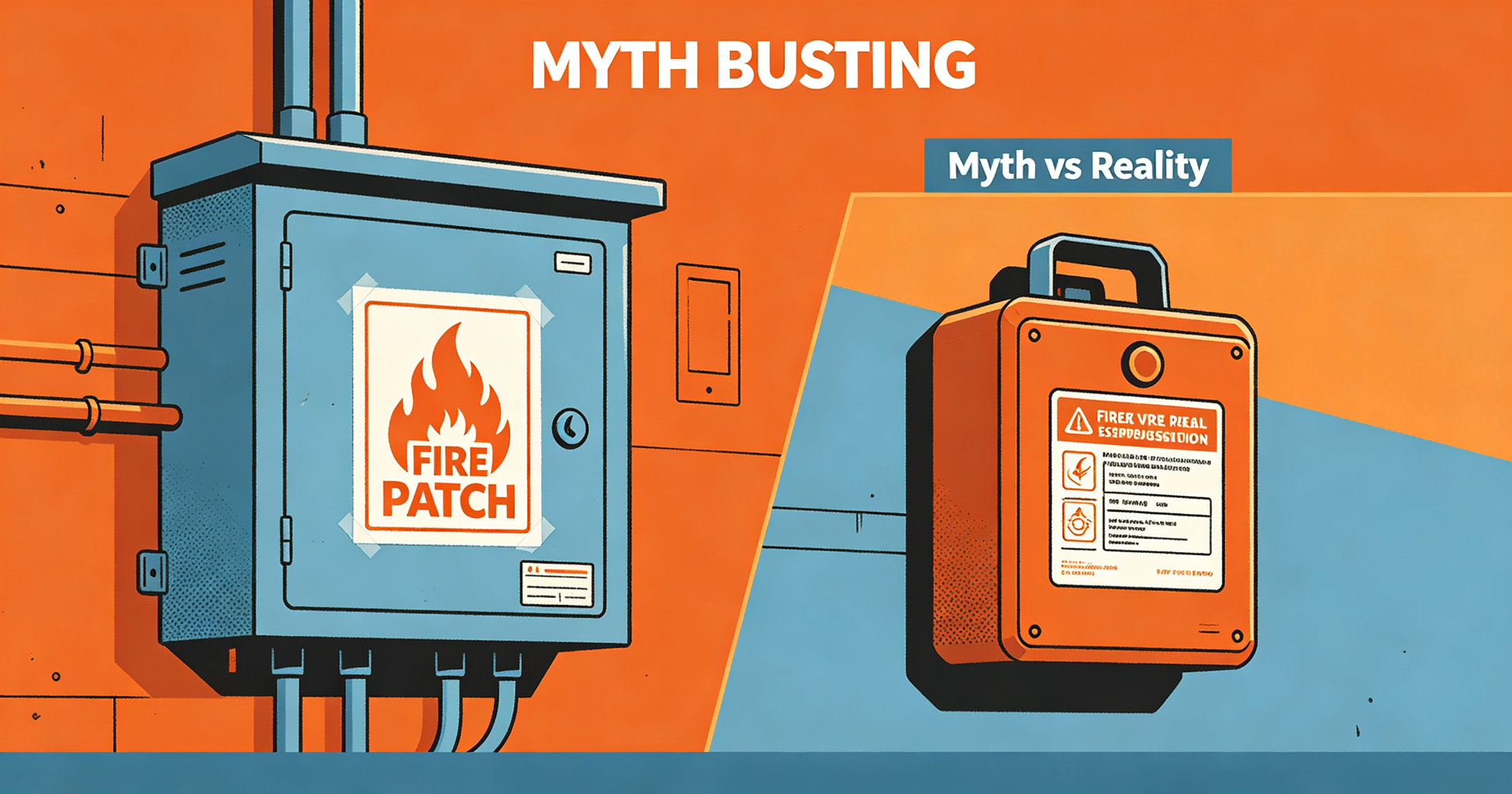
A listed patch restores the fire rating of a wall or floor penetration. A sticker does not. The listing names UL, EN, or IEC.
A fire-rated patch is a tested, listed assembly — not a sticker. When installed per its listing, it restores the fire resistance rating of a wall or floor penetration. Products like intumescent pads and composite patches carry UL, EN, or IEC classifications, and they are subject to the same third-party testing as firestop sealants, mortars, and collars.
Why "Just a Sticker" Is a Persistent Myth
The misconception starts with appearance. A fire patch is often a thin, flexible sheet — sometimes less than 1/8 inch thick — with an adhesive backing. It looks like a label. It feels like a label. In a warehouse or a server room, someone sees a contractor peel one off a roll and press it over a cable tray penetration, and the mental comparison is immediate: that's a sticker.
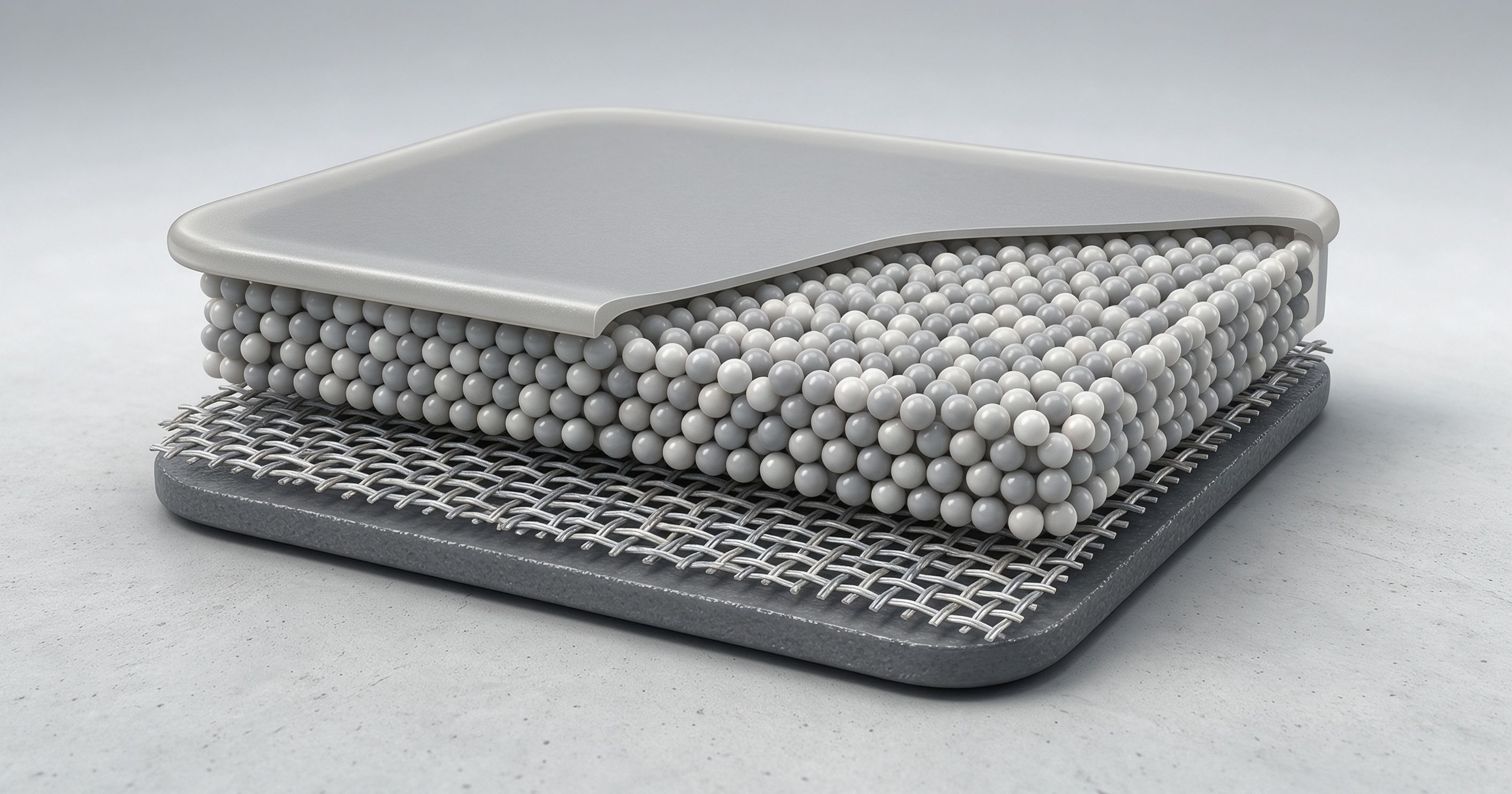
That comparison misses what the patch does under heat. The visible product is only the delivery mechanism. The functional components are the intumescent layer, the endothermic fillers, and the reinforcing mesh. At 392°F (200°C) or higher, the intumescent material begins to expand — some formulations reach 20 to 30 times their original volume. That expansion seals the penetration opening, chokes off the oxygen supply to a fire, and blocks the passage of hot gases and flames. The adhesive is the least important part of the system.
A second reason the myth persists: fire patches are frequently used in low-voltage and data applications where the penetration itself is small. A 2-inch cable bundle passing through a 3-inch sleeve doesn't look like a serious fire risk. Facility managers who have spent years around 4-hour rated block walls and 3-inch concrete slabs may instinctively distrust a product that weighs a few ounces. But fire resistance ratings depend on the assembly, not the mass of the individual component.
A third factor is the market itself. Some flexible patches are sold as general-purpose covers for conduit or cable openings with no fire rating at all. These products exist, and they are sometimes confused with listed fire patches. The distinction is critical: an unlisted patch is a cover; a listed fire patch is a tested firestop system. The presence of both on the same shelf or website fuels the myth.
What "Fire Rated" Actually Means for a Patch
Fire ratings for penetration seals are not self-declared. They come from standardized fire tests performed by accredited laboratories such as UL, Intertek, or — in Europe — notified bodies operating under the Construction Products Regulation.
In North America, the governing test is ASTM E814 (equivalent to UL 1479). A patch must survive a furnace test where the assembly is exposed to a time-temperature curve that reaches 1,700°F (927°C) at one hour and 1,925°F (1,052°C) at two hours. The test measures three things:
- F-rating: The time the assembly prevents flame passage.
- T-rating: The time the assembly keeps the unexposed side below 325°F (163°C) above ambient.
- Hose stream test: A 30 psi water spray applied immediately after the fire exposure to simulate a real firefighting response.
In Europe, EN 1366-3 governs penetration seals, and classification follows EN 13501-2. A patch rated EI 120 means it maintains integrity (E) and insulation (I) for 120 minutes. That is a two-hour rating, identical to what a firestop mortar or sealant would need to achieve in the same penetration. The patch format does not lower the requirement.
A common objection is that patches only cover small openings. True — most listed patches are tested for annular spaces up to 2 inches (50 mm) and cable tray penetrations up to certain dimensions. But a firestop sealant that is only tested for a 1-inch gap has the same limitation. The rating applies to the tested configuration, not to an unlimited range of sizes.
ASTM E814 does not have a separate category for patches. The test is the test. A product that passes is a firestop. A product that doesn't pass is not.
The Testing Evidence Behind Fire Patches
Look at any listed fire patch and you will find a UL file number or an ETA (European Technical Assessment). That number links to a published test report. The report includes:
- The exact substrate types tested — concrete, gypsum board, masonry, or metal deck.
- The penetration type — cable bundle, conduit, cable tray, or mixed.
- The maximum and minimum annular space.
- The required orientation — floor, wall, or both.
- The F and T ratings achieved.
Deviating from any of these conditions voids the rating. That is why a patch installed on a gypsum wall cannot be used on a concrete floor without a separate test. The restriction is not a sign of weakness; it is the same restriction that applies to every firestop product on the market. The difference is that a fire patch's test report is often thinner and less familiar to inspectors, which makes it easier to dismiss.
Field data supports the lab results. Firequell has deployed microencapsulated patch systems across data center and industrial applications where cable penetrations are dense and access is limited. Post-installation inspections in those environments have confirmed that the patches maintain their intumescent activation thresholds after years of exposure to 80°F (27°C) ambient temperatures and typical humidity ranges. The material does not degrade into a non-reactive film.
Independent third-party verification is also available. Intertek's Warnock Hersey mark and UL's classified mark both require follow-up inspections at the manufacturing facility. A factory that produces a listed patch is audited at least four times per year. A sticker printer is not.
Where the Myth Causes Real Problems
Believing that fire patches have no real rating leads to two failure modes. The first is under-specification: a contractor substitutes an unlisted patch for a listed one because "they're all the same." That substitution can fail an inspection and, in a fire, allow flames to pass through a penetration that should have been sealed. The second is over-specification: a facility manager rejects a valid listed patch in favor of a bulkier sealant or mortar, which may be impossible to install in a tight cable bundle or a live data center without downtime.
Both errors waste money and time. A listed patch can be installed in under five minutes on a typical cable penetration. A mortar repair on the same penetration can take 30 minutes and requires a cure time before the system is back in service. In a 24/7 facility, that difference matters.
For more detail on how fire patches compare to traditional sealants, see our fire patch vs. sealant guide. For installation requirements, the fire patch installation guide covers substrate preparation and annular space limits.
How to Verify a Fire Patch Rating Yourself
You do not need to trust a label. Every listed fire patch has a paper trail. Here is a practical three-step check:
- Find the listing mark. Look for a UL classified mark, an Intertek listing, or an ETA number. If the product only carries a "meets ASTM E84" or "flame retardant" claim, it is not a firestop patch.
- Download the test report. UL's Product iQ database and Intertek's directory are searchable by file number. The report will state the F and T ratings and the tested substrates.
- Compare the installation conditions. If the penetration in your building does not match the tested substrate, orientation, or annular space, the rating does not apply. Do not assume a patch rated for a 1-inch gap will work on a 3-inch gap.
If the listing checks out and the installation matches, the patch is as valid as any other firestop. The format is different; the performance standard is identical. For a broader overview of firestop system selection, see our firestop system selection guide.
Need a passive fire protection assessment?
Our editorial team covers enclosure fire suppression, electrical safety monitoring, and fire-resistant coatings. Talk to our partners about your specific application.
Frequently Asked Questions
Can a fire patch really achieve a 2-hour rating?
Yes. Many intumescent patches carry an F-rating of 120 minutes or more under ASTM E814. The rating depends on the substrate, the annular space, and the specific listing. A 2-hour patch on a concrete floor is a different assembly than a 2-hour patch on a gypsum wall. Always verify the tested configuration matches your installation.
Are fire patches approved for use in data centers and telecom rooms?
Listed fire patches are commonly used in these environments because they install without dust, require no mixing, and can be applied around live cables. The key requirement is that the patch is listed for the cable type and penetration size. Unlisted patches, even if they look similar, do not meet code.
Do fire patches expire or lose their rating over time?
Intumescent materials are designed for long-term service. Most manufacturers provide a 25-year or longer service life when the patch is installed indoors and not exposed to continuous temperatures above 120°F (49°C). Mechanical damage or painting over the patch can affect performance. Periodic visual inspection is recommended.
What is the difference between a fire patch and a firestop sealant?
A fire patch is a pre-formed, flexible sheet with an intumescent layer. A sealant is a paste or caulk applied in place. Both can achieve the same F and T ratings, but patches are faster to install on small penetrations and sealants are better for irregular or large openings. Selection depends on the penetration geometry and the required rating.