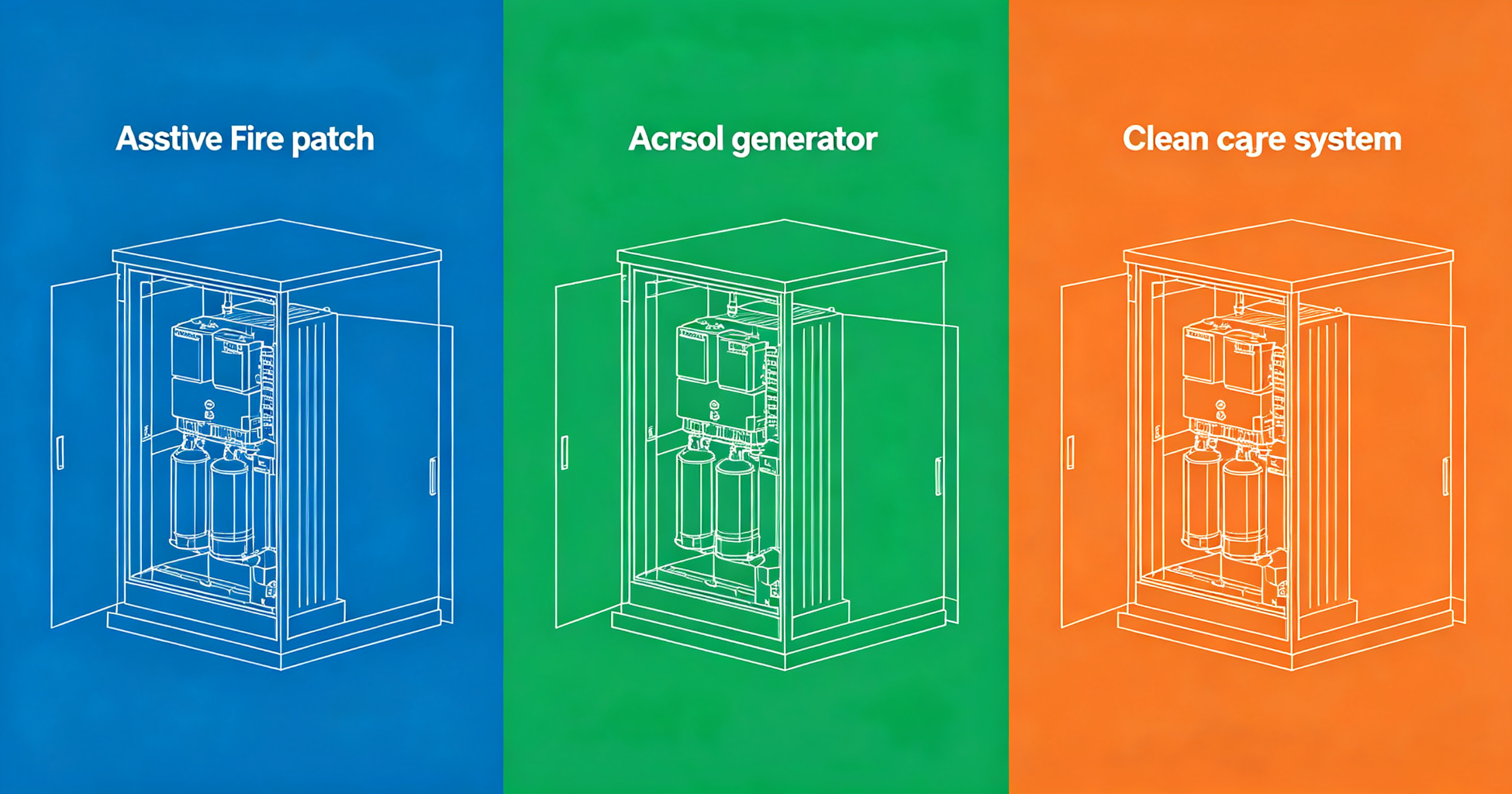
Patches for a small sealed cabinet, aerosol when the volume is larger, and clean agent only when the enclosure can hold concentration.
For small, enclosed electrical cabinets, passive fire patches are the most cost-effective choice. For larger or inaccessible volumes, aerosol generators offer broader coverage at lower installation cost. Clean agent systems remain the only option when a space must stay operational, meet clean-agent discharge standards, or protect occupied areas. The right pick depends on volume, downtime tolerance, and code path.
How Each Technology Suppresses a Fire
The three approaches differ in chemistry, activation, and the physical form of the agent. Those differences drive nearly every selection decision that follows.
Passive fire patches
A passive fire patch is a sealed pouch or laminate containing a condensed aerosol-forming compound. Mounted inside an enclosure, it ignites via a thermal cord or heat-sensitive element when temperatures reach roughly 150–200°C (302–392°F). The compound burns and releases potassium-based aerosol particles that interrupt the free-radical chain reaction of combustion. Discharge is directional within a confined volume. Patches are non-pressurized, have no detection circuit, and typically carry a 5–10 year service life. The Firequell patch line illustrates how passive suppression can be retrofitted into existing enclosures without cutting, piping, or control wiring.
Aerosol generators
Aerosol generators use the same potassium-salt chemistry but in a larger housing with a controlled discharge port. Units range from small 10 g canisters up to 2 kg+ cylinders covering 1–4 m³. Most models activate through an electrical signal from a control panel or a thermal link, though self-contained thermal units exist. Discharge is rapid—often under 10 seconds—and produces a dense aerosol cloud that fills the protected volume. Because the agent is not stored under pressure, generators avoid the hydrostatic testing and leak-check requirements that apply to pressurized cylinders.
Clean agent systems
Clean agent systems store a liquefied gas or blend—HFC-227ea, FK-5-1-12 (Novec 1230), or IG-541—in pressurized cylinders. A detection system triggers a solenoid valve, releasing agent through a piped network of nozzles. The agent extinguishes by heat absorption and, in some cases, chemical interruption. NFPA 2001 governs design concentration, typically 6–7% for HFC-227ea in Class C (electrical) hazards, with a 10-second maximum discharge time and a hold time of at least 10 minutes for occupied spaces. Systems require room integrity testing, pressure relief venting, and regular weighing of cylinders.
Side-by-Side Comparison
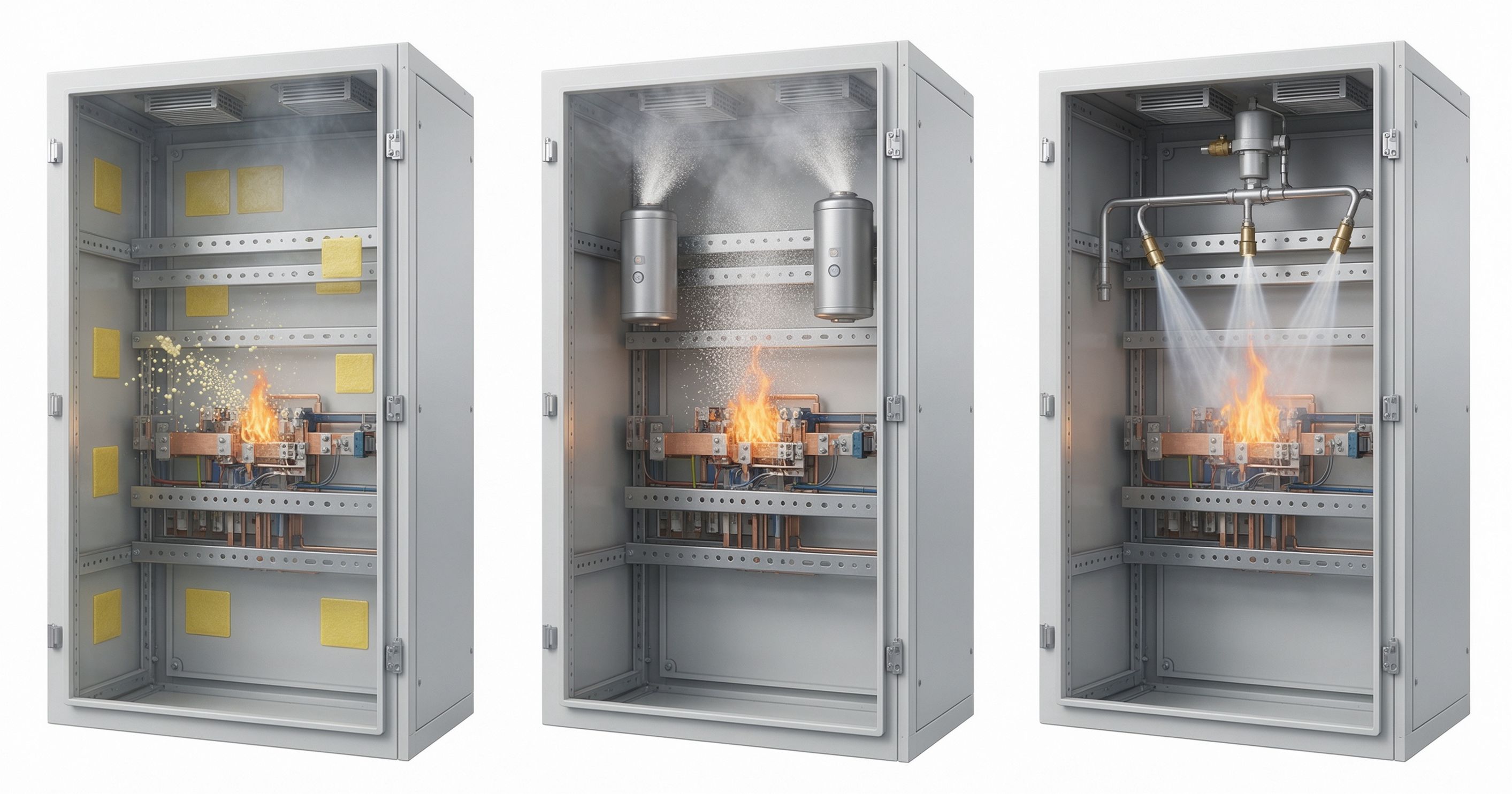
| Parameter | Passive Fire Patch | Aerosol Generator | Clean Agent System |
|---|---|---|---|
| Typical protected volume | 0.1–1 m³ | 0.5–4 m³ | 10–2,000+ m³ |
| Activation | Thermal (self-activating) | Thermal or electrical | Detection + control panel |
| Discharge time | 10–30 s | 5–15 s | ≤10 s (NFPA 2001) |
| Residue | Aerosol particulate, ~1–5 µm | Aerosol particulate, ~1–5 µm | None (gaseous) |
| Cleanliness | Requires wipe-down | Requires wipe-down | No cleanup |
| Power required | None | None (thermal) or 24 VDC | Yes (panel, detection, release) |
| Piping / nozzles | None | None | Full pipe network |
| Relative installed cost | Lowest | Low–moderate | Highest |
| Room integrity test | Not required | Not required | Required (door fan test) |
| Occupied-space use | Not for occupied spaces | Not for occupied spaces | Permitted per NFPA 2001 |
| Applicable standards | UL 2775, NFPA 2010 | UL 2775, NFPA 2010 | NFPA 2001, UL 2166/2127 |
Performance and Code Considerations
Standards that apply
Aerosol-based products—patches and generators alike—fall under NFPA 2010, Standard for Fixed Aerosol Fire-Extinguishing Systems, and are listed to UL 2775. That standard caps the design application density and specifies maximum protected volume per unit. Clean agent systems are governed by NFPA 2001 in North America and by ISO 14520 in Europe, with component listings under UL 2166 and UL 2127. If you operate in the EU, EN 15004-1 applies to gaseous systems and the Pressure Equipment Directive (2014/68/EU) governs cylinder certification.
Enclosure integrity matters more than agent choice
All three technologies depend on retaining the agent long enough to suppress combustion. Aerosol particles settle; clean agents leak through gaps. A cabinet with large unsealed openings will fail regardless of which system you install. NFPA 2001 requires a door fan test to confirm the enclosure holds the design concentration for the specified hold time. Aerosol installations do not carry that formal requirement, but the physics are the same. Seal cable entries, ventilation slots, and door gaskets before selecting hardware.
In practice, the most common cause of failed suppression in small electrical enclosures is not the agent—it is an unsealed 100 mm cable gland that lets the entire agent charge escape in under 30 seconds.
Detection and false discharge
Clean agent systems rely on cross-zoned detection to avoid accidental discharge, which adds cost and complexity but also reduces nuisance trips. Passive patches have no detection logic—they respond only to actual heat, so false discharge is essentially impossible, but they also cannot be manually triggered or monitored. Aerosol generators sit in between: thermal units behave like patches, while electrically triggered units can integrate with a panel and provide status feedback.
Cost and Lifecycle
Installed cost scales with volume and complexity. For a 0.5 m³ control cabinet, a passive patch might run $80–200 in hardware with near-zero labor. An aerosol generator for the same volume runs $150–400. A clean agent system for a small room starts around $3,000–8,000 including detection, piping, cylinders, and commissioning.
Lifecycle costs diverge further. Patches require replacement every 5–10 years and visual inspection annually. Aerosol generators need periodic inspection and replacement of the activating element. Clean agent systems require semi-annual cylinder weighing (NFPA 2001 §7.8), room integrity re-testing after any enclosure modification, and hydrostatic testing of cylinders every 5 years for some agent types. If a clean agent system discharges, recharging costs can exceed $2,000 for a small room.
- Lowest total cost of ownership: passive patches in small, sealed enclosures.
- Best coverage per dollar: aerosol generators in medium, unoccupied volumes.
- Highest cost, highest capability: clean agent systems in occupied or high-value spaces.
When to Choose Which
Choose passive fire patches when:
- The enclosure is small (under 1 m³) and reasonably sealed.
- No power is available for detection or release circuits.
- The space is unoccupied and cleanup of aerosol residue is acceptable.
- You need a retrofit that does not require cutting, piping, or panel changes.
- Budget is the binding constraint and the hazard is a single small cabinet.
Choose aerosol generators when:
- The protected volume is 1–4 m³ or spans multiple connected compartments.
- You want electrical activation tied to a fire panel for monitoring and annunciation.
- Piping a clean agent network is impractical due to geometry or cost.
- The space is normally unoccupied, and post-discharge cleanup is manageable.
- You need faster knock-down than a single small patch can deliver.
Choose clean agent systems when:
- The space is occupied or intermittently occupied.
- Equipment cannot tolerate any residue—servers, medical imaging, telecom switches.
- Code or insurer requires a listed, pressurized system with NFPA 2001 compliance.
- The volume exceeds what aerosol units can cover in a single discharge.
- You need a hold time and design concentration verifiable through room integrity testing.
For a broader look at how passive suppression fits into an overall protection scheme, see the guide on enclosure fire protection. If you are comparing aerosol chemistry against gaseous agents in more detail, the aerosol vs clean agent breakdown covers design density and residue differences. And for guidance on installation and sealing, refer to sealing electrical cabinets.
Need a passive fire protection assessment?
Our editorial team covers enclosure fire suppression, electrical safety monitoring, and fire-resistant coatings. Talk to our partners about your specific application.
Frequently Asked Questions
Can a passive fire patch replace a clean agent system?
No, not for occupied spaces or volumes above roughly 1 m³. Patches are listed under UL 2775 and NFPA 2010 for small, unoccupied enclosures. Clean agent systems are the only option when NFPA 2001 occupancy rules, residue-free discharge, or room integrity testing are required by code or insurer.
Do aerosol generators require electrical power?
Thermal-activated models do not—they trigger from a heat-sensitive element, similar to a patch. Electrically activated units require a 24 VDC signal from a fire panel and provide status monitoring. Choose based on whether you need remote annunciation and supervisory feedback or a fully standalone installation.
What is the design concentration for clean agent systems?
NFPA 2001 specifies a minimum design concentration based on the hazard class and agent. For HFC-227ea in Class C (electrical) hazards, the typical design concentration is 6–7% by volume. FK-5-1-12 uses roughly 4.5–6%. Discharge must complete within 10 seconds and hold for at least 10 minutes.
How often do passive fire patches need replacement?
Most manufacturers specify a 5–10 year service life, with annual visual inspection for damage, corrosion, or obstruction. Replacement is required after discharge or if the thermal activation element shows signs of degradation. Check the listing label and the manufacturer's installation manual for the exact interval applicable to your unit.