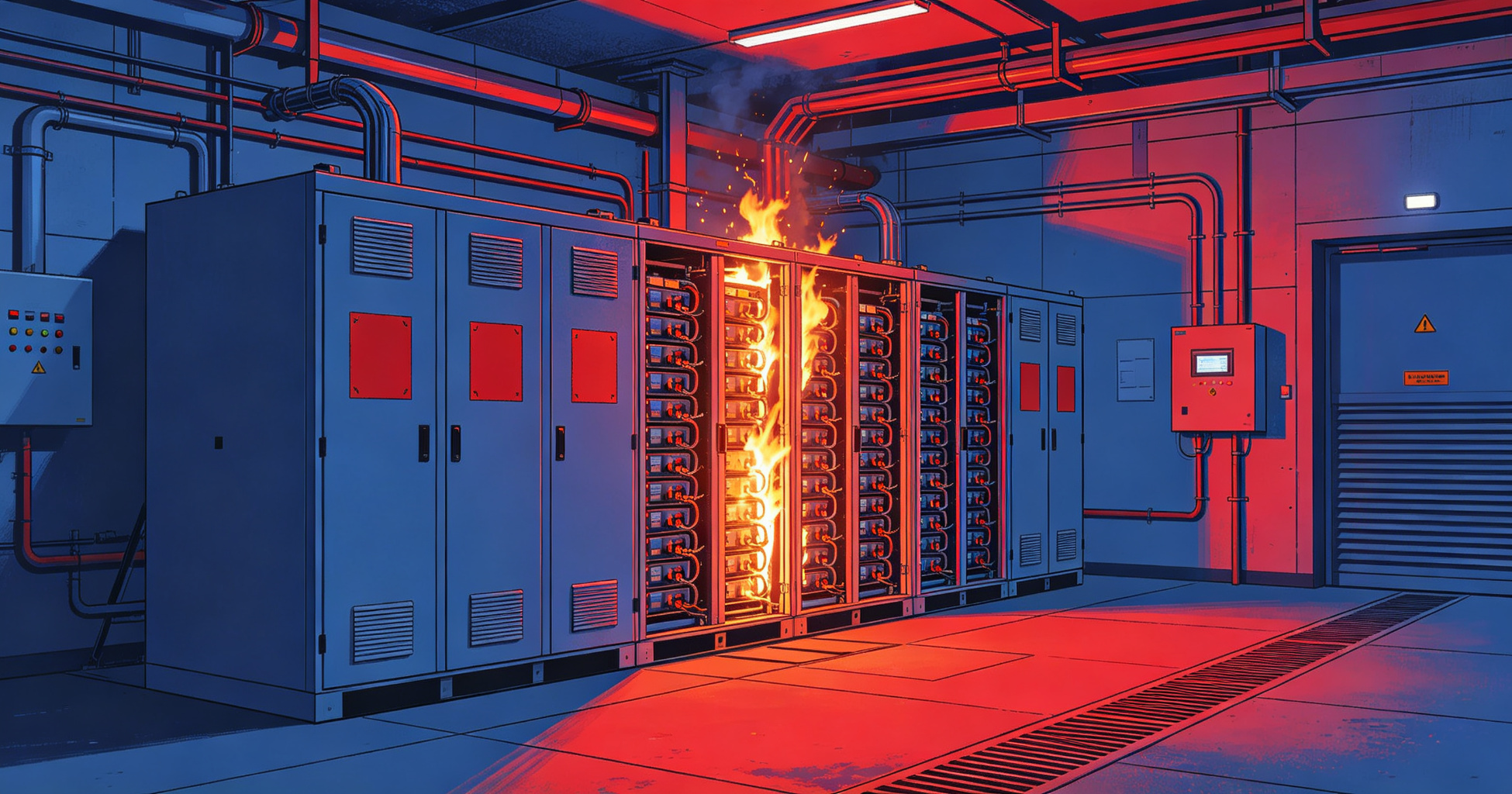
UL 9540A measures how much gas a failing lithium-ion cell releases and whether that gas ignites. It is not a pass/fail certificate.
UL 9540A is a test methodology, not a pass/fail certification. It quantifies how much gas a failing lithium-ion cell releases, at what rate, and whether that gas ignites. Passive fire protection — intumescent coatings, ceramic blankets, flame arrestors, enclosure linings — determines whether the cabinet survives the thermal runaway event UL 9540A simulates. Installers who treat UL 9540A as a checkbox miss its actual function: it produces the data that passive protection must be designed around.
What UL 9540A Actually Tests
ANSI/CAN/UL 9540A, Test Method for Evaluating Thermal Runaway Fire Propagation in Battery Energy Storage Systems, was first published in 2017 and updated in 2019 and 2023. It does not certify a product. It generates performance data at four escalating levels:
- Cell level — a single cell is forced into thermal runaway. The test records peak temperature, gas composition, and whether the cell vents violently.
- Module level — cells are packed into a module. The question shifts to propagation: does one cell's failure ignite its neighbors?
- Unit level — a full battery cabinet or rack is tested. This is where enclosure design, spacing, and passive barriers are evaluated.
- Installation level — the unit is placed in a mock installation with the specified clearances, ventilation, and suppression. This level is optional and only performed when the manufacturer claims installation-level performance.
At the cell level, a typical 18650 or prismatic cell reaching thermal runaway vents gas at 200–800 °C. The gas mixture is roughly 30–50% hydrogen, 15–25% carbon monoxide, with the balance carbon dioxide, hydrocarbons, and trace hydrogen fluoride. Hydrogen's lower flammability limit is 4% by volume in air. A single 100 Wh cell can produce enough hydrogen to exceed that limit inside a sealed 20-liter enclosure.
That number matters because it defines the passive protection problem. You are not stopping the first cell from failing. You are preventing the gas from accumulating to its flammable limit and preventing the enclosure from becoming a pressure vessel.
Where Passive Protection Enters the Test Protocol
UL 9540A does not specify materials. It specifies outcomes. A unit-level test passes if thermal runaway does not propagate from the initiating module to adjacent modules, and if the enclosure does not rupture or eject flaming debris. Passive protection is one of several ways to achieve those outcomes.
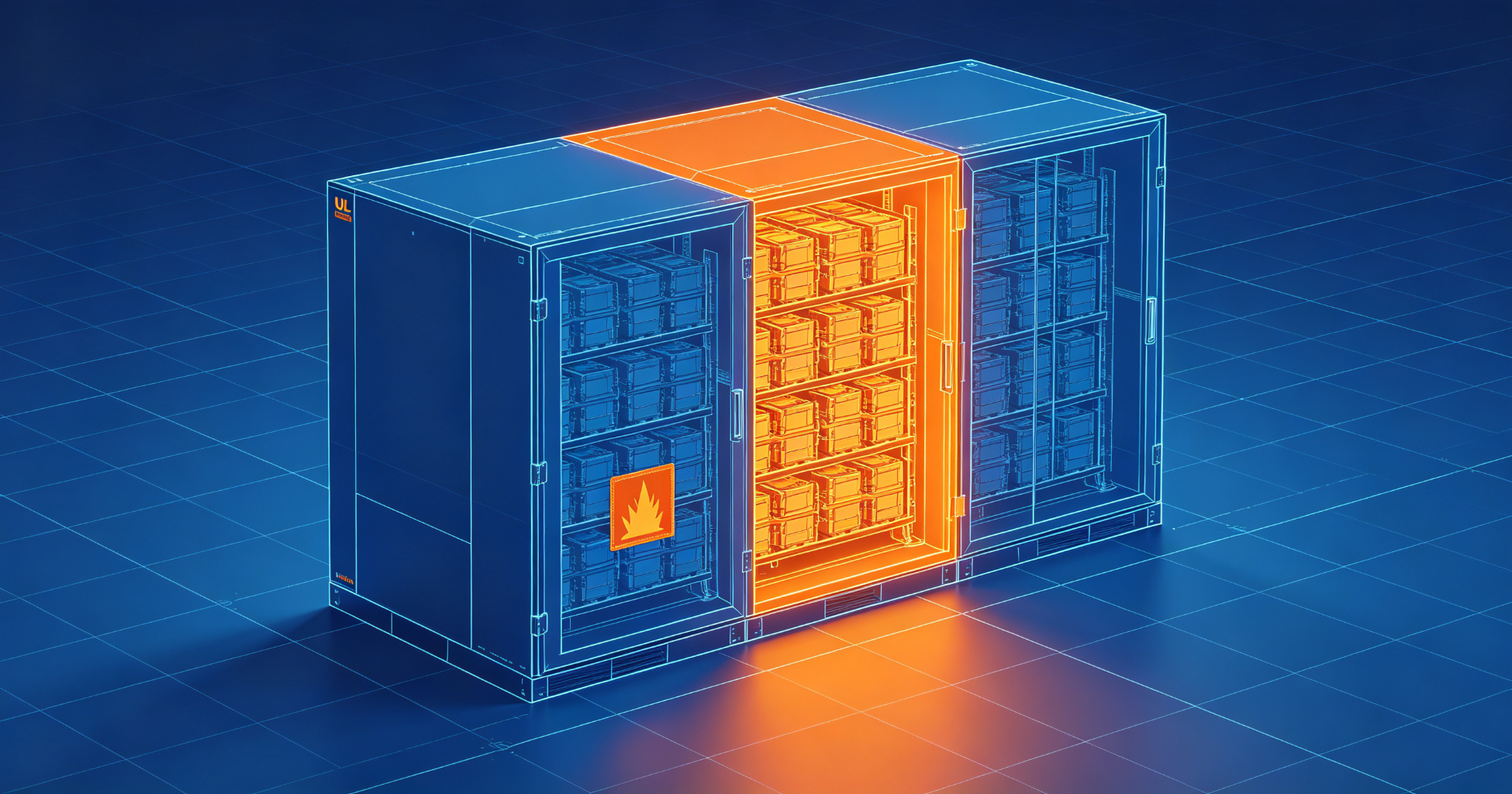
Deflagration pressure and venting
When hydrogen-rich gas ignites inside a cabinet, the pressure rise follows a deflagration curve. NFPA 68, Standard on Explosion Protection by Deflagration Venting, provides the calculation methods. A sealed steel cabinet with a 2 m³ internal volume can see peak pressures of 7–10 bar (100–145 psi) from a hydrogen deflagration if no venting is provided. Most battery cabinet enclosures are rated for less than 0.5 bar.
Passive venting panels — sometimes called explosion relief panels — open at a predetermined pressure, typically 0.1–0.2 bar, and direct the flame front and pressure wave away from occupied spaces. UL 9540A unit-level testing records whether the enclosure's venting strategy prevents rupture. The 2023 revision added explicit guidance on vent panel orientation and the exclusion zone in front of the vent.
Thermal barriers between modules
Intumescent coatings and ceramic fiber blankets slow heat transfer between modules. The target is to keep the adjacent module's cell temperature below its thermal runaway onset — typically 130–180 °C for lithium nickel manganese cobalt oxide (NMC) cells, higher for lithium iron phosphate (LFP).
A 10 mm ceramic blanket with a thermal conductivity of 0.08 W/m·K at 400 °C reduces heat flux by roughly 70% compared to an uninsulated steel partition. That delay is often enough to keep propagation from occurring within the 60-minute observation window UL 9540A uses at the unit level.
Flame arrestors and gas management
Vent paths that pass through flame arrestors prevent external ignition of vented gas. Arrestors are rated by maximum experimental safe gap (MESG). Hydrogen's MESG is 0.28 mm, which requires a tightly specified arrestor element. A generic metal mesh rated for hydrocarbon vapors will not stop a hydrogen flame.
UL 9540A test reports list the gas composition measured at the cell level. That composition determines which arrestor rating is required. Designers who skip the cell-level data and specify arrestors by habit frequently specify the wrong element.
Passive suppression patches, such as the Firequell patch line, sit inside the enclosure and release an extinguishing agent when exposed to the temperatures a thermal runaway event produces. They supplement — they do not replace — the venting and barrier strategy.
How UL 9540A Compares to NFPA 855 and IEC 62933-5-2
Three documents govern battery storage fire safety in North America and Europe, and they serve different purposes.
- UL 9540A is the test method. It produces data. It does not tell you where to install a cabinet or how far it must be from a wall.
- NFPA 855, Standard for the Installation of Stationary Energy Storage Systems, is the installation standard. It references UL 9540A as the acceptable means of demonstrating that a unit does not propagate. NFPA 855 sets separation distances (3 ft / 900 mm between units and walls in many configurations), maximum energy per unit, and ventilation requirements.
- IEC 62933-5-2 is the international equivalent of the installation side. It covers safety requirements for grid-integrated energy storage systems and references IEC 62619 for cell-level testing.
The practical difference: UL 9540A tells you what the cabinet does under failure. NFPA 855 tells you what to do with that information. A cabinet that passes UL 9540A unit-level testing without propagation still requires the separation distances and ventilation NFPA 855 specifies unless the manufacturer's installation-level test data supports a reduced clearance.
This is a common compliance pitfall. A facility manager reads a UL 9540A report showing "no propagation" and assumes the cabinet can be installed anywhere. The report covers the unit in isolation. NFPA 855 covers the unit in a room with other equipment, people, and egress paths.
Common Compliance Pitfalls
Confusing UL 9540A with UL 9540
UL 9540 is the product certification standard for energy storage systems. UL 9540A is the test method used to generate data that supports UL 9540 certification. A cabinet can carry a UL 9540 listing without having undergone UL 9540A testing if the manufacturer chose a different compliance path. Always ask for the UL 9540A test report, not just the UL 9540 certificate.
Assuming cell-level data applies to the installed system
Cell chemistry, state of charge, and cell format all change the gas composition and peak temperature. A UL 9540A report for a 3.2 V LFP cell at 50% state of charge does not describe the behavior of a 3.7 V NMC cell at 100% state of charge. The report is valid only for the specific configuration tested.
Ignoring the installation-level test
NFPA 855 permits reduced separation distances when installation-level UL 9540A testing demonstrates that propagation does not occur under the actual mounting conditions. Without that data, the default distances apply. Many projects budget for unit-level testing and skip installation-level testing, then discover the required clearances do not fit the available space.
Specifying passive protection without sizing it
Intumescent coatings have a defined activation temperature and expansion ratio. A coating rated for 200 °C activation and 10:1 expansion will perform differently than one rated for 150 °C and 25:1. The selection must match the measured cell-level vent temperature from the UL 9540A report for the specific battery. Generic "fire-rated" enclosures do not satisfy this requirement.
Overlooking gas detection and ventilation interlocks
Passive protection handles the thermal event. It does not handle the period before ignition, when hydrogen is accumulating. NFPA 855 requires ventilation or gas detection for many indoor installations. A cabinet with excellent passive barriers but no gas detection can still accumulate a flammable atmosphere if the vent path is obstructed or the passive vent panel is undersized for the gas generation rate.
Practical Summary
UL 9540A produces the data that passive fire protection must be designed around. Cell-level testing gives you gas composition, peak temperature, and vent rate. Unit-level testing tells you whether the enclosure's barriers, venting, and suppression prevent propagation. NFPA 855 and IEC 62933-5-2 tell you how to install the result. The failure modes that matter — deflagration pressure, inter-module heat transfer, hydrogen accumulation — are all addressed by passive means, but only when those means are sized to the specific test data for the specific battery. Request the full UL 9540A report, not the certificate. Verify that the tested configuration matches the installed configuration. And confirm that the passive protection strategy addresses both the thermal event and the gas event, because UL 9540A tests both.
Need a passive fire protection assessment?
Our editorial team covers enclosure fire suppression, electrical safety monitoring, and fire-resistant coatings. Talk to our partners about your specific application.
Frequently Asked Questions
Is UL 9540A a certification or a test method?
UL 9540A is a test method. It produces data on thermal runaway behavior at the cell, module, unit, and installation levels. It does not certify a product. UL 9540 is the certification standard for energy storage systems. A UL 9540 listing may or may not be supported by UL 9540A testing, so always request the test report separately.
Does passing UL 9540A eliminate the need for NFPA 855 separation distances?
Only if installation-level testing was performed and the results support reduced clearances. Unit-level testing alone does not address the surrounding room, egress paths, or adjacent equipment. NFPA 855 default distances apply unless the manufacturer's installation-level UL 9540A data explicitly covers the proposed configuration.
What passive fire protection materials are used in battery cabinets?
Common materials include intumescent coatings, ceramic fiber blankets, vermiculite boards, and explosion relief panels. Each addresses a different failure mode: heat transfer, flame impingement, or pressure relief. Selection depends on the cell-level gas composition and peak temperature recorded in the UL 9540A report for the specific battery being installed.
Can passive protection be added to an existing battery cabinet?
In many cases, yes. Retrofit options include internal ceramic blankets, intumescent coatings applied to the enclosure interior, and passive suppression patches that activate on exposure to high temperature. Any retrofit must be evaluated against the original UL 9540A test configuration, because adding material inside the enclosure changes the internal volume and vent path.