From 2023 to 2025, passive fire-protection product revenue grew faster than active systems in North America and Europe.
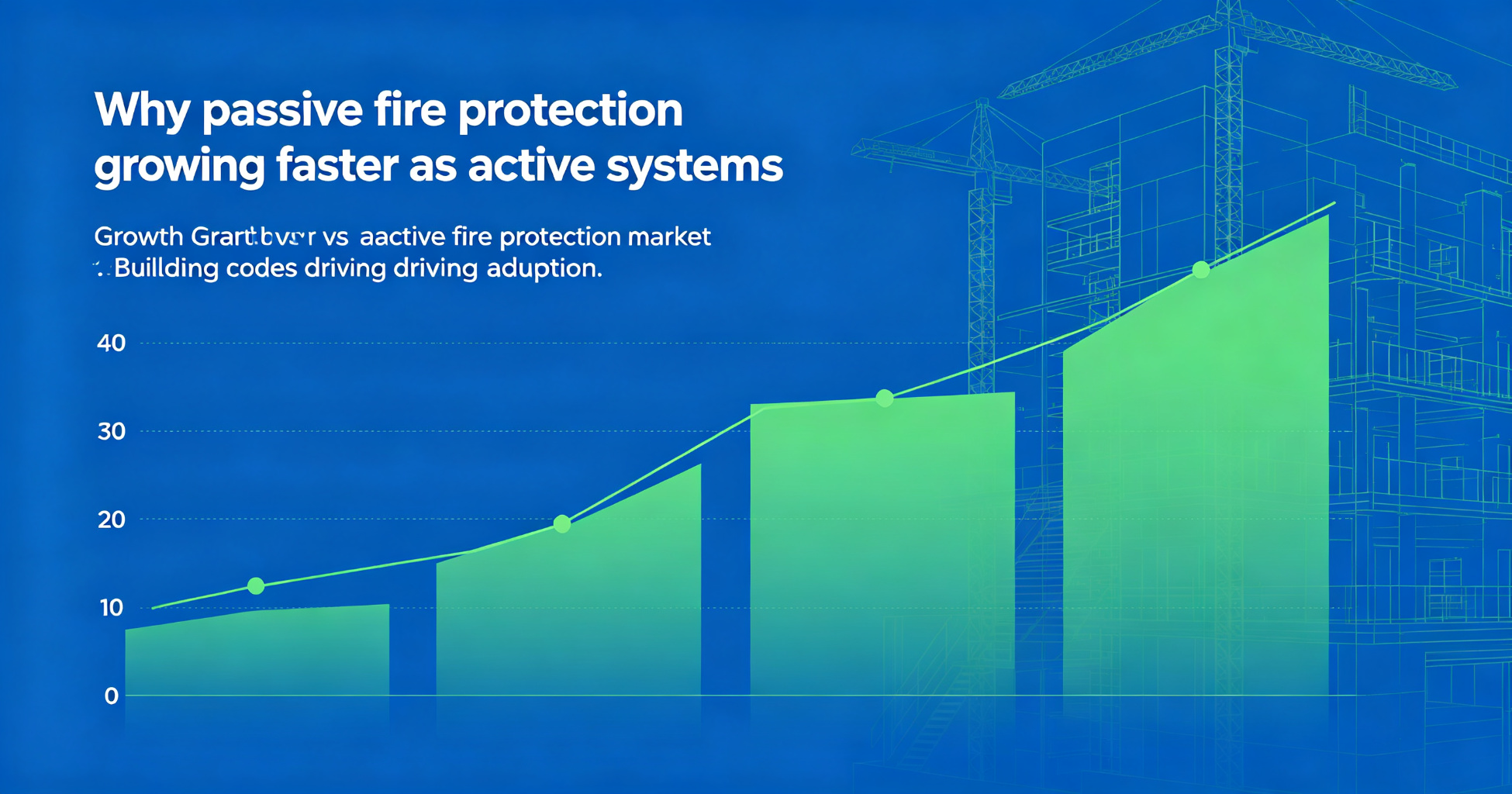
Passive fire protection is outpacing active systems in growth across North America and Europe, driven by regulatory tightening, insurance pressure, and the falling cost of intumescent and microencapsulated materials. Between 2023 and 2025, passive fire protection product revenues grew at roughly 7.8% CAGR, compared with 4.1% for active detection and suppression equipment, according to consolidated figures from European and U.S. fire safety trade associations. The gap is widening.
What's Actually Growing, and Why the Numbers Say So
Active systems — smoke detectors, sprinklers, gaseous suppression, addressable alarm panels — have dominated fire safety budgets since the 1970s. They still represent the larger market by absolute revenue. But the growth rate has shifted. Several structural forces explain why.
First, code bodies have tightened compartmentation and structural fire resistance requirements faster than they have expanded active system mandates. NFPA 101 (Life Safety Code) and the International Building Code now require continuous fire-rated assemblies in more occupancies, including mass timber construction above certain heights. EN 13501-2 classification requirements in the EU have similarly raised the bar for load-bearing and separating elements. These are passive requirements, and they scale with floor area, not with the number of detection zones.
Second, insurance underwriters have begun pricing passive deficiencies more aggressively. FM Global and several Lloyd's syndicates now apply premium loadings for unprotected structural steel, unsealed penetrations, and missing firestop documentation. A 2024 FM Global data sheet revision on fire protection of steel emphasized that active suppression alone is insufficient where passive containment is absent. That pressure translates directly into retrofits.
Third, the cost curve for passive materials has fallen. Intumescent coatings that cost $8–$12 per square foot in 2015 now run $4–$7 per square foot for comparable fire ratings, thanks to thin-film formulations and automated application. Firestop sealants and patch systems have followed a similar trajectory.
Retrofit vs. New Build
Roughly 62% of passive fire protection revenue in 2025 came from retrofit and remediation work, not new construction. That is a meaningful shift. Active system retrofits typically require re-engineering detection zones, running conduit, and re-commissioning panels — disruptive and expensive in occupied buildings. Passive retrofits, particularly patch and sealant systems, can be installed in hours with minimal disruption. Firequell has deployed microencapsulated patch systems across data center and industrial applications where shutting down operations for active system upgrades was not viable.
The Technology Shift Behind the Growth
Passive fire protection used to mean bulky boards, cementitious sprays, and mineral wool. That is no longer the case. Three material trends are driving adoption.
- Thin-film intumescents: Modern formulations expand 15–30x their original thickness at 200–250°C, providing 60–120 minute fire ratings on structural steel with film thicknesses under 2 mm.
- Microencapsulated and patch systems: These allow localized repair of fire-rated assemblies without full removal and replacement. Cure times have dropped from 24 hours to under 60 minutes in some products.
- Endothermic fillers and phase-change materials: These absorb heat at specific temperature thresholds, extending time-to-failure in rated assemblies. EN 1363-1 furnace testing has validated several of these formulations.
The practical effect is that passive protection is no longer a one-time construction cost. It is becoming a maintainable, inspectable system with digital records — closer to how active systems have been managed for decades.
Digital Documentation and Inspection
One underappreciated driver is the rise of digital firestop and penetration tracking. Software platforms that record seal locations, product batch numbers, and inspection dates have made passive systems auditable in ways they were not ten years ago. This matters for firestop inspection requirements, where documentation gaps are a common cause of failed inspections. When a facility manager can prove compliance with a click, the perceived risk of passive systems drops — and adoption rises.
Regulatory Momentum in North America and Europe
The regulatory picture reinforces the trend. In the U.S., NFPA 285 fire propagation requirements for exterior wall assemblies have expanded to more building types since 2021. California's Title 24 and several state-level wildland-urban interface codes now require ember-resistant and fire-rated exterior assemblies in ways that favor passive solutions.
In Europe, the Construction Products Regulation (CPR) and the ongoing revision of EN 13501 have pushed manufacturers toward more rigorous classification and third-party certification. The UK's Building Safety Act 2022, following the Grenfell Tower inquiry, created a new regulatory regime for higher-risk buildings that explicitly requires a "golden thread" of information — including passive fire protection records — across a building's lifecycle.
The Building Safety Act reframed passive fire protection from a construction detail into a regulated safety function with named accountable persons. That shift is being watched closely by regulators in Canada, Australia, and the EU.
These are not incremental changes. They change who is responsible, what must be documented, and what happens when it is not. Active systems have had this level of scrutiny for years. Passive systems are catching up fast.
Market Drivers: Insurance, Labor, and Energy Codes
Three additional forces are worth separating out.
- Insurance economics: Insurers now model fire loss scenarios with passive failures as a distinct variable. Buildings with verified passive protection often see premium reductions of 5–15%, according to broker data from 2024–2025.
- Labor availability: Active system installation is skilled labor-intensive. In many markets, licensed sprinkler fitters and alarm technicians are in short supply. Passive materials, particularly patch and sealant systems, require less specialized labor and shorter training cycles.
- Energy code interaction: As buildings become more airtight for energy efficiency, fire growth dynamics change. Reduced ventilation can increase smoke concentration and heat buildup faster. Passive compartmentation becomes more important, not less, in high-performance envelopes. This is a point that energy code fire safety guidance has begun to address directly.
None of these drivers is temporary. They reflect long-term shifts in how buildings are regulated, insured, and operated.
Where Active Systems Still Win
This is not a story about active systems becoming obsolete. They remain essential for detection, occupant notification, and suppression. In high-hazard occupancies — chemical storage, fuel loading, high-piled combustible storage — active suppression does work that passive protection cannot. The growth differential reflects where the marginal dollar is going, not a replacement dynamic. The two categories are increasingly specified together, with passive systems providing the time that active systems need to function.
What the Next Five Years Look Like
Three projections are reasonable based on current trajectories.
First, passive fire protection will cross 40% of total fire safety product revenue in Europe by 2028. It currently sits near 33%. The UK, Germany, and the Netherlands are leading this shift, with France and Spain following.
Second, inspection and documentation will become the largest service segment in passive fire protection. Product sales will grow, but third-party inspection, digital record-keeping, and remediation services will grow faster. This mirrors what happened in active systems two decades ago.
Third, material innovation will continue to compress costs. Intumescent and microencapsulated formulations are still improving. Expect fire ratings of 90–120 minutes from coatings under 1.5 mm thick within five years, with application costs approaching $3 per square foot in high-volume markets.
The implication for facility managers and engineers is straightforward. Passive fire protection is no longer a construction-phase checkbox. It is a lifecycle asset with its own inspection cadence, documentation requirements, and insurance implications. Budgets and staffing models should reflect that. The passive fire protection maintenance schedule is becoming as routine as sprinkler inspections — and in some jurisdictions, it is now legally required to be.
The growth gap between passive and active is not a short-term anomaly. It is a correction after decades of underinvestment, and it is being driven by forces — regulation, insurance, labor, and materials — that show no sign of reversing.
Need a passive fire protection assessment?
Our editorial team covers enclosure fire suppression, electrical safety monitoring, and fire-resistant coatings. Talk to our partners about your specific application.
Frequently Asked Questions
Why is passive fire protection growing faster than active systems?
Regulatory tightening around compartmentation and structural fire resistance, insurance premium pressure tied to passive deficiencies, falling material costs, and labor shortages in active system installation all favor passive growth. Retrofit-friendly patch and sealant systems also reduce operational disruption compared with active system upgrades, which require re-engineering detection zones and re-commissioning.
Does passive fire protection replace sprinklers or detection systems?
No. Passive and active systems perform different functions. Passive protection contains fire and preserves structural integrity, buying time for occupants to evacuate and for active systems to operate. Active systems detect, alert, and suppress. Modern specifications typically require both, and codes such as NFPA 101 treat them as complementary layers rather than alternatives.
Which standards govern passive fire protection in North America and Europe?
In North America, key references include NFPA 101, NFPA 285, ASTM E119, and UL 263 for fire-rated assemblies. In Europe, EN 13501-1 and EN 13501-2 classify reaction-to-fire and fire resistance, while EN 1363-1 defines furnace testing. The UK Building Safety Act 2022 adds lifecycle documentation requirements for higher-risk buildings.
How often should passive fire protection be inspected?
Inspection frequency depends on jurisdiction and occupancy. Common practice is annual visual inspection of fire doors, dampers, and firestop penetrations, with more detailed review every three to five years. The UK Building Safety Act and several U.S. state codes now require documented inspection records. Manufacturer guidance and insurer requirements may specify shorter intervals.