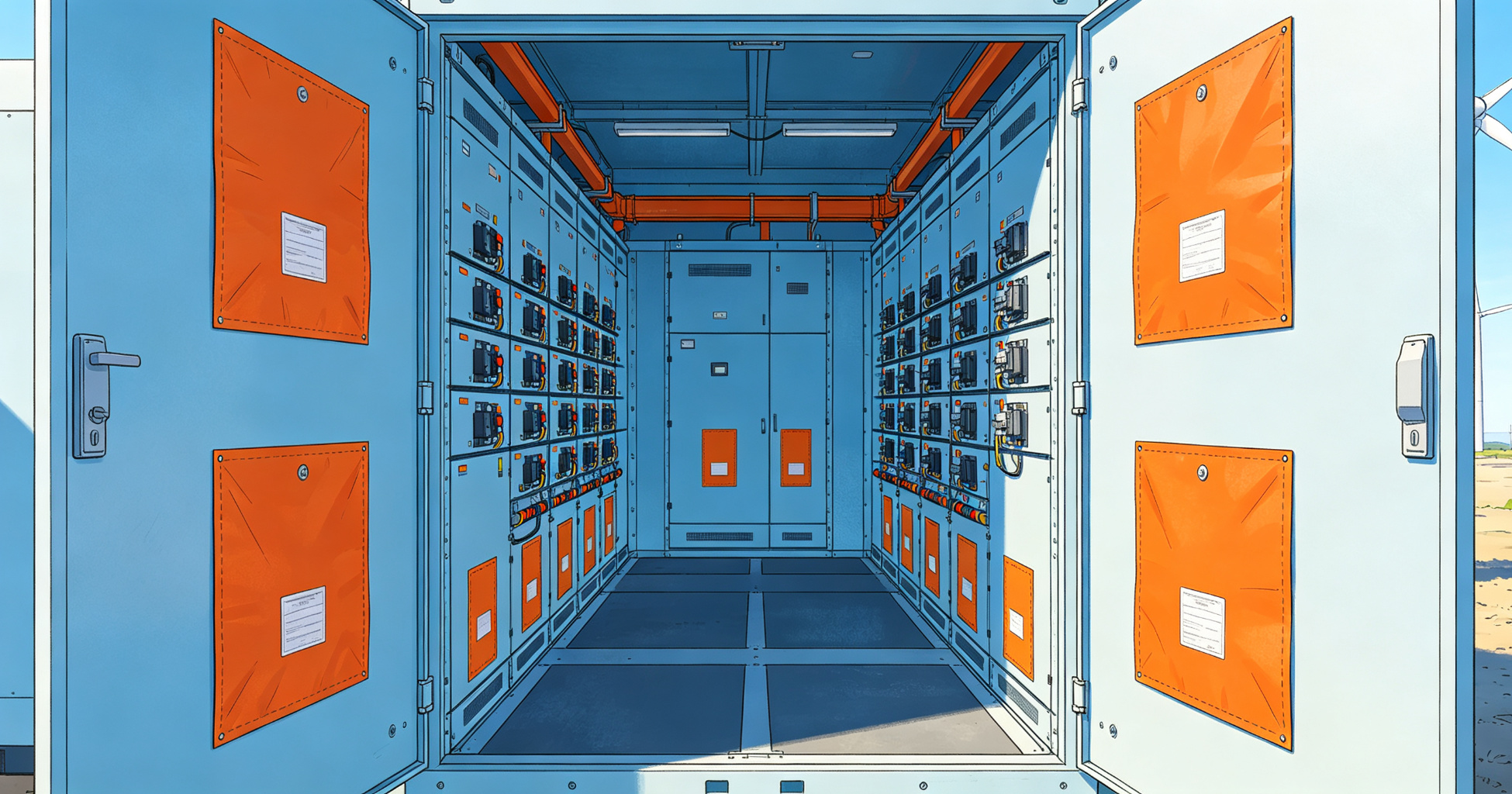
A 2.4 MW turbine in eastern Colorado: about $41,000 of converter damage instead of an estimated $1.9 million nacelle loss.
A 2.4 MW onshore wind turbine in eastern Colorado survived a converter cabinet fire with $41,000 in damage instead of an estimated $1.9 million loss. The difference came down to a single aerosol fire-suppression patch installed eighteen months earlier during a routine maintenance window. No turbine downtime beyond 72 hours. No nacelle replacement. No insurance claim above deductible.
This is the story of how that patch got there, why the site operator chose it over a traditional clean-agent system, and what the post-incident inspection revealed.
The Facility: Cedar Ridge Wind Farm
Cedar Ridge sits on 14,000 acres of rolling shortgrass prairie north of Burlington, Colorado. The site has 63 GE 2.4-116 turbines rated at 2.4 MW each, commissioned between 2016 and 2018. Total nameplate capacity: 151.2 MW. The site interconnects to a 230 kV transmission line owned by Tri-State Generation and Transmission.
Each turbine nacelle houses a power conversion system inside a sealed steel enclosure roughly the size of a residential refrigerator. The converter cabinet contains the following components:
- Two 1,200 A IGBT stacks with integrated gate drivers
- DC-link capacitor bank (4,800 µF total, 1,100 V DC bus)
- LCL line filter with 0.35 mH inductors
- Grid-side and rotor-side converter control boards
- Liquid-cooled cold plates running a 50/50 glycol-water mix at 45°C inlet
The cabinet is IP54-rated per IEC 60529, with forced-air ventilation through filtered louvers. Internal ambient temperature during summer peak generation reaches 58°C. That thermal profile matters later.
Chronology of the Fire
June 14, 2024 — 14:22 MDT
Turbine 37 tripped offline. The SCADA system logged a DC-link overvoltage fault followed by loss of converter communication. The site's operations center in Denver saw the alarm and dispatched a two-person maintenance crew from the local service depot, 40 minutes out.
14:31 MDT
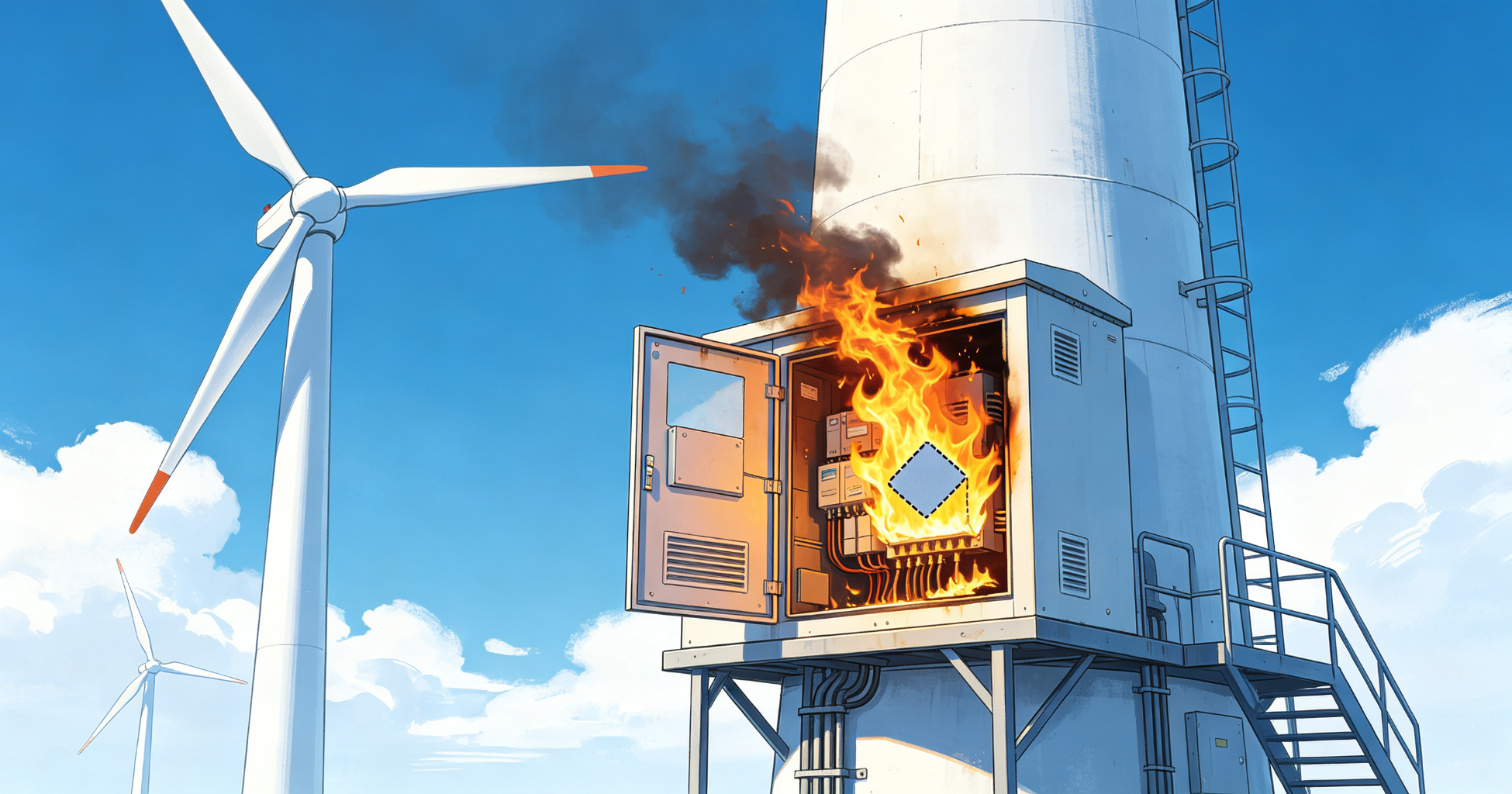
An ionization smoke detector inside the converter cabinet triggered. The nacelle fire detection system, wired to a Fenwal control panel, activated the suppression circuit. The aerosol patch — a 200 mm × 200 mm solid compound generator mounted to the interior cabinet wall — discharged. Discharge time: approximately 12 seconds. Aerosol concentration within the 0.9 m³ free volume of the cabinet reached an estimated 85 g/m³.
14:33 MDT
The turbine's yaw system executed an emergency stop. The pitch system feathered blades to 90°. Brake calipers engaged on the high-speed shaft. The nacelle remained sealed.
14:52 MDT
The maintenance crew arrived at the tower base. They noted no visible smoke from the nacelle exterior and no smell of burning insulation at ground level. They climbed the tower and entered the nacelle at 15:10.
15:12 MDT
Inside the nacelle, the crew found light soot deposits on the cabinet exterior and a faint acrid odor. Cabinet interior temperature had peaked at an estimated 310°C based on thermal paint indicators on the capacitor bank. The fire was out.
What Failed and Why
Post-incident teardown at the operator's component lab in Aurora, Colorado, identified the ignition source: a failed DC-link capacitor. The capacitor's internal dielectric had degraded over 6.5 years of thermal cycling. At the time of failure, the capacitor shorted, drawing fault current that vaporized the internal metallization and ignited the polypropylene dielectric and surrounding potting compound.
Capacitor fires in converter cabinets are not rare. Industry failure data compiled by DNV puts the annualized failure rate for DC-link capacitor banks in wind converters at 0.8% to 1.2% per unit-year. Across Cedar Ridge's 63 turbines, that translates to roughly one capacitor fire every 16 to 20 months.
The fire self-extinguished. But it self-extinguished because the aerosol patch had already knocked down the flame front before it could spread to the adjacent IGBT stack and the wiring harness running along the cabinet's top rail. Without suppression, the fire would likely have consumed the harness, breached the cabinet's cable glands, and spread into the nacelle's composite structures.
"The capacitor was a loss either way. The question was whether we lost the capacitor or the turbine. The patch answered that question in about twelve seconds." — Cody Reinhardt, O&M Manager, Cedar Ridge Wind Farm
Why a Patch Instead of a Clean-Agent System
The decision to install aerosol patches at Cedar Ridge dates to 2022, when the operator evaluated suppression options for all 63 converter cabinets. Three candidates were on the table:
- Clean-agent systems (FM-200 or Novec 1230) with dedicated cylinders, piping, and nozzles. Cost: $8,500–$12,000 per turbine installed.
- CO₂ systems with local cylinders. Cost: $5,200–$7,000 per turbine, but problematic in occupied nacelles due to asphyxiation risk.
- Aerosol patch generators. Cost: $340–$600 per unit, no piping, no cylinders, no pressure vessels.
The clean-agent option was technically superior in terms of post-discharge cleanup (no residue) and design flexibility under NFPA 2001. But the economics didn't work. Retrofitting piping and nozzles into a sealed nacelle cabinet required drilling through the enclosure, compromising the IP54 rating, and adding 14 kg of hardware to a structure with tight mass constraints. The nacelle's crane capacity for maintenance lifts is 1,000 kg; every kilogram of suppression hardware competes with spare parts and tools.
Aerosol patches offered a different trade-off. They use a solid compound that, when thermally activated, produces a potassium-based aerosol that interrupts the free-radical chain reaction of combustion. The residue is minimal — a fine dust that wipes off with isopropyl alcohol — and the units have a 15-year service life with no pressure monitoring or hydrostatic testing. The Firequell patch line illustrates how passive suppression can be retrofitted into existing enclosures without compromising ingress protection or adding significant mass.
The operator installed patches in all 63 turbines over a six-week window in spring 2023, during scheduled gearbox oil changes. Total project cost: $28,400, including labor. By comparison, the clean-agent retrofit would have cost $620,000.
Measurable Outcomes
The June 2024 incident provided the first real-world validation. Here's what the data showed:
- Damage limited to the failed capacitor and adjacent bus bars: $41,000 in parts and labor, including a new capacitor bank, bus bar replacement, and cabinet cleaning.
- Turbine back online in 72 hours: The crew replaced the capacitor bank, verified insulation resistance on the DC bus (measured > 500 MΩ at 1,000 V DC), and returned the turbine to service on June 17.
- No nacelle structural damage: Thermal imaging after the event showed no delamination or heat damage to the nacelle's glass-reinforced epoxy shell.
- No insurance claim: The $41,000 fell below the operator's $150,000 deductible, avoiding a claim that would have increased premiums across the fleet.
For comparison, the operator's insurance carrier provided a loss estimate for an unsuppressed converter fire in a 2.4 MW nacelle: $1.7M–$2.1M, including turbine replacement, crane mobilization, lost production, and site restoration. The patch cost $450. The math is not complicated.
Production Impact
Turbine 37's downtime cost the site approximately 172 MWh of generation, valued at $6,200 at Colorado's 2024 average power purchase agreement price of $36/MWh. Had the fire spread and required nacelle replacement, the turbine would have been offline for 4–6 months, representing 14,000–21,000 MWh of lost generation and $500,000–$750,000 in revenue.
Lessons for Other Sites
Three takeaways from Cedar Ridge apply broadly to wind operators evaluating converter cabinet protection:
- Thermal cycling is the enemy. The failed capacitor had logged 6.5 years of 45°C-to-58°C daily cycling. Sites in high-ambient-temperature regions should shorten capacitor inspection intervals and consider thermal imaging surveys every 18 months.
- Passive suppression fits where active systems don't. Nacelle mass constraints, IP rating requirements, and maintenance access make piped systems impractical for many existing turbines. Aerosol patches solve the installation problem, even if they sacrifice some design flexibility.
- Detection matters as much as suppression. The ionization detector triggered within 9 seconds of fault initiation. Without that detection, the patch would still have activated thermally, but the delay would have allowed more fire growth. Sites should verify detector function during annual maintenance.
For broader guidance on converter cabinet fire risks and suppression design, see our wind turbine fire protection guide and the NFPA 2001 clean agent design overview.
Need a passive fire protection assessment?
Our editorial team covers enclosure fire suppression, electrical safety monitoring, and fire-resistant coatings. Talk to our partners about your specific application.
Frequently Asked Questions
What standards apply to aerosol fire suppression in wind turbine nacelles?
NFPA 2010 covers fixed aerosol extinguishing systems and is the primary U.S. reference. In Europe, EN 15276-1 and EN 15276-2 govern condensed aerosol systems. UL 2775 lists aerosol units for fire suppression. For wind-specific guidance, DNV-ST-0437 and IEC 61400-3-1 address fire risk in nacelles, though neither prescribes a specific suppression technology.
How long do aerosol suppression patches last?
Most manufacturers rate solid aerosol generators for 15 years of service life when installed within their specified temperature range (–40°C to +85°C). No pressure monitoring, hydrostatic testing, or cylinder replacement is required. Annual visual inspection for corrosion, obstruction, and mounting integrity is typically sufficient. Some sites replace units at 12 years as a conservative measure.
Can aerosol residue damage converter electronics?
Potassium-based aerosol residue is mildly alkaline and slightly conductive when wet. In practice, the residue is a fine, dry dust that deposits on surfaces. Manufacturers recommend cleaning with isopropyl alcohol or a dry cloth after discharge. For the Cedar Ridge incident, the crew cleaned the cabinet interior in about 90 minutes. No control boards or IGBT drivers showed degradation after cleaning.
Does a suppression patch eliminate the need for fire detection?
No. Aerosol patches can activate thermally without detection, but detection provides earlier activation, faster turbine shutdown, and confirmation that suppression has occurred. NFPA 2010 requires detection for most applications. In wind nacelles, ionization or optical smoke detectors wired to the turbine control system provide the fastest response and allow remote verification before crews climb the tower.